Loading...
Done
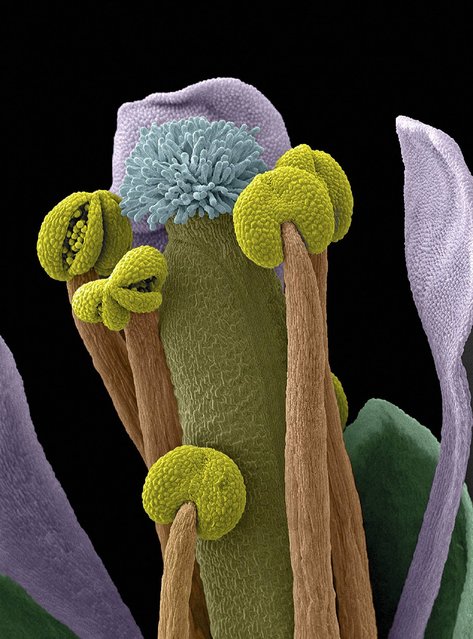
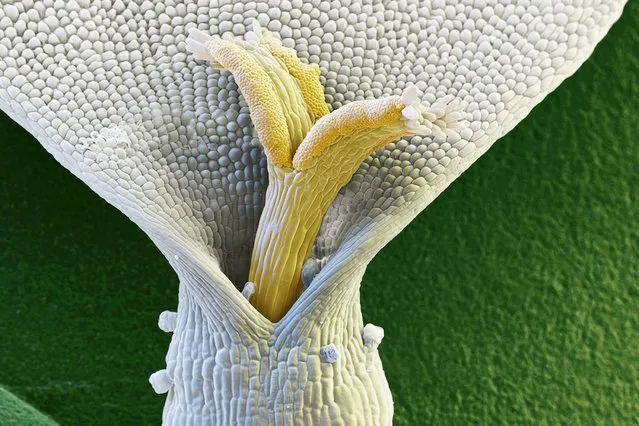
The floret of a Chamomile flower up close and personal. (Photo by Oliver Meckes/Barcroft Media)

These images have been created using a colour scanning electron microscope (SEM) by the award-winning Eye of Science, comprised of snapper Oliver Meckes and biologist Nicole Ottawa. For a decade the pair, based in Reutlingen in the south of Germany, worked with an old SEM they saved from the scrapheap, but for the last five years they have used a £250,000 FEI Quanta Series Field Emission SEM. Oliver said: “Flowers are beautiful in 'normal' view, but when you look closer, some parts get very bizarre and unexpected structures appear – flowers within flowers, worlds within worlds”. Photo: The floret of a Chamomile flower up close and personal. (Photo by Oliver Meckes/Barcroft Media)
Details
26 May 2014 13:51:00
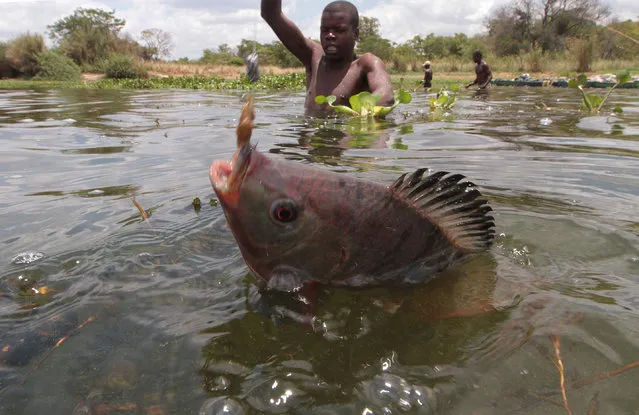
In this photo taken Wednesday, October 29, 2014, a fisherman catches a fish near the shores of Lake Chivero, west of Harare. (Photo by Tsvangirayi Mukwazhi/AP Photo)

In this photo taken Wednesday, October 29, 2014, a fisherman catches a fish near the shores of Lake Chivero, west of Harare. Illegal fishing can be hazardous in Zimbabwe, where poachers scan the banks for armed rangers and the water for crocodiles while they cast their rods. The country is in such a dire economic state that thousands of people, unable to find regular work, flock to Lake Chivero in hopes of catching fish, mostly bream, that they can sell for desperately needed income. (Photo by Tsvangirayi Mukwazhi/AP Photo)
Details
13 Nov 2014 13:55:00

A handout image provided by the New Zealand Defence Force shows aid supplies being unloaded by Fijian soldiers from an Royal New Zealand Airforce C-130 Hercules plane in Suva, Fiji, 23 February 2016. Tool kits, generators, ration packs, water containers and chainsaws make up part of the New Zealand relief following Tropical Cyclone Winston. The death toll from the cyclone that hit Fiji over the weekend climbed to 29, local media reported ON 23 February. (Photo by Sam Shepherd/EPA/NZ Defence Force)

A handout image provided by the New Zealand Defence Force shows aid supplies being unloaded by Fijian soldiers from an Royal New Zealand Airforce C-130 Hercules plane in Suva, Fiji, 23 February 2016. Tool kits, generators, ration packs, water containers and chainsaws make up part of the New Zealand relief following Tropical Cyclone Winston. The death toll from the cyclone that hit Fiji over the weekend climbed to 29, local media reported ON 23 February. Cyclone Winston, the most powerful storm in Fiji's history, battered the country's main island of Viti Levu and other smaller surrounding islands on Saturday, the Fiji Broadcasting Corporation reported. (Photo by Sam Shepherd/EPA/NZ Defence Force)
Details
24 Feb 2016 12:56:00
Parallel Worlds By Karezoid Michal Karcz

Karezoid Michal Karcz is a photographer from Warsaw, Poland. He first started with painting, which helped him to develop a vision that was hard to create with other visual techniques. Then in early 90s discovered photography. His early fascinations of painting and photography have been combined into one piece, with the use of digital tools. Digital photography gave him the opportunity to generate unique realities that were impossible to be created with an ordinary dark room techniques.
Details
20 Jul 2013 18:06:00
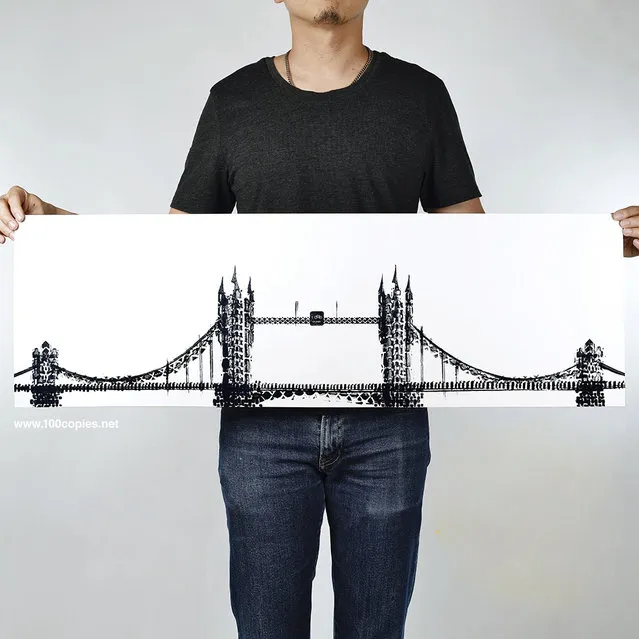
The Unforbidden Cyclist By Thomas Yang

Image patterning has existed for hundreds of years; however, before Thomas Yang no one has ever thought of putting paint on the bicycle wheels and using it as a patterning tool to create very interesting-looking pictures. Being an avid cyclist and an artist, Thomas Yang has decided to combine the two, creating the 100copies. The name of this project not only alludes to the fact that only one hundred copies of those pictures were going to be made, but also to the fact that the pictures themselves consist of hundreds of repeating shapes. And even though the project is called 100copies, no two pictures are alike due to the nature of their creation, making them truly unique. (Photo by Thomas Yang)
Details
11 Nov 2014 12:00:00
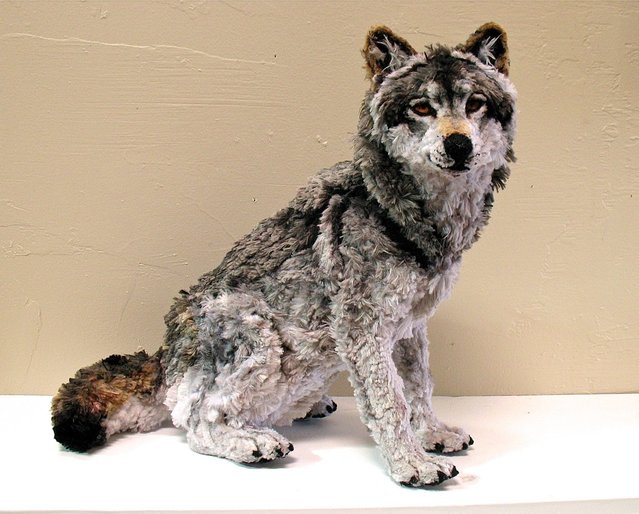
New Pipe Cleaner Wolf. (Photo by Lauren Ryan)

“These are the mind-bending sculptures that take up to 40 hours to create – as they're made entirely from pipe cleaners. The fuzzy flexible figures are made entirely from the tobacco cleaning tools – which are now more commonly found strewn across nurseries and art classrooms – to construct the incredible life-like animals”. – Caters News. Photo: New Pipe Cleaner Wolf. (Photo by Lauren Ryan)
Details
20 Nov 2013 08:17:00
Scanning electron micrograph (SEM) of an Arabidopsis thaliana flower, also commonly known as thale cress. Some of the anthers are open, revealing pollen grains ready for dispersal. Arabidopsis was the first plant to have its entire genome sequenced and is widely used as a model organism in molecular and plant biology. Horizontal width of image is 1200 microns. Magnification 100x. (Photo by Stefan Eberhard/Wellcome Images)

Beautiful, strange and occasionally alarming pictures from the shortlist for this year’s Wellcome image awards – which celebrate the very best in science photography and imaging – from an x-ray of a bat to a micrograph of a kidney stone. The exhibition opens on 12 March at three science centres and the Museum of Science and Industry in Manchester. Photo: Scanning electron micrograph (SEM) of an Arabidopsis thaliana flower, also commonly known as thale cress. Some of the anthers are open, revealing pollen grains ready for dispersal. Arabidopsis was the first plant to have its entire genome sequenced and is widely used as a model organism in molecular and plant biology. Horizontal width of image is 1200 microns. Magnification 100x. (Photo by Stefan Eberhard/Wellcome Images)
Details
11 Mar 2014 05:58:00
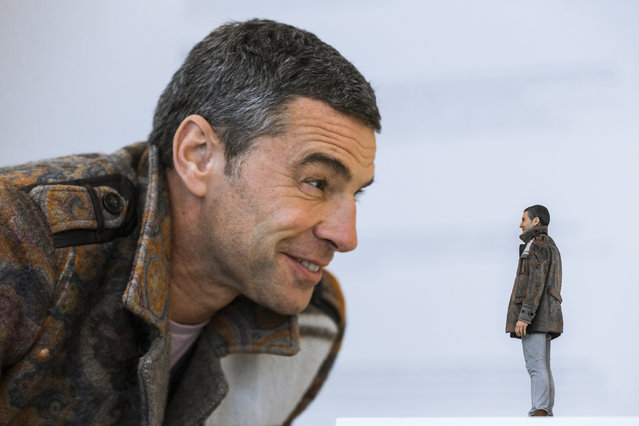
Customer Andreas Kroker looks at a 3D-printed figure of himself at the Twinkind 3D printing studio in Berlin, December 13, 2013. (Photo by Thomas Peter/Reuters)

Customer Andreas Kroker looks at a 3D-printed figure of himself at the Twinkind 3D printing studio in Berlin, December 13, 2013. A 3D-printed likeness is produced by taking a 360 degree photographic scan of a person, which is then rendered into a 3D digital model and retouched to meet the requirements for printing. The printing machine uses this digital model to produce a high-resolution solid figure. Twinkind co-founder Timo Schaedel said, people often come to the session well-groomed, with fresh hair-cuts and their best clothes, “just as they used to do in the past, when they had their portrait taken in a photo studio”. (Photo by Thomas Peter/Reuters)
Details
17 Jul 2014 11:22:00