Loading...
Done
NASA's New Space Launch System

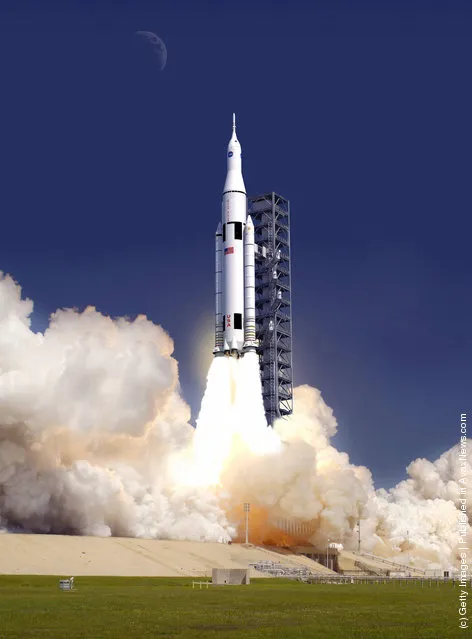
“The Space Launch System, or SLS, is a Shuttle-Derived heavy launch vehicle being designed by NASA, following the cancellation of the Constellation Program, to replace the Space Shuttle after its retirement. The NASA Authorization Act of 2010 envisions the transformation of the Ares I and Ares V vehicle designs into a single launch vehicle usable for both crew and cargo. It is to be upgraded over time with more powerful versions. The proposed SLS is visually similar to the legacy Saturn V booster and in particular the proposed, two-stage, Saturn INT-20”. – Wikipedia

Photo: In this illustration provided by NASA, the design for a new space rocket system, the Space Launch System, is seen. NASA's new rocket design will reportedly cost about $35 billion and be ready to for test launch in 2017. According to NASA, the rocket will be used to carry Orion Multi-Purpose Crew Vehicle as well as cargo and science experiments to earth's orbit, as a backup for the space station and possibly destinations beyond that. (Illustration by NASA via Getty Images)
Details
15 Sep 2011 10:50:00


“Space Exploration Technologies Corp. (SpaceX) is an American space transport company founded by PayPal co-founder Elon Musk. It has developed the Falcon 1 and Falcon 9 rockets, both of which are built with a goal of being reusable launch vehicles. SpaceX is also developing the Dragon spacecraft to be carried to orbit by Falcon 9 launch vehicles. SpaceX designs, tests and fabricates the majority of their components in-house, including the Merlin, Kestrel, and Draco rocket engines. In December 2010, SpaceX became the first private company to successfully launch, orbit and recover a spacecraft (a Dragon)”. – Wikipedia

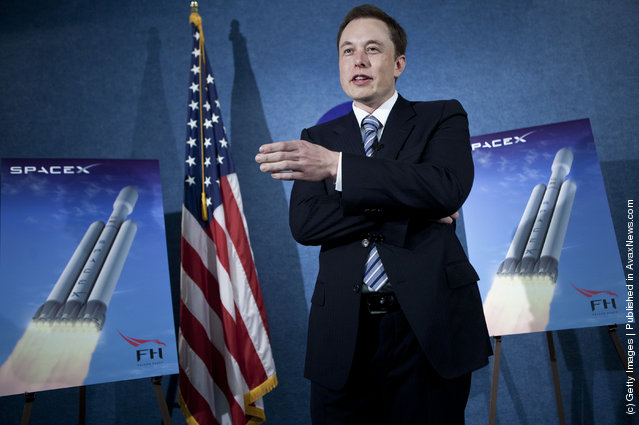
Photo: Elon Musk, CEO of Space Exploration Technologies Corp, speaks during a news conference at the National Press Club April 5, 2011 in Washington, DC. Elon Musk, CEO of Space Exploration Technologies Corp (SpaceX) and Tesla Motors, held the news conference to announce SpaceX's Falcon Heavy rocket which could complete missions to the International Space Station and Moon and should be ready for use by the end of 2012. (Photo by Brendan Smialowski/Getty Images)
Details
06 Apr 2011 09:05:00
Revellers celebrate moments before the rocket fire or “Txupinazo” marks the start of the Festival of San Fermin (or Sanfermines) at Consistorio square in Pamplona, Spain, 06 July 2014. (Photo by Javier Lizin/EFE)

Revellers celebrate moments before the rocket fire or “Txupinazo” marks the start of the Festival of San Fermin (or Sanfermines) at Consistorio square in Pamplona, Spain, 06 July 2014. The annual nine day long running-with-the-bulls fiesta commemorates St. Fermin, Pamplona's patron saint. (Photo by Javier Lizin/EFE)
Details
07 Jul 2014 13:17:00
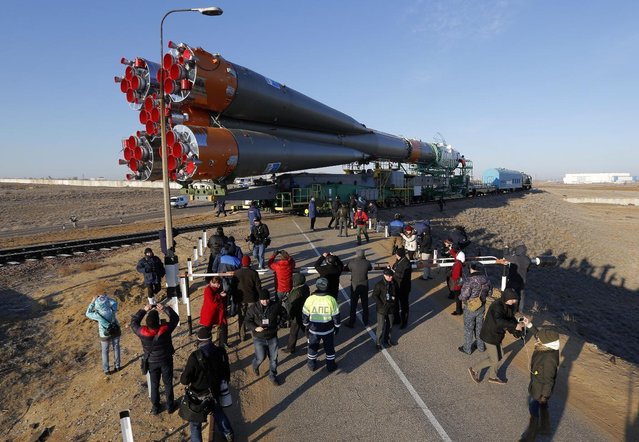
Russia's Soyuz-FG booster rocket with the space capsule Soyuz TMA-16M that will carry a new crew to the International Space Station (ISS) is transported from the hangar to the launch pad in Russian leased Baikonur cosmodrome, Kazakhstan, Wednesday, March 25, 2015. (Photo by Dmitry Lovetsky/AP Photo)

Russia's Soyuz-FG booster rocket with the space capsule Soyuz TMA-16M that will carry a new crew to the International Space Station (ISS) is transported from the hangar to the launch pad in Russian leased Baikonur cosmodrome, Kazakhstan, Wednesday, March 25, 2015. (Photo by Dmitry Lovetsky/AP Photo)
Details
26 Mar 2015 12:29:00
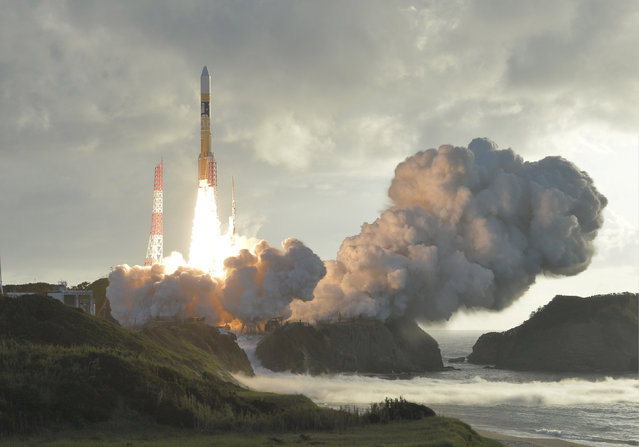
An H-2A rocket carrying Japan's fourth and final quasi-zenith satellite, the Michibiki No. 4, lifts off from the Tanegashima Space Center in Kagoshima Prefecture, southwestern Japan in this photo taken by Kyodo on October 10, 2017. (Photo by Reuters/Kyodo News)

An H-2A rocket carrying Japan's fourth and final quasi-zenith satellite, the Michibiki No. 4, lifts off from the Tanegashima Space Center in Kagoshima Prefecture, southwestern Japan in this photo taken by Kyodo on October 10, 2017. (Photo by Reuters/Kyodo News)
Details
11 Oct 2017 07:50:00
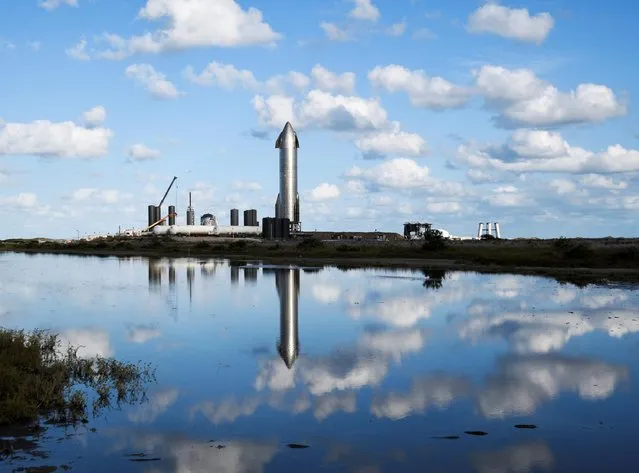
Clouds reflect off the water as they pass over while SpaceX prepares their super heavy-lift Starship SN8 rocket for a test launch this week at the company's facilities in Boca Chita, Texas, U.S. December 1, 2020. (Photo by Gene Blevins/Reuters)

Clouds reflect off the water as they pass over while SpaceX prepares their super heavy-lift Starship SN8 rocket for a test launch this week at the company's facilities in Boca Chita, Texas, U.S. December 1, 2020. (Photo by Gene Blevins/Reuters)
Details
09 Dec 2020 00:01:00
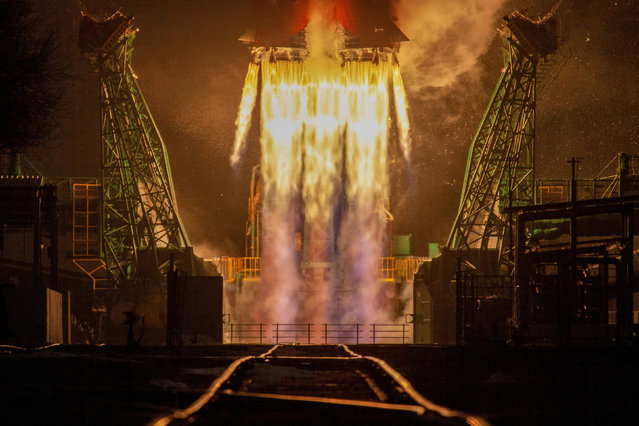
The Soyuz 2.1b rocket with a Fregat-M booster and meteorology and emergency communications satellite Arktika-M No 1 launches from Baikonur Cosmodrome in Baikonur, Kazakhstan on February 28, 2021. Arktika-M No 1 is the first of ten Arktika satellites to be launched by Roscosmos into orbit. (Photo by Roscomos/TASS)

The Soyuz 2.1b rocket with a Fregat-M booster and meteorology and emergency communications satellite Arktika-M No 1 launches from Baikonur Cosmodrome in Baikonur, Kazakhstan on February 28, 2021. Arktika-M No 1 is the first of ten Arktika satellites to be launched by Roscosmos into orbit. (Photo by Roscomos/TASS)
Details
10 Mar 2021 10:12:00
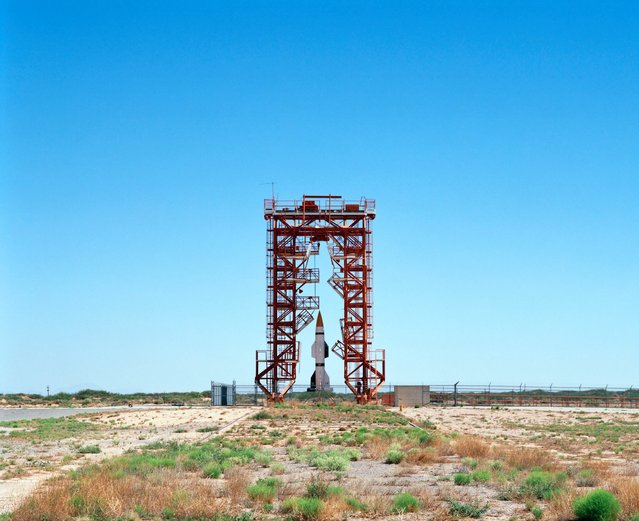
Launch Pad and Gantry with Hermes A-1 Rocket – V2 Launch Complex 33, White Sands missile range, New Mexico in 2006. (Photo by Roland Miller)

Roland Miller is on a mission to document the deserted sites of America’s space race. He has photographed launch pads, bunkhouses and research facilities across the country, some of which no longer exist or are closed to the public on secure military bases. His book, “Abandoned in Place”, is published by the University of New Mexico Press in March. Here: Launch Pad and Gantry with Hermes A-1 Rocket – V2 Launch Complex 33, White Sands missile range, New Mexico in 2006. (Photo by Roland Miller)
Details
25 Feb 2016 11:38:00