A camel wearing a hat amid a heatwave, looks on, in front of the Great Pyramids of Giza, on the outskirts of Cairo, Egypt on July 19, 2023. (Photo by Mohamed Abd El Ghany/Reuters)
A prong extending from a remote-controlled robot prototype approaches the mouth of a volunteer to extract a throat swab sample, as part of a self-funded project to assist physicians in running tests on suspected COVID-19 coronavirus patients in a bid to limit human exposure to disease-carriers, at a private hospital in Egypt's Nile delta city of Tanta, on March 20, 2021. (Photo by Khaled Desouki/AFP Photo)
Guards wait for the start of former Egyptian President Hosni Mubarak's funeral at Field Marshal Mohammed Hussein Tantawi Mosque east of Cairo, Egypt on February 26, 2020. (Photo by Amr Abdallah Dalsh/Reuters)
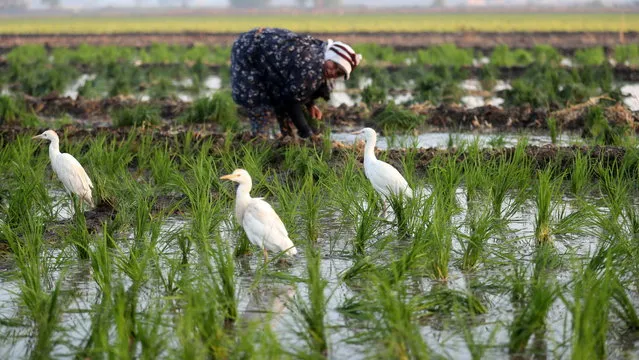
A farmer carries a bundle of wheat after harvesting it from a field in the Gharbia Governorate, as Egypt ramps up efforts to slow the spread of the coronavirus disease (COVID-19), Egypt on May 14, 2020. (Photo by Mohamed Abd El Ghany/Reuters)
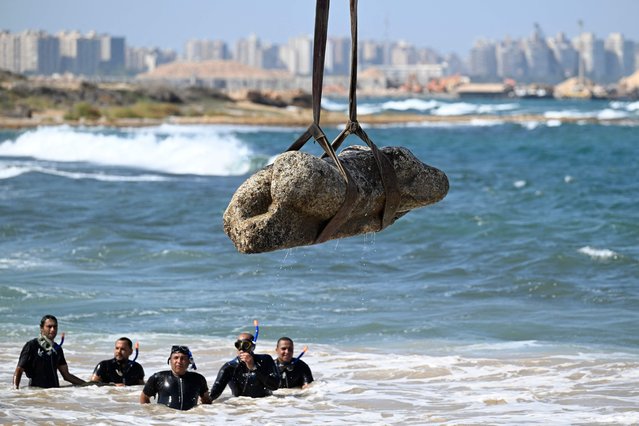
Divers watch as a crane pulls a piece of stone from the waters at Abu Qir bay in Alexandria on August 21, 2025, as part of an event organized by the Ministry of Tourism and Antiquities to recover sunken antiquities. (Photo by Khaled Desouki/AFP Photo)
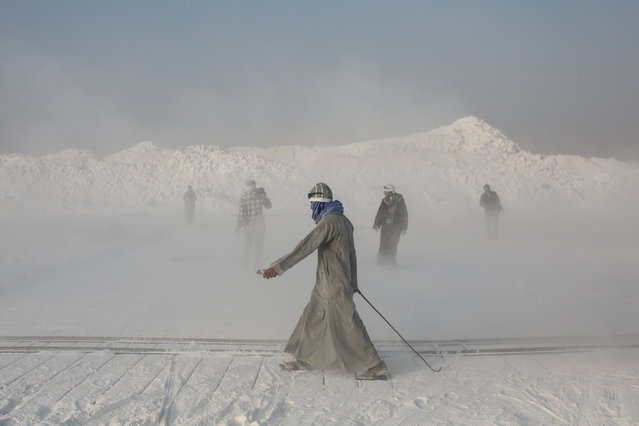
In this Wednesday, March 18, 2015 photo, limestone quarry workers walk through a cloud of dust spewed into the air by rotor blades of the stone-cutting machinery in the desert of Minya, southern Egypt. Around 45,000 people, including children, work in an estimated 1,500 quarries, digging out stones that later will be used in construction or powdered to be used by pharmaceutical and ceramic companies. (Photo by Mosa'ab Elshamy/AP Photo)
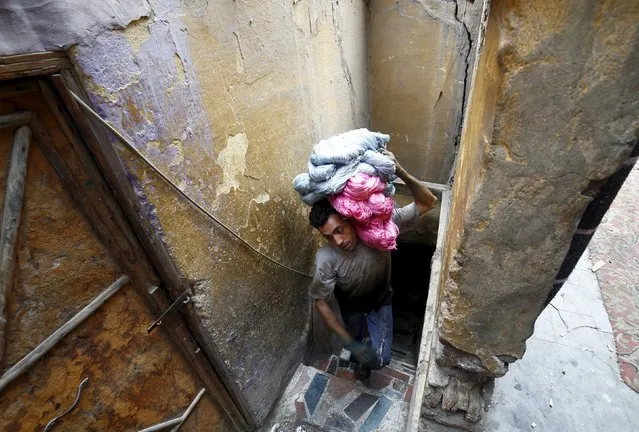
Mohamed Mostafa, 35, carries dyed yarns at a dye workshop in old Cairo, Egypt, March 17, 2016. Egypt's hard currency crisis and competition from modern factories in Asia and at home threaten one of the last dye workshops in Egypt. But one of its owners takes comfort in the trade's ancient resilience. Mohamed Mostafa boasts that the profession dates back 3,000 years, so it can survive anything. (Photo by Amr Abdallah Dalsh/Reuters)