Loading...
Done
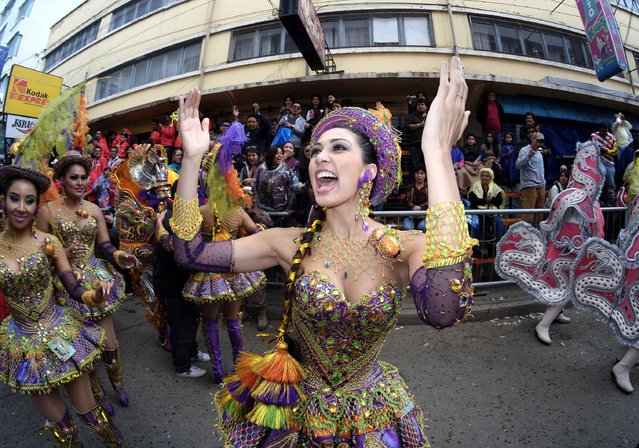
A member of the “Morenada Los Cocanis” group dances during the Carnival parade in Oruro February 14, 2015. (Photo by David Mercado/Reuters)

A member of the “Morenada Los Cocanis” group dances during the Carnival parade in Oruro February 14, 2015. Thousands of dancers and tourists attend the carnival celebrations in Oruro, south of La Paz. (Photo by David Mercado/Reuters)
Details
15 Feb 2015 14:25:00
Girls look at a penitent taking part in “Nuestro Senor Atado a la Columna, Maria Santisima de la Paz y San Juan Evangelista” Holy Week procession in Arcos de la Frontera, Spain, Tuesday, March 31, 2015. Hundreds of processions take place throughout Spain during the Easter Holy Week. (Photo by Daniel Ochoa de Olza/AP Photo)

Girls look at a penitent taking part in “Nuestro Senor Atado a la Columna, Maria Santisima de la Paz y San Juan Evangelista” Holy Week procession in Arcos de la Frontera, Spain, Tuesday, March 31, 2015. Hundreds of processions take place throughout Spain during the Easter Holy Week. (Photo by Daniel Ochoa de Olza/AP Photo)
Details
02 Apr 2015 12:55:00
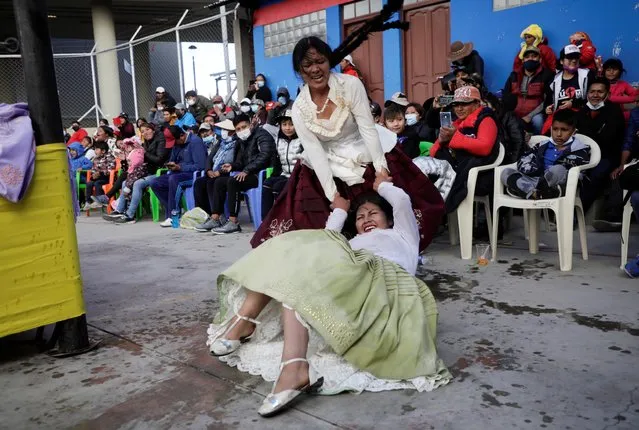
Barbara Quisbert and Susana La Bonita, cholitas wrestlers, fight during their return to the ring after the coronavirus disease (COVID-19) restrictions, in El Alto outskirts of La Paz, November 29, 2020. (Photo by David Mercado/Reuters)

The Fighting Cholitas are a group of female wrestlers who perform in El Alto, Bolivia. Tickets to the exhibitions cost $1. Like the general population of El Alto, which consists almost entirely of Aymara and Quechua residents, the Cholitas are indigenous. They wear braided hair, bowler hats and multilayered skirts in the ring. Here: Barbara Quisbert and Susana La Bonita, cholitas wrestlers, fight during their return to the ring after the coronavirus disease (COVID-19) restrictions, in El Alto outskirts of La Paz, November 29, 2020. (Photo by David Mercado/Reuters)

Details
12 Dec 2020 00:03:00
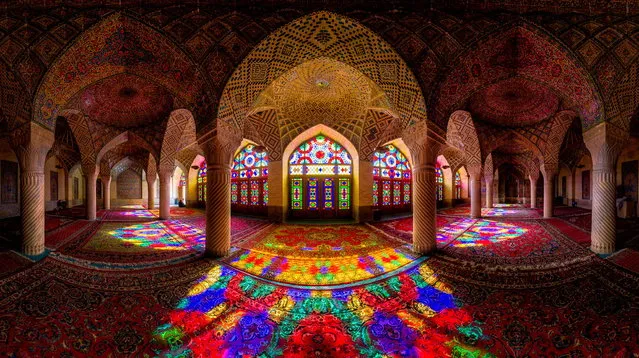
The Nasir Al-Mulk Mosque

The Nasīr al-Mulk Mosque or Pink Mosque is a traditional mosque in Shiraz, Iran, located in Goade-e-Araban place (near the famous Shah Cheragh mosque). The mosque was built during the Qājār era, and is still in use under protection by Nasir al Mulk's Endowment Foundation. It was built by the order of Mirza Hasan Ali Nasir al Molk, one of the lords of the Qajar Dynasty, in 1876 and was finished in 1888. The designers were Muhammad Hasan-e-Memar and Muhammad Reza Kashi Paz-e-Shirazi. The mosque extensively uses colored glass in its facade, and displays other traditional elements such as panj kāseh-i (five concaves) in its design, it is also named in popular culture as Pink Mosque due to the usage of beautiful pink color tiles for its interior design.
Details
26 Mar 2014 14:04:00
A girl looks at other children practicing on a boxing ring during an exercise session at a boxing school, in the Mare favela of Rio de Janeiro, Brazil, June 2, 2016. (Photo by Nacho Doce/Reuters)

A girl looks at other children practicing on a boxing ring during an exercise session at a boxing school, in the Mare favela of Rio de Janeiro, Brazil, June 2, 2016. For many young residents the Luta Pela Paz (Fight For Peace) academy offers a glimpse of an alternative: a chance to build discipline and self-esteem through boxing and martial arts. (Photo by Nacho Doce/Reuters)
Details
19 Jun 2016 10:00:00
Aerial view of the “Viracocha III”, a boat made only from the totora reed, as it is being prepared to cross the Pacific from Chile to Australia on an expected six-month journey, La Paz, Bolivia, October 19, 2016. An expedition in a boat made only of reeds crafted by indigenous Bolivians is getting ready to cross the Pacific from South America to Australia, in a fresh attempt to prove that ancient mariners were capable of making the journey. Phil Buck, a 51-year-old explorer from the United States, already has led two similar expeditions and will captain the “Viracocha III” set to depart from northern Chile in February on an expected six-month journey. (Photo by David Mercado/Reuters)
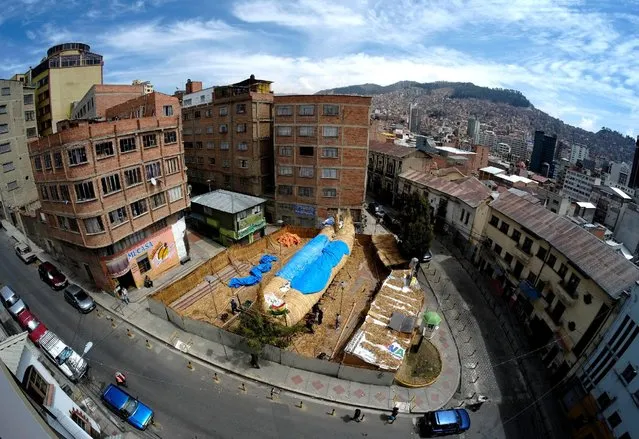
Aerial view of the “Viracocha III”, a boat made only from the totora reed, as it is being prepared to cross the Pacific from Chile to Australia on an expected six-month journey, La Paz, Bolivia, October 19, 2016. An expedition in a boat made only of reeds crafted by indigenous Bolivians is getting ready to cross the Pacific from South America to Australia, in a fresh attempt to prove that ancient mariners were capable of making the journey. (Photo by David Mercado/Reuters)
Details
20 Oct 2016 10:53:00
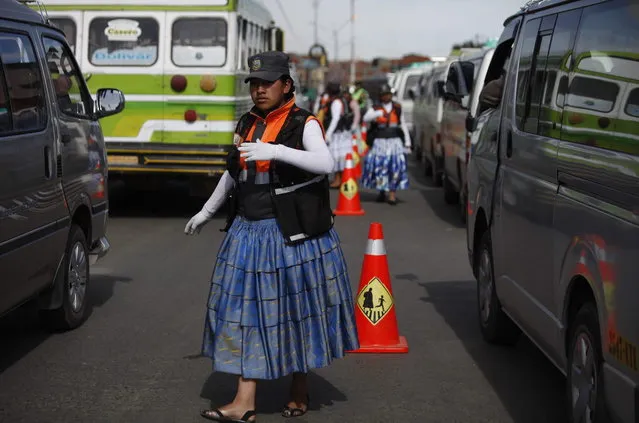
In this December 3, 2013 photo, an Aymara woman cops directs traffic on the streets of El Alto, Bolivia. The women wear the bright petticoats and shawls of indigenous women in the Andes, called cholitas in Bolivian slang, the main difference being that instead of bowler hats they wear khaki green police-style caps. Some don fluorescent traffic vests. (Photo by Juan Karita/AP Photo)

“This city in Bolivia's highlands has hired Aymara women dressed in traditional multilayered Andean skirts and brightly embroidered vests to work as traffic cops and bring order to its road chaos. About 20 of the “traffic cholitas” have been trained to direct cars and buses in El Alto, a teeming, impoverished sister city of La Paz in Bolivia's Andes mountains”. – El Alto via Associated Press. Photo: In this December 3, 2013 photo, an Aymara woman cops directs traffic on the streets of El Alto, Bolivia. The women wear the bright petticoats and shawls of indigenous women in the Andes, called cholitas in Bolivian slang, the main difference being that instead of bowler hats they wear khaki green police-style caps. Some don fluorescent traffic vests. (Photo by Juan Karita/AP Photo)
Details
25 Dec 2013 10:48:00
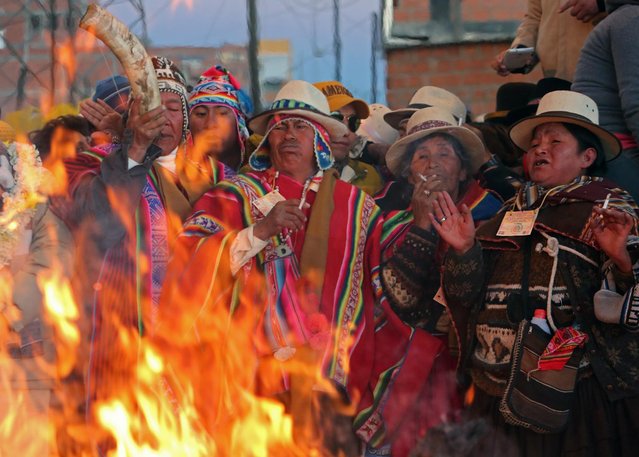
Local priests celebrate the “Aimara New Year”, an Andean Bolivian traditional festival that marks the winter solstice in El Alto, Bolivia, 21 June 2016. Aimara or Aymara means the Return of the Sun. (Photo by Martin Alipaz/EPA)

Local priests celebrate the “Aimara New Year”, an Andean Bolivian traditional festival that marks the winter solstice in El Alto, Bolivia, 21 June 2016. Aimara or Aymara means the Return of the Sun. (Photo by Martin Alipaz/EPA)
Details
22 Jun 2016 12:57:00