Loading...
Done
WWII: Women And The War Effort

These stunning color portraits, produced by the U.S. Office of War Information during World War II depict the role of women in the US war effort. All of the images were shot on 4x5 color transparency film by Howard R. Hollem and Alfred T. Palmer during 1942 and 1943 and were turned over to the Library of Congress Prints and Photographs Division in 1944. They are seen here with their original captions.
Details
18 Aug 2013 13:26:00
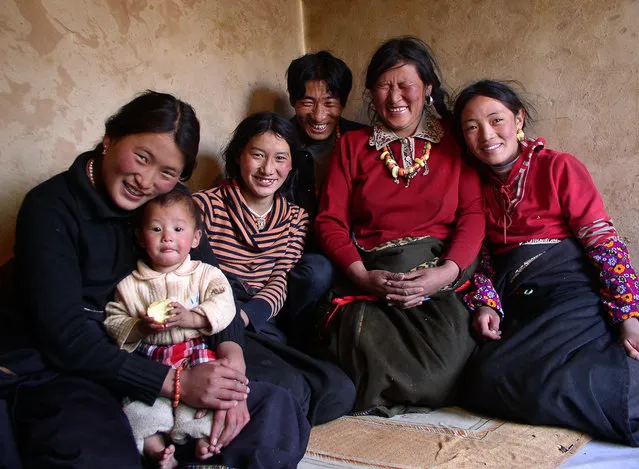
Buddhist pilgrim family from Sichuan. (Photo by Tom Carter/The Atlantic)

Nine years ago, Tom Carter traveled from San Francisco to China, responding to a job posting that turned out to be a scam. He managed to find another job as a teacher, and saved enough money to embark on a 56,000 km trip through all of China's 33 provinces that lasted two years. Carrying a camera – just a a 4-megapixel point-and-shoot – Carter captured some amazing images of the widely varying landscape, people, and architecture across the nation. Photo: Buddhist pilgrim family from Sichuan. (Photo by Tom Carter via The Atlantic)
Details
12 Mar 2013 14:19:00
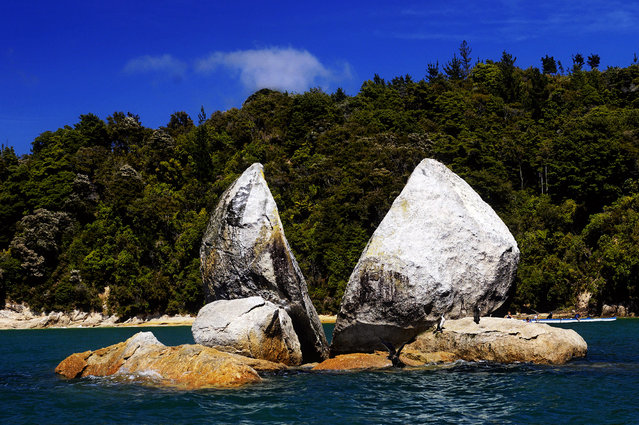
Split Apple Rock

Split Apple Rock is a geological rock formation in The Tasman Bay off the northern coast of the South Island of New Zealand. Made of granite, it is in the shape of an apple which has been cut in half. It is a popular tourist attraction in the waters of the Tasman Sea approximately 50 metres off the coast between Kaiteriteri and Marahau. The rock sits in shallow water at low tide and is accessible by wading. It is also a point of interest for the many tourist boats and pleasure craft which operate along the shores of the Abel Tasman National Park. The cleft to produce two sides of the 'apple' was a natural occurrence. It is unknown when this happened and therefore the cleaving of the rock has attracted mythological explanations.
Details
19 Oct 2013 10:58:00
Rooftops of solar powered houses are pictured in Ota, 80 km northwest of Tokyo in this October 28, 2008 file photo. One by one, Japan is turning off the lights at the giant oil-fired power plants that propelled it to the ranks of the world's top industrialised nations. With nuclear power in the doldrums after the Fukushima disaster, it's solar energy that is becoming the alternative. (Photo by Yuriko Nakao/Reuters)

Rooftops of solar powered houses are pictured in Ota, 80 km northwest of Tokyo in this October 28, 2008 file photo. One by one, Japan is turning off the lights at the giant oil-fired power plants that propelled it to the ranks of the world's top industrialised nations. With nuclear power in the doldrums after the Fukushima disaster, it's solar energy that is becoming the alternative. Solar power is set to become profitable in Japan as early as this quarter, according to the Japan Renewable Energy Foundation (JREF), freeing it from the need for government subsidies and making it the last of the G7 economies where the technology has become economically viable. (Photo by Yuriko Nakao/Reuters)
Details
24 Nov 2015 08:04:00
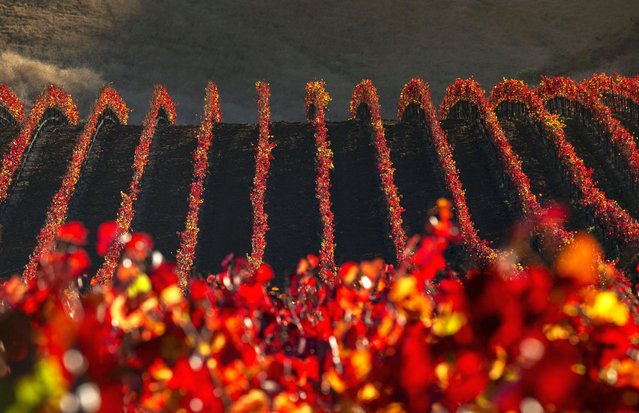
Pinot noir vineyards in the famed Sta. Rita Hills AVA turn a vivid red, orange, and yellow, signaling the end of the grape harvest and approach of winter as viewed on November 26, 2023, near Buellton, California. Following the notoriety from the Academy Award-winning film Sideways, this buccolic farming region north of Santa Barbara has become a popular Wine Country stop for global and domestic tourists traveling between San Francisco and Los Angeles. (Photo by George Rose/Getty Images)

Pinot noir vineyards in the famed Sta. Rita Hills AVA turn a vivid red, orange, and yellow, signaling the end of the grape harvest and approach of winter as viewed on November 26, 2023, near Buellton, California. Following the notoriety from the Academy Award-winning film Sideways, this buccolic farming region north of Santa Barbara has become a popular Wine Country stop for global and domestic tourists traveling between San Francisco and Los Angeles. (Photo by George Rose/Getty Images)
Details
01 Feb 2025 03:30:00
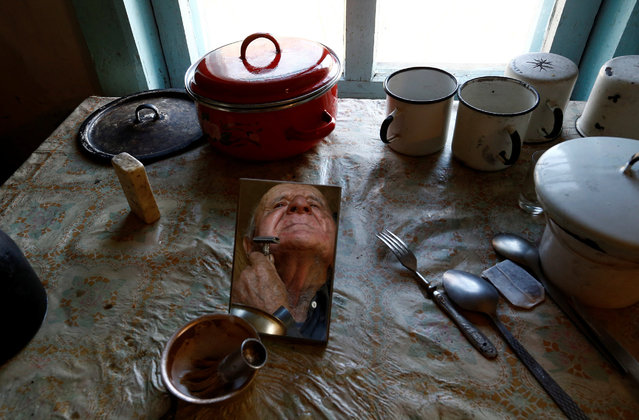
Ivan Shamyanok, 90, shaves in his house in the village of Tulgovichi, near the exclusion zone around the Chernobyl nuclear reactor, Belarus March 15, 2016. “My sister lived here with her husband. They decided to leave and soon enough they were in the ground ... They died from anxiety. I'm not anxious. I sing a little, take a turn in the yard, take things slowly like this and I live”, he said. (Photo by Vasily Fedosenko/Reuters)

Ivan Shamyanok, 90, shaves in his house in the village of Tulgovichi, near the exclusion zone around the Chernobyl nuclear reactor, Belarus March 15, 2016. “My sister lived here with her husband. They decided to leave and soon enough they were in the ground ... They died from anxiety. I'm not anxious. I sing a little, take a turn in the yard, take things slowly like this and I live”, he said. (Photo by Vasily Fedosenko/Reuters)
Details
27 Apr 2016 09:50:00
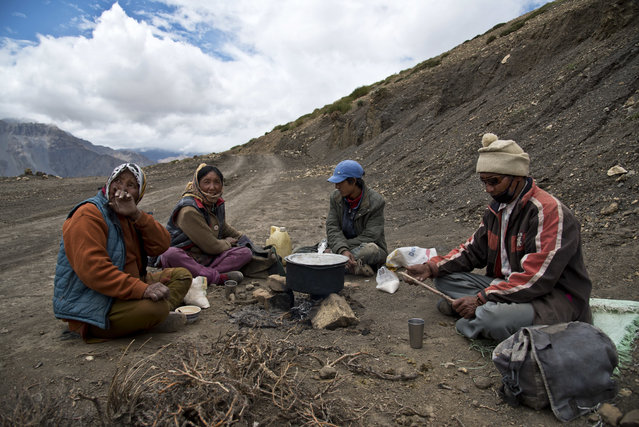
In this August 17, 2016, photo, from left to right, Chhering Chodom, 60, Tashi Yangzom, 50, Lobsang Chhering, 27, and Dorje Tandup, 58, drink milk tea on the side of the road. For centuries, the sleepy valley nestled in the Indian Himalayas remained a hidden Buddhist enclave forbidden to outsiders. Enduring the harsh year-round conditions of the high mountain desert, the people of Spiti Valley lived by a simple communal code – share the Earth's bounty, be hospitable to neighbors, and eschew greed and temptation at all turns. That's all starting to change, for better or worse. Since India began allowing its own citizens as well as outsiders to visit the valley in the early 1990s, tourism and trade have boomed. And the marks of modernization, such as solar panels, asphalt roads and concrete buildings, have begun to appear around some of the villages that dot the remote landscape at altitudes above 4,000 meters (13,000 feet). (Photo by Thomas Cytrynowicz/AP Photo)

In this August 17, 2016, photo, from left to right, Chhering Chodom, 60, Tashi Yangzom, 50, Lobsang Chhering, 27, and Dorje Tandup, 58, drink milk tea on the side of the road. For centuries, the sleepy valley nestled in the Indian Himalayas remained a hidden Buddhist enclave forbidden to outsiders. Enduring the harsh year-round conditions of the high mountain desert, the people of Spiti Valley lived by a simple communal code – share the Earth's bounty, be hospitable to neighbors, and eschew greed and temptation at all turns. That's all starting to change, for better or worse. (Photo by Thomas Cytrynowicz/AP Photo)
Details
15 Sep 2016 09:22:00
Shoppers wrestle over a television as they compete to purchase retail items on “Black Friday” at an Asda superstore in Wembley, north London November 28, 2014. Britain's high streets, malls and online sites were awash with discounts on Friday as more retailers than ever embraced U.S.-style “Black Friday” promotions, seeking to kickstart trading in the key Christmas period. (Photo by Luke MacGregor/Reuters)

Shoppers wrestle over a television as they compete to purchase retail items on “Black Friday” at an Asda superstore in Wembley, north London November 28, 2014. Britain's high streets, malls and online sites were awash with discounts on Friday as more retailers than ever embraced U.S.-style “Black Friday” promotions, seeking to kickstart trading in the key Christmas period. In the United States the Friday following the Thanksgiving Day holiday is called Black Friday because spending usually surges and indicates the point at which American retailers begin to turn a profit for the year, or go “into the black”. (Photo by Luke MacGregor/Reuters)
Details
29 Nov 2014 12:48:00