Loading...
Done
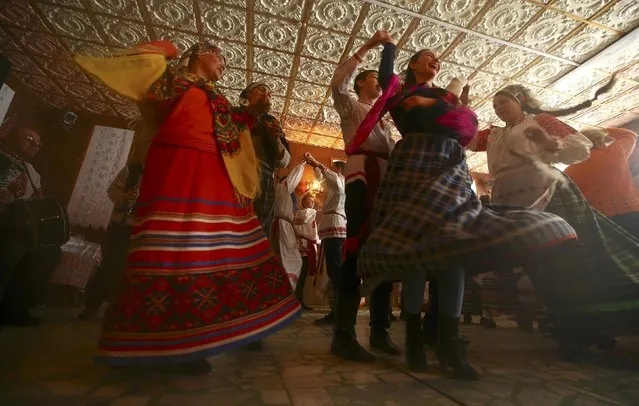
Local residents take part in the celebrations of Kolyada pagan holiday, which over the centuries has merged with Orthodox Christmas festivities and marks the upcoming end of winter, in the village of Noviny, Belarus, January 21, 2017. (Photo by Vasily Fedosenko/Reuters)

Local residents take part in the celebrations of Kolyada pagan holiday, which over the centuries has merged with Orthodox Christmas festivities and marks the upcoming end of winter, in the village of Noviny, Belarus, January 21, 2017. (Photo by Vasily Fedosenko/Reuters)
Details
22 Jan 2017 09:38:00
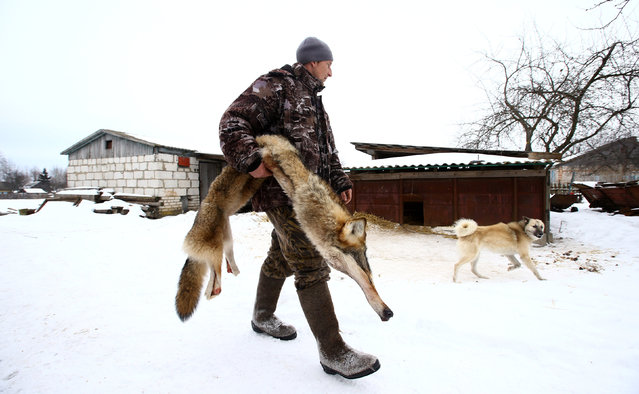
Nikolay Skidan, a hunter, carries the skin of a wolf in the village of Khrapkovo, Belarus February 1, 2017. (Photo by Vasily Fedosenko/Reuters)

Nikolay Skidan, a hunter, carries the skin of a wolf in the village of Khrapkovo, Belarus February 1, 2017. Wolf fur grows thickest in winter, so Belarussian hunter Vladimir Krivenchik only sets his traps once snow is on the ground. He and his wife live on the edge of the Chernobyl exclusion zone – 2,600 square km of land on the Belarus-Ukraine border that was contaminated by a nuclear disaster in 1986. (Photo by Vasily Fedosenko/Reuters)
Details
16 Feb 2017 00:04:00
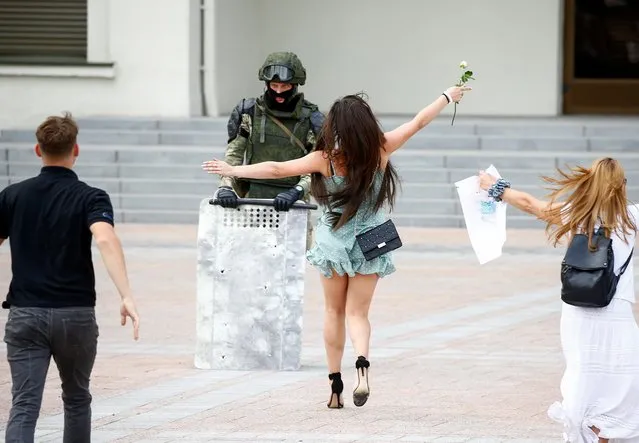
Participants approach a law enforcement officer with open arms during an opposition demonstration to protest against police violence and to reject the presidential election results near the Government House in Independence Square in Minsk, Belarus on August 14, 2020. (Photo by Vasily Fedosenko/Reuters)

Participants approach a law enforcement officer with open arms during an opposition demonstration to protest against police violence and to reject the presidential election results near the Government House in Independence Square in Minsk, Belarus on August 14, 2020. (Photo by Vasily Fedosenko/Reuters)
Details
31 Jan 2021 08:39:00
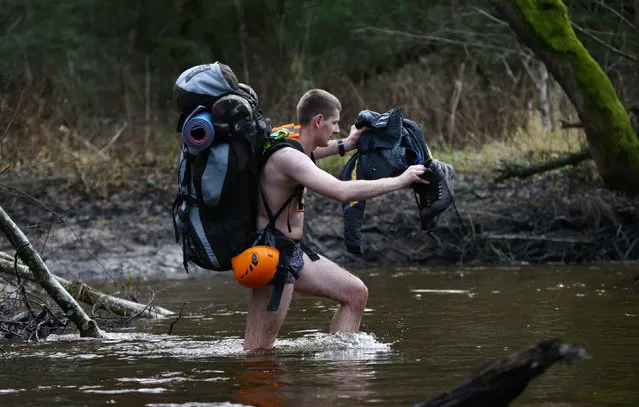
A Belarussian tourist crosses the river as he takes part in “Search and rescue operations – 2016”, a three-day competition, near the village of Priselki, Belarus, November 25, 2016. Photo taken November 25, 2016. (Photo by Vasily Fedosenko/Reuters)

A Belarussian tourist crosses the river as he takes part in “Search and rescue operations – 2016”, a three-day competition, near the village of Priselki, Belarus, November 25, 2016. Photo taken November 25, 2016. (Photo by Vasily Fedosenko/Reuters)
Details
28 Nov 2016 11:51:00
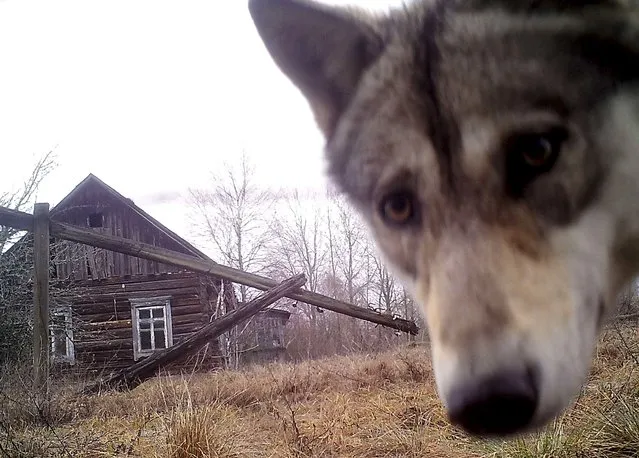
A wolf looks into the camera at the 30 km (19 miles) exclusion zone around the Chernobyl nuclear reactor in the abandoned village of Orevichi, Belarus, March 2, 2016. (Photo by Vasily Fedosenko/Reuters)

A wolf looks into the camera at the 30 km (19 miles) exclusion zone around the Chernobyl nuclear reactor in the abandoned village of Orevichi, Belarus, March 2, 2016. What happens to the environment when humans disappear? Thirty years after the Chernobyl nuclear disaster, booming populations of wolf, elk and other wildlife in the vast contaminated zone in Belarus and Ukraine provide a clue. (Photo by Vasily Fedosenko/Reuters)
Details
08 Apr 2016 15:13:00
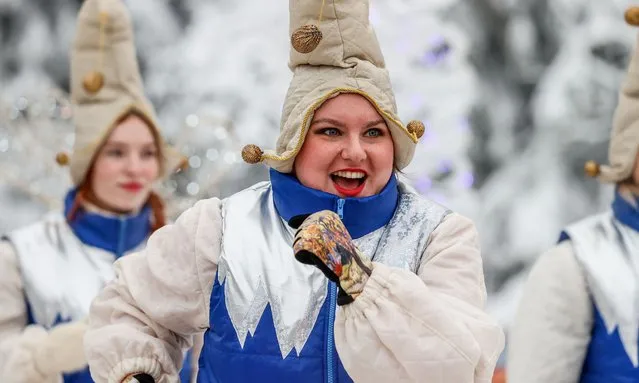
Performers are seen as a 90-year old spruce tree cut down in the woods of the Shchyolkovsky District in Moscow Region, Russia on December 16, 2021 is sent to Moscow. The almost 28-metre high tree will be put up at the Moscow Kremlin's Sobornaya (Cathedral) Square this New Year and Christmas. (Photo by Vasily Fedosenko/TASS)

Performers are seen as a 90-year old spruce tree cut down in the woods of the Shchyolkovsky District in Moscow Region, Russia on December 16, 2021 is sent to Moscow. The almost 28-metre high tree will be put up at the Moscow Kremlin's Sobornaya (Cathedral) Square this New Year and Christmas. (Photo by Vasily Fedosenko/TASS)
Details
17 Dec 2021 10:27:00
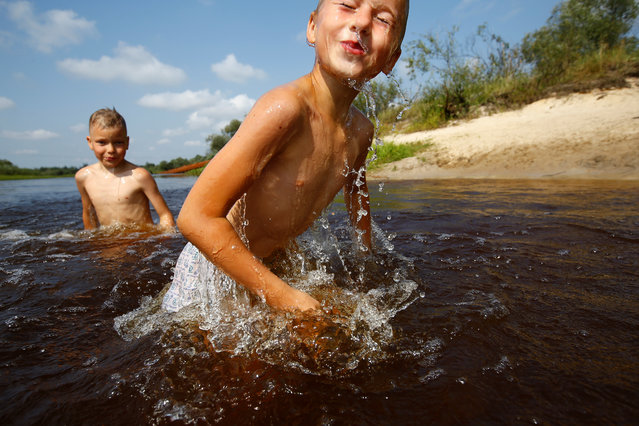
Boys play in the Stviga River on a hot summer day near the village of Pogost, Belarus, August 16, 2017. (Photo by Vasily Fedosenko/Reuters)

Just a few hours’ drive from the Belarus capital of Minsk, many villagers still live off the land. Nearly 80% of the country’s 9.5 million citizens live in urban areas, but for the rest, being close to nature can outweigh the hardships of country life. Here: Boys play in the Stviga River on a hot summer day near the village of Pogost, Belarus, August 16, 2017. (Photo by Vasily Fedosenko/Reuters)
Details
30 Nov 2017 08:28:00
Employees cover bacon on fried dranik, a potato pancake that is the national dish of Belarus, in the Sula History Park near the village of Sula, Belarus March 7, 2016. (Photo by Vasily Fedosenko/Reuters)

Employees cover bacon on fried dranik, a potato pancake that is the national dish of Belarus, in the Sula History Park near the village of Sula, Belarus March 7, 2016. According to the park's representatives, the two-metre-wide pancake was an attempt to enter the Guinness World Records as the world's largest dranik. (Photo by Vasily Fedosenko/Reuters)
Details
08 Mar 2016 13:41:00