Loading...
Done
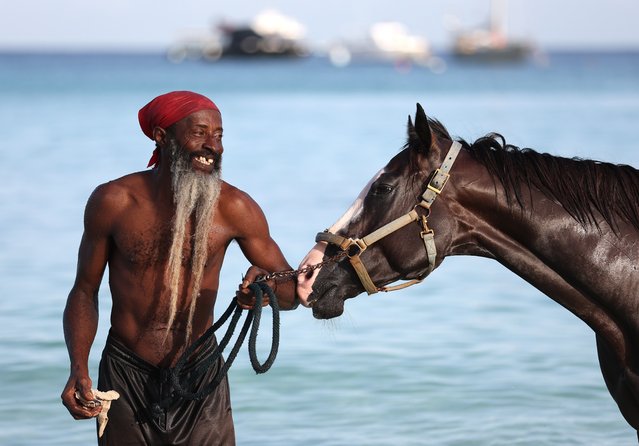
A horse trainer takes his horse into the water at Pebble Beach on June 28, 2024 in Bridgetown, Barbados. The swimming horses of Barbados offer a unique and remarkable experience at Pebbles Beach, where racehorses from the nearby Garrison Savannah enjoy their morning swim almost daily between 5:30 am and 7 am. During this ritual, horses swim out surprisingly far to the moored boats before returning to shore, with some staying longer in the water if recovering from injury or soreness after a race. Visitors can observe the horses' individual personalities as they swim and interact with the water, but are advised to respect the guidance of the grooms and maintain a safe distance, as horses can behave unpredictably, especially if frightened. (Photo by Robert Cianflone/Getty Images)

A horse trainer takes his horse into the water at Pebble Beach on June 28, 2024 in Bridgetown, Barbados. The swimming horses of Barbados offer a unique and remarkable experience at Pebbles Beach, where racehorses from the nearby Garrison Savannah enjoy their morning swim almost daily between 5:30 am and 7 am. During this ritual, horses swim out surprisingly far to the moored boats before returning to shore, with some staying longer in the water if recovering from injury or soreness after a race. Visitors can observe the horses' individual personalities as they swim and interact with the water, but are advised to respect the guidance of the grooms and maintain a safe distance, as horses can behave unpredictably, especially if frightened. (Photo by Robert Cianflone/Getty Images)
Details
07 Jul 2024 03:07:00
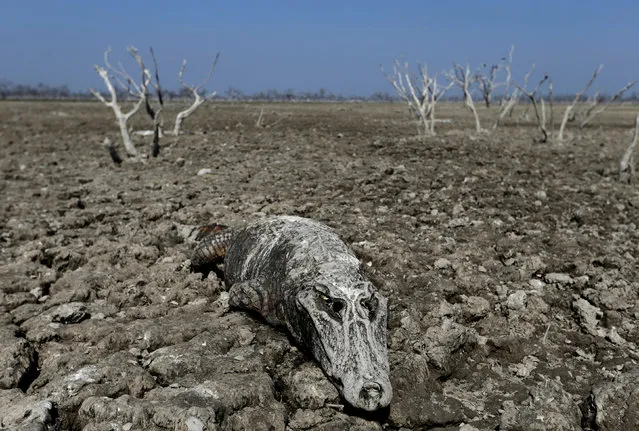
The carcass of a yacare caiman lies in the dried-up river bed of the Pilcomayo river in Boqueron, Paraguay, August 14, 2016. In Paraguay, alongside the Pilcomayo River, black vultures flew over a shrinking pond where a group of crocodilian reptiles known as yacare caimans sought refuge. Water from the river, which divides Paraguay and Argentina in the area of the Gran Chaco, was scarce. This is not an uncommon sight in the region of General Diaz, about 700 kilometres (435 miles) northwest of the country's capital Asuncion, where the Pilcomayo's waters form lakes and streams that give life to capybaras, birds and caimans. “The river's situation is critical. No water is forecast to enter the basin until December, as happens every year”, said Alcides Gonzalez, a resident of the area. (Photo by Jorge Adorno/Reuters)

The carcass of a yacare caiman lies in the dried-up river bed of the Pilcomayo river in Boqueron, Paraguay, August 14, 2016. In Paraguay, alongside the Pilcomayo River, black vultures flew over a shrinking pond where a group of crocodilian reptiles known as yacare caimans sought refuge. Water from the river, which divides Paraguay and Argentina in the area of the Gran Chaco, was scarce. This is not an uncommon sight in the region of General Diaz, about 700 kilometres (435 miles) northwest of the country's capital Asuncion, where the Pilcomayo's waters form lakes and streams that give life to capybaras, birds and caimans. (Photo by Jorge Adorno/Reuters)
Details
03 Nov 2016 12:40:00
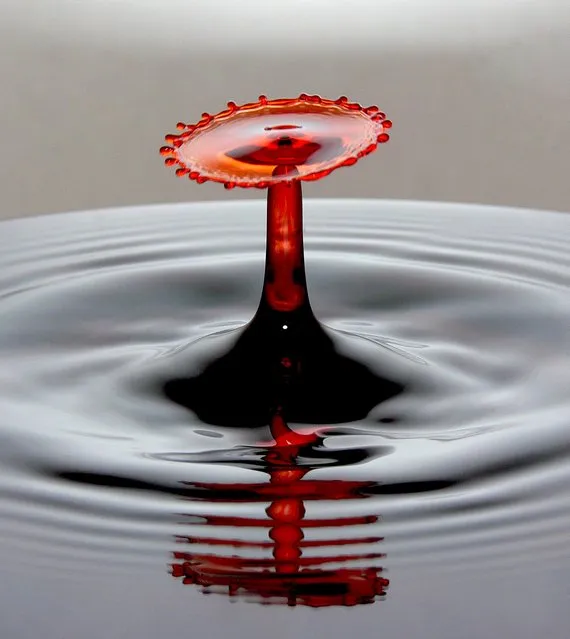
Waterdrop Sculptures by Josh Fancher

“I'm Josh Fancher, a 21 year old with an avid interest in photography, including macro, nature and wildlife, night photography, landscapes, cityscapes and architectural photography. Inspired by the beautiful and amazing water drop photography of Martin Waugh, I started doing water drop collisions in December of 2007. I use a 105mm Micro Nikkor lens for water drops, along with a pair of Nikon SB 600 flashes. I recently got a StopShot system (Nov 2009), which makes timing a lot easier. Before then, timing was manual, with an eye dropper, eye-hand coordination, and a lot of patience” – Josh Fancher. (Photo by Josh Fancher)
Details
19 Aug 2012 10:30:00
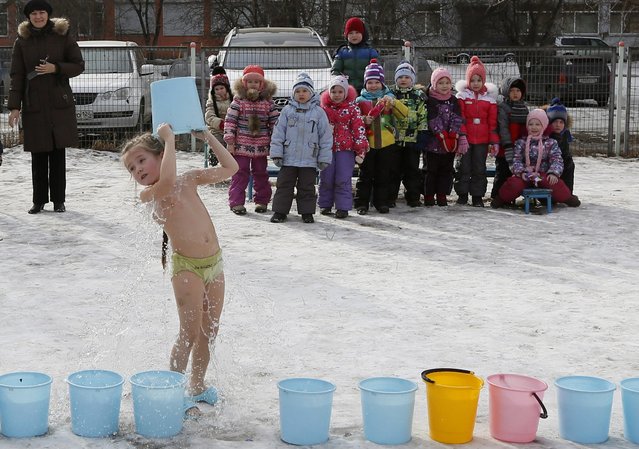
Children watch their classmate pour cold water on herself under the watch of a fitness coach at a local kindergarten in Russia's Siberian city of Krasnoyarsk, March 11, 2015. The program, which also involves sports training and sauna usage, has been practiced by the kindergarten for more than 15 years as they believe it has health benefits and keeps the children fit. (Photo by Ilya Naymushin/Reuters)

Children watch their classmate pour cold water on herself under the watch of a fitness coach at a local kindergarten in Russia's Siberian city of Krasnoyarsk, March 11, 2015. The program, which also involves sports training and sauna usage, has been practiced by the kindergarten for more than 15 years as they believe it has health benefits and keeps the children fit. Children start pouring cold water on themselves outdoors after about three years of training and undergoing medical tests, and the kindergarten is the only one in the region that practices these exercises, according to employees. (Photo by Ilya Naymushin/Reuters)
Details
19 Mar 2015 13:18:00


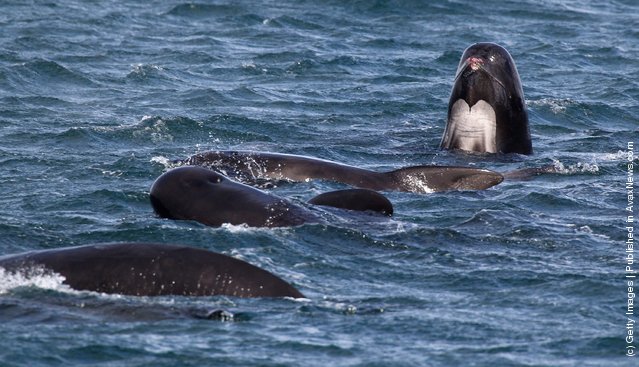
“Pilot whales are cetaceans belonging to the genus Globicephala. There are two extant species, the long-finned pilot whale (G. melas) and the short-finned pilot whale (G. macrorhynchus). The two are not readily distinguished at sea and analysis of the skulls is the best way to tell the difference between the two species. Between the two species, pilot whales range in waters nearly worldwide with long-finned pilot whales living in cooler waters and short-finned pilot whales living in warmer waters. Pilot whales are among the largest of the oceanic dolphins, exceeded in size only by the killer whale. They and other large members of the dolphin family are also known as blackfish”. – Wikipedia

Photo: Pilot whales swim in Loch Carron on May 20, 2011 in South Uist, Scotland. A major operation is underway to prevent up to 100 pilot whales from stranding on the rocky shoreline of Loch Carron on South Uist in the Western Isles. (Photo by Jeff J Mitchell/Getty Images)
Details
21 May 2011 07:58:00
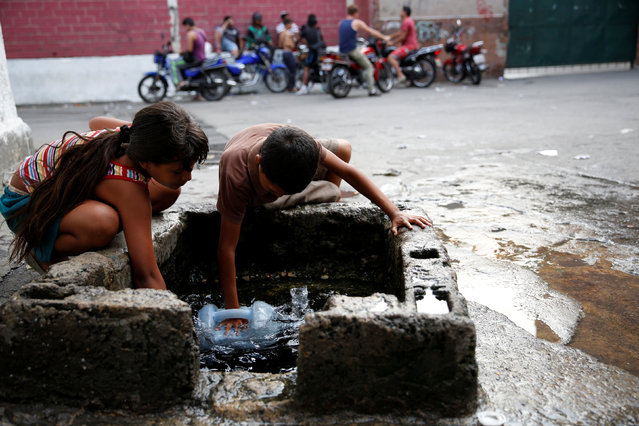
Children fill plastic containers with water from a well on a street, close to a neighbourhood called “The Tank” in the slum of Petare in Caracas, Venezuela, March 17, 2016. (Photo by Carlos Garcia Rawlins/Reuters)

Children fill plastic containers with water from a well on a street, close to a neighbourhood called “The Tank” in the slum of Petare in Caracas, Venezuela, March 17, 2016. Although their nation has one of the world's biggest hydroelectric dams and vast rivers like the fabled Orinoco, Venezuelans are still suffering water and power cuts most days. The problems with stuttering services have escalated in the last few weeks: yet another headache for the OPEC nation's 30 million people already reeling from recession, the world's highest inflation rate, and scarcities of basic goods. President Nicolas Maduro blames a drought, while the opposition blames government incompetence. (Photo by Carlos Garcia Rawlins/Reuters)
Details
08 May 2016 11:15:00
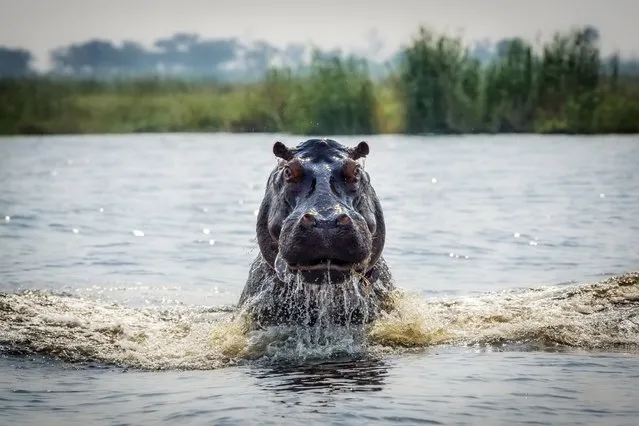
“Hippo Chase”. As we approached the camp the Selinda Reserve of northern Botswana our boat passed by a hippo resting in the water. I turned around to look back at the boat's wake and saw the hippo charging after us! The hippo must've been tired from an all-nighter because he was angry. (Photo and caption by Curtis Simmons/National Geographic Photo Contest)

“Hippo Chase”. As we approached the camp the Selinda Reserve of northern Botswana our boat passed by a hippo resting in the water. I turned around to look back at the boat's wake and saw the hippo charging after us! The hippo must've been tired from an all-nighter because he was angry. He rose way up out of the water three times trying to chase our boat! He was coming at us with such force that he created a wake of his own. Photo location: Selinda Reserve of northern Botswana. (Photo and caption by Curtis Simmons/National Geographic Photo Contest)
Details
06 Nov 2014 08:59:00
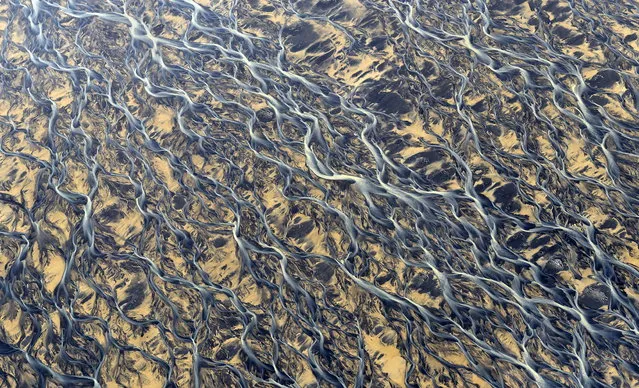
These pictures look like an artist has painted abstract patterns on canvas – but in fact they are natural rivers captured on camera. The spectacular rivers in Iceland's central highlands and southern parts originate from glaciers, which is why the water is a milky colour. (Photo by Andrey Ermolaev/Solent News)

These picture look like an artist has painted abstract patterns on canvas – but in fact they are natural rivers captured on camera. The spectacular rivers in Iceland's central highlands and southern parts originate from glaciers, which is why the water is a milky colour. They are shallow rivers and the water spreads quickly over a flat and sandy surface, creating random and beautiful patterns. Photographer Andrey Ermolaev from Moscow, Russia, flew 500ft above the unique sight in a small plane. (Photo by Andrey Ermolaev/Solent News)
Details
05 May 2014 10:57:00