Loading...
Done
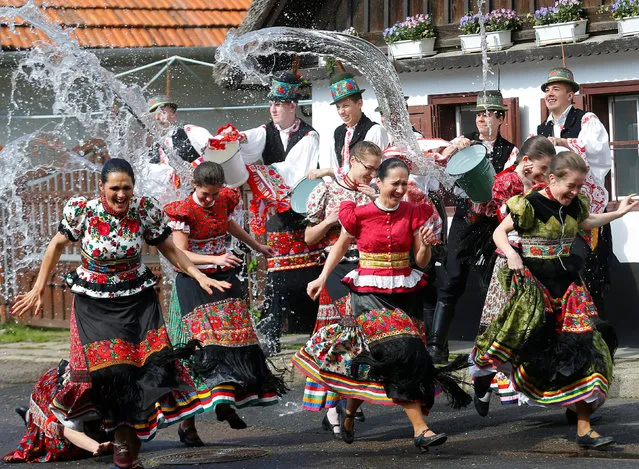
Girls dressed in traditional costumes run as men throw water on them as part of Easter celebrations during a presentation to the media in Mezokovesd, Hungary, April 13, 2017. (Photo by Laszlo Balogh/Reuters)

Girls dressed in traditional costumes run as men throw water on them as part of Easter celebrations during a presentation to the media in Mezokovesd, Hungary, April 13, 2017. (Photo by Laszlo Balogh/Reuters)
Details
15 Apr 2017 08:58:00
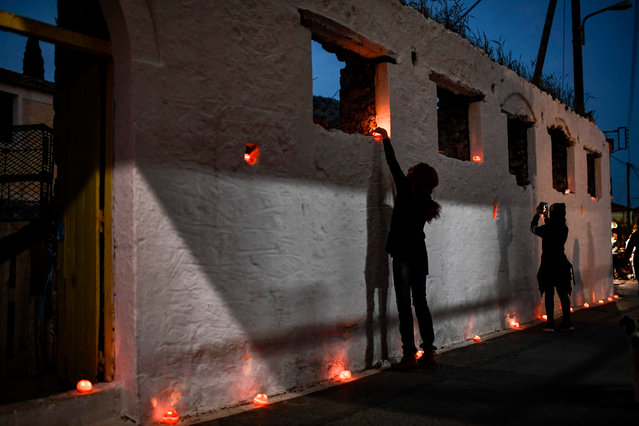
People decorate a street with candles inside oranges during the Epitaph ceremony during Good Friday's “Apokathelosis”, the Descent of Christ's dead body from the Cross, which forms a key part of Orthodox Easter, in the southern city of Leonidio, at the Peloponnese peninsula on April 26, 2019. Millions of Greeks flock to churches around the country this week to celebrate Easter, the country's foremost religious celebration. (Photo by Aris Messinis/AFP Photo)

People decorate a street with candles inside oranges during the Epitaph ceremony during Good Friday's “Apokathelosis”, the Descent of Christ's dead body from the Cross, which forms a key part of Orthodox Easter, in the southern city of Leonidio, at the Peloponnese peninsula on April 26, 2019. Millions of Greeks flock to churches around the country this week to celebrate Easter, the country's foremost religious celebration. (Photo by Aris Messinis/AFP Photo)
Details
15 May 2019 00:05:00
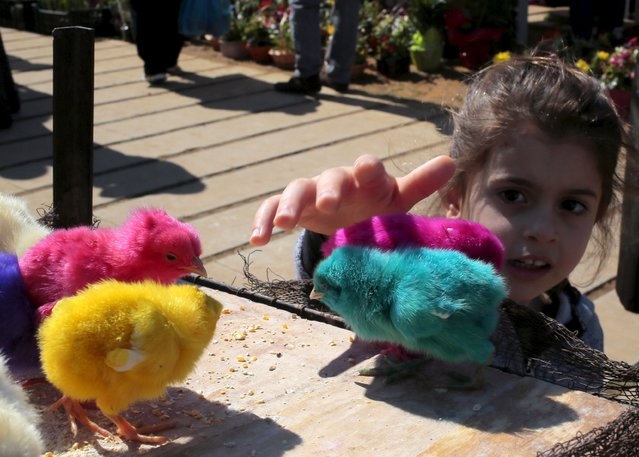
A girl plays with coloured chicks for sale prior to Easter celebrations in Byblos March 22, 2015. (Photo by Jamal Saidi/Reuters)

A girl plays with coloured chicks for sale prior to Easter celebrations in Byblos, Lebanon on March 22, 2015. (Photo by Jamal Saidi/Reuters)
Details
28 Mar 2015 11:23:00
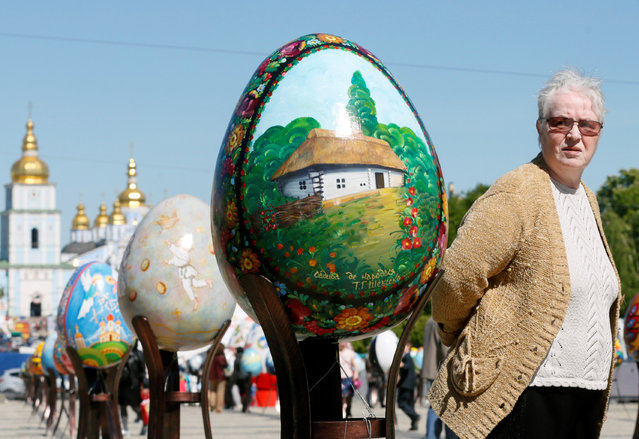
A woman looks at traditional Ukrainian Easter eggs “Pysanka”, installed as part of the upcoming celebrations of Easter, in central Kiev, Ukraine, April 29, 2016. A pysanka is a Ukrainian Easter egg, decorated with traditional Ukrainian folk designs using a wax-resist (batik) method. The word pysanka comes from the verb pysaty, “to write”, as the designs are not painted on, but written with beeswax. Many other eastern European ethnic groups decorate eggs using wax resist for Easter. These include the Belarusians, Bulgarians, Croats, Czechs, Hungarians, Lithuanians, Poles, Romanians, Serbs, Slovaks, Slovenes and Sorbs. (Photo by Valentyn Ogirenko/Reuters)

A woman looks at traditional Ukrainian Easter eggs “Pysanka”, installed as part of the upcoming celebrations of Easter, in central Kiev, Ukraine, April 29, 2016. A pysanka is a Ukrainian Easter egg, decorated with traditional Ukrainian folk designs using a wax-resist (batik) method. The word pysanka comes from the verb pysaty, “to write”, as the designs are not painted on, but written with beeswax. Many other eastern European ethnic groups decorate eggs using wax resist for Easter. These include the Belarusians, Bulgarians, Croats, Czechs, Hungarians, Lithuanians, Poles, Romanians, Serbs, Slovaks, Slovenes and Sorbs. (Photo by Valentyn Ogirenko/Reuters)
Details
30 Apr 2016 09:00:00
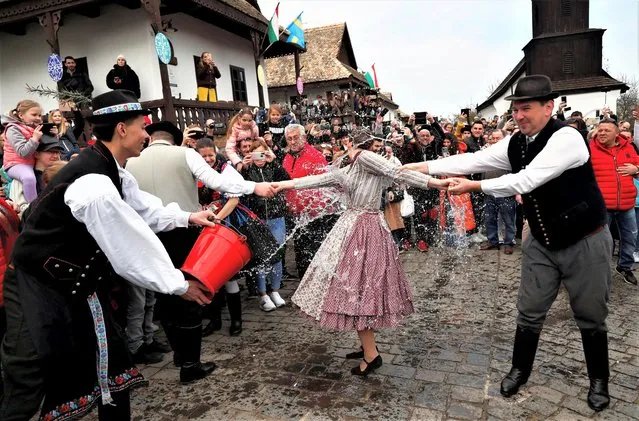
A woman wearing traditional clothes reacts as men throw water at her during a traditional Easter celebration in Holloko, Hungary on April 10, 2023. (Photo by Bernadett Szabo/Reuters)

A woman wearing traditional clothes reacts as men throw water at her during a traditional Easter celebration in Holloko, Hungary on April 10, 2023. (Photo by Bernadett Szabo/Reuters)
Details
16 Apr 2023 03:50:00
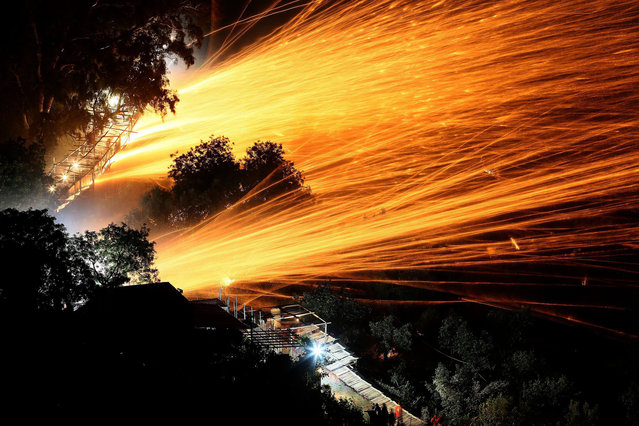
St. Mark's and Panagia Erithiani church congregations perform “Rocket War” by firing thousands of home-made rockets across the sky during Greek Orthodox Easter celebrations in the town of Vrontados on the Greek island of Chios on April 19, 2014. Greek habit of throwing handmade rockets with the aim of hitting the bell tower of the church at the other side during the celebration of the service at midnight before Easter Sunday. (Photo by Cem Oksuz/Anadolu Agency/Getty Images)

St. Mark's and Panagia Erithiani church congregations perform “Rocket War” by firing thousands of home-made rockets across the sky during Greek Orthodox Easter celebrations in the town of Vrontados on the Greek island of Chios on April 19, 2014. Greek habit of throwing handmade rockets with the aim of hitting the bell tower of the church at the other side during the celebration of the service at midnight before Easter Sunday. (Photo by Cem Oksuz/Anadolu Agency/Getty Images)
Details
11 Jun 2024 02:35:00
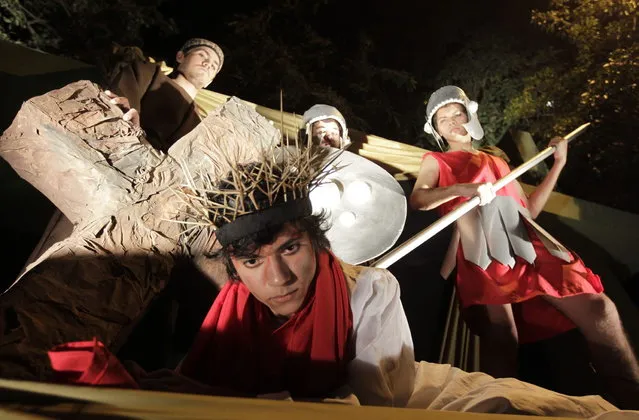
An actor carries a cross as he plays the role of Jesus Christ in a re-enactment of the Via Crucis (Way of the Cross) during a Holy Week procession, in preparation for Good Friday celebrations, in Luque, Paraguay, on March 27, 2013. Holy Week is celebrated in many Christian traditions during the week before Easter. (Photo by Jorge Adorno/Reuters)

An actor carries a cross as he plays the role of Jesus Christ in a re-enactment of the Via Crucis (Way of the Cross) during a Holy Week procession, in preparation for Good Friday celebrations, in Luque, Paraguay, on March 27, 2013. Holy Week is celebrated in many Christian traditions during the week before Easter. (Photo by Jorge Adorno/Reuters)
Details
28 Mar 2013 12:06:00
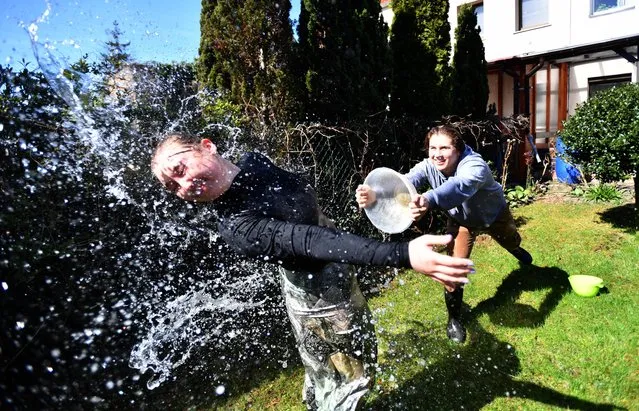
Polish boys and girls throw water over each other on “Smigus-dyngus” (or Wet Monday) during the Easter Monday in Szczecin, northwestern Poland, 18 April 2022. Smigus-dyngus is a Roman Catholic celebration held on Easter Monday in Poland. Traditionally, boys throw water over girls, this is accompanied by a number of other rituals, such as making verse declarations and holding door-to-door processions. (Photo by Marcin Bielecki/EPA/EFE)

Polish boys and girls throw water over each other on “Smigus-dyngus” (or Wet Monday) during the Easter Monday in Szczecin, northwestern Poland, 18 April 2022. Smigus-dyngus is a Roman Catholic celebration held on Easter Monday in Poland. Traditionally, boys throw water over girls, this is accompanied by a number of other rituals, such as making verse declarations and holding door-to-door processions. (Photo by Marcin Bielecki/EPA/EFE)
Details
15 Jul 2023 02:04:00