Loading...
Done
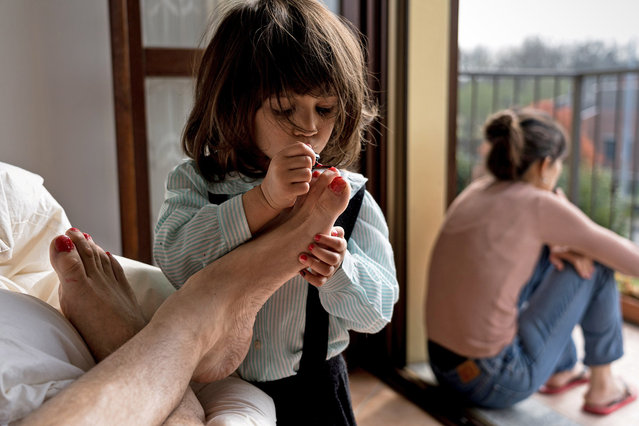
Life in lockdown: Schoolteacher Marzio Toniolo, 35, takes a picture of his two-year-old daughter Bianca painting his toenails as they while away time at home in San Fiorano, one of the original “red zone” towns in northern Italy that has now been extended to the whole country, as his wife, Bianca's mum Chiara Zuddas looks out from their balcony, March 20, 2020. Toniolo has been documenting how his family has dealt with being under quarantine since it began for them in February. (Photo by Marzio Toniolo via Reuters)

Life in lockdown: Schoolteacher Marzio Toniolo, 35, takes a picture of his two-year-old daughter Bianca painting his toenails as they while away time at home in San Fiorano, one of the original “red zone” towns in northern Italy that has now been extended to the whole country, as his wife, Bianca's mum Chiara Zuddas looks out from their balcony, March 20, 2020. Toniolo has been documenting how his family has dealt with being under quarantine since it began for them in February. (Photo by Marzio Toniolo via Reuters)
Details
09 Apr 2020 00:03:00
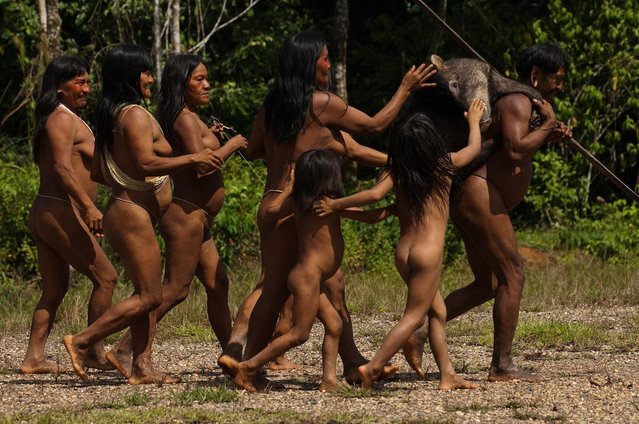
Spectacular images offering insight into the lives of the Huaorani people in the Ecuadorian Amazon have been revealed showing how they use traditional methods to hunt monkeys for food. The stunning pictures were taken by conservation photographer Pete Oxford from Torquay, Devon in the Ecuadorian Amazon. “The Huaorani Indians are a forest people highly in tune with their environment. Many are now totally acculturated since the 1950s by missionaries”, said Pete. “Today they face radical change to their culture to the proximity of oil exploration within their territory and the Yasuni National Park and Biosphere Reserve, they are vastly changed. Some still live very traditionally and for this shoot, through my Huaorani friend, a direct relative of those photographed he wanted to depict them as close to their original culture as possible. They still largely hunt with blow pipes and spears eating a lot of monkeys and peccaries”. The Huaorani are also known as the Waorani, Waodani or the Waos and are native Amerindians. Their lands are located between the Curaray and Napo rivers and speak the Huaorani language. Pete says that during his visit he was welcomed into the group and hopes that ancient cultures can be saved. Here: The tribe were seen celebrating after a hunter returned to camp with a wild pig. (Photo by Pete Oxford/Mediadrumworld.com)

Spectacular images offering insight into the lives of the Huaorani people in the Ecuadorian Amazon have been revealed showing how they use traditional methods to hunt monkeys for food. The stunning pictures were taken by conservation photographer Pete Oxford from Torquay, Devon in the Ecuadorian Amazon. Here: The tribe were seen celebrating after a hunter returned to camp with a wild pig. (Photo by Pete Oxford/Mediadrumworld.com)
Details
20 Jan 2017 07:58:00
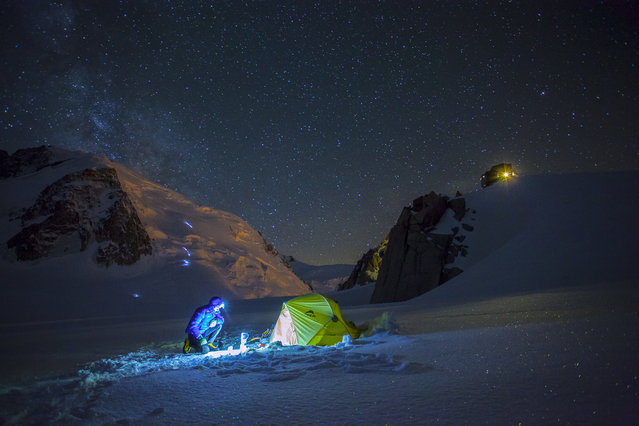
“A snapshot from mountaineer's life”. Have you ever wondered how does a mountaineer's day start? (Photo and caption by Kamil Tamiola/National Geographic Traveler Photo Contest)

“A snapshot from mountaineer's life”. Have you ever wondered how does a mountaineer's day start? I will give you a hint: you wake up at 3 am, set the stove, wake up your partner, pretend it is warm, quickly consume a high-calorie breakfast, watch your friends slowly ascending the icy slopes of your dream summit with their tiny head torches glimmering against perfectly blue ice, and hope for the good weather. One would ask: why all this trouble? The answer is easy: for the love of the adventure and the unknown. Location: Chamonix, Haute Savoye, France. (Photo and caption by Kamil Tamiola/National Geographic Traveler Photo Contest)

ATTENTION! All pictures are presented in high resolution. To see Hi-Res images – just TWICE click on any picture. In other words, click small picture – opens the BIG picture. Click BIG picture – opens VERY BIG picture.
Details
27 Jun 2013 12:47:00
A boy walks past boats docked at the entrance gate of the fishermen's village in the El Max area of the Mediterranean city of Alexandria September 12, 2014.  El Max, where hundreds of boats dart through the canals, has been called the “Venice of Egypt” for its waterways and relaxed atmosphere. Its fishermen, however, worry about how they will make ends meet on meagre earnings they  say are being reduced further by polluted waters that are making fishing more difficult. (Photo by Amr Abdallah Dalsh/Reuters)

A boy walks past boats docked at the entrance gate of the fishermen's village in the El Max area of the Mediterranean city of Alexandria September 12, 2014. El Max, where hundreds of boats dart through the canals, has been called the “Venice of Egypt” for its waterways and relaxed atmosphere. Its fishermen, however, worry about how they will make ends meet on meagre earnings they say are being reduced further by polluted waters that are making fishing more difficult. While the government has tried to fix the state's bloated finances by cutting subsidies and reining in spending, some argue the reforms hurt Egypt's most vulnerable who have long relied on a generous system of fuel and food subsidies to supplement low incomes. (Photo by Amr Abdallah Dalsh/Reuters)
Details
12 Dec 2014 12:42:00
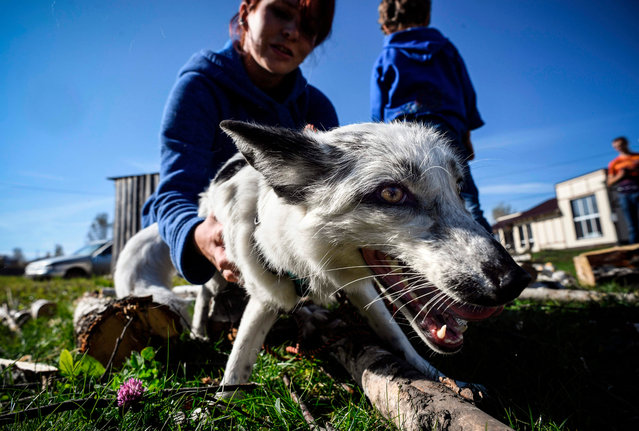
Tatyana Abramova, 33, plays with her home fox Plombir at her countryside house outside Siberian city of Novosibirsk on September 12, 2020. The official start of the Soviet experiment to better understand the domestication of animals by humans began in 1959, and was initiated by geneticists Dmitri Beliaiev and Lioudmila Trout on a farm in Akademgorodok, the scientific center of excellence in Siberia. Their primary objective was to domesticate foxes, to understand how the ancestor of wolves, another canine, evolved into a loyal and loving dog. And understand what this domestication tells us about the genetic evolution of species. (Photo by Alexander Nemenov/AFP Photo)

Tatyana Abramova, 33, plays with her home fox Plombir at her countryside house outside Siberian city of Novosibirsk on September 12, 2020. The official start of the Soviet experiment to better understand the domestication of animals by humans began in 1959, and was initiated by geneticists Dmitri Beliaiev and Lioudmila Trout on a farm in Akademgorodok, the scientific center of excellence in Siberia. Their primary objective was to domesticate foxes, to understand how the ancestor of wolves, another canine, evolved into a loyal and loving dog. And understand what this domestication tells us about the genetic evolution of species. (Photo by Alexander Nemenov/AFP Photo)
Details
25 Oct 2020 00:05:00
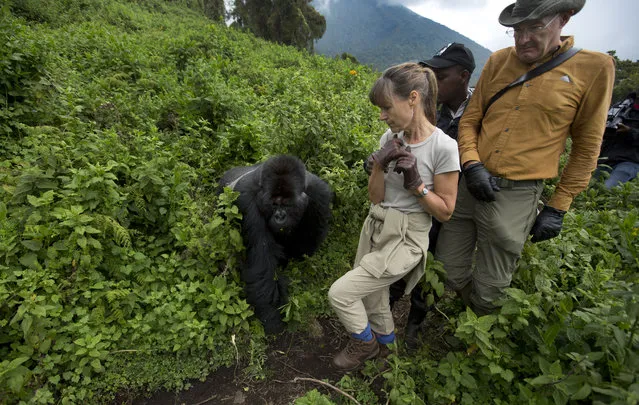
In this photo taken Friday, September 4, 2015, tourists Sarah and John Scott from Worcester, England, take a step back as a male silverback mountain gorilla from the family of mountain gorillas named Amahoro, which means “peace” in the Rwandan language, unexpectedly steps out from the bush to cross their path in the dense forest on the slopes of Mount Bisoke volcano in Volcanoes National Park, northern Rwanda. (Photo by Ben Curtis/AP Photo)

In this photo taken Friday, September 4, 2015, tourists Sarah and John Scott from Worcester, England, take a step back as a male silverback mountain gorilla from the family of mountain gorillas named Amahoro, which means “peace” in the Rwandan language, unexpectedly steps out from the bush to cross their path in the dense forest on the slopes of Mount Bisoke volcano in Volcanoes National Park, northern Rwanda. Deep in Rwanda's steep-sloped forest, increasing numbers of tourists are heading to see the mountain gorillas, a subspecies whose total population is an estimated 900 and who also live in neighboring Uganda and Congo, fueling an industry seen as key to the welfare of the critically endangered species as well as Rwanda's economy. (Photo by Ben Curtis/AP Photo)
Details
18 Sep 2015 14:55:00
Using his camera skills, Marc meters the background sky in order to achieve the beautiful black silhouettes of the wildlife, Africa, 2010-2016. A photographer has travelled around Africa for six years to capture striking silhouettes of lions, giraffes and birds. Australian wildlife photographer, Marc Mol took the series of pictures in various areas of Africa; including Botswana and Kenya to Tanzania and Zambia. Whether grazing, hunting or resting, the animals' daily activities are transformed into something majestic when cast against golden evenings and pink dawns. (Photo by Marc Mol/Barcroft Images)

Using his camera skills, Marc meters the background sky in order to achieve the beautiful black silhouettes of the wildlife, Africa, 2010-2016. (Photo by Marc Mol/Barcroft Images)
Details
10 Jan 2017 13:36:00
Interior designer Zahra Afridi (R) kicks a punching bag during a kickboxing training session at her home in Islamabad February 10, 2014. Afridi runs her own interior design company. Her most recent project was a Classic Rock Coffee cafe in Islamabad. (Photo by Zohra Bensemra/Reuters)

Interior designer Zahra Afridi (R) kicks a punching bag during a kickboxing training session at her home in Islamabad February 10, 2014. Afridi runs her own interior design company. Her most recent project was a Classic Rock Coffee cafe in Islamabad. Though instability continues to plague Pakistan and many areas are dominated by social conservatism, some of the country's more affluent residents have worked to fashion a very different kind of lifestyle for themselves. Pictures of men and women taking part in all sorts of activities and professions – from being a pilates instructor, to a textile retail entrepreneur, to a member of a rock band – offer a different view of Pakistan to images of conflict that often make the news. (Photo by Zohra Bensemra/Reuters)
Details
13 Jul 2014 10:47:00