Loading...
Done
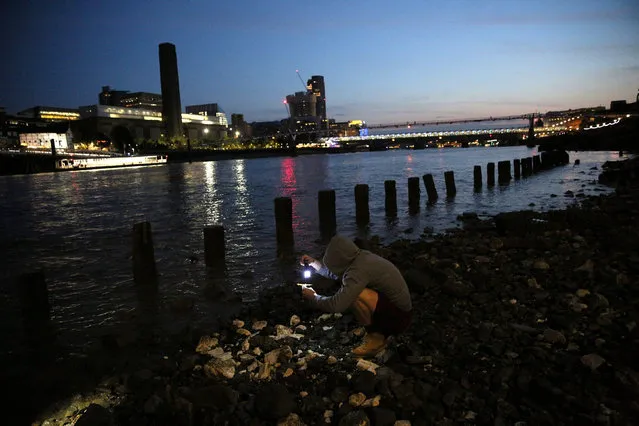
A mudlark uses a torch to look for items on the bank of the River Thames in London, Britain June 06, 2016. Mudlarking is believed to trace its origins to the 18th and 19th century, when scavengers searched the Thames' shores for items to sell. These days, history and archaeology fans are the ones hoping to find old relics such as coins, ceramics, artifacts or everyday items from across centuries. They wait for the low tide and then scour specific areas of exposed shores. "If you're in a field you could be out all day long, with the river you're restricted to about two or three hours," mudlark Nick Stevens said. While many just use the naked eye for their searches, others rely on metal detectors for which a permit from the Port of London Authority is needed. Digging also requires consent. (Photo by Neil Hall/Reuters)

A mudlark uses a torch to look for items on the bank of the River Thames in London, Britain June 06, 2016. Mudlarking is believed to trace its origins to the 18th and 19th century, when scavengers searched the Thames' shores for items to sell. These days, history and archaeology fans are the ones hoping to find old relics such as coins, ceramics, artifacts or everyday items from across centuries. their finds with the Portable Antiquities Scheme. Any item over 300 years old must be recorded. (Photo by Neil Hall/Reuters)
Details
27 Aug 2016 10:43:00
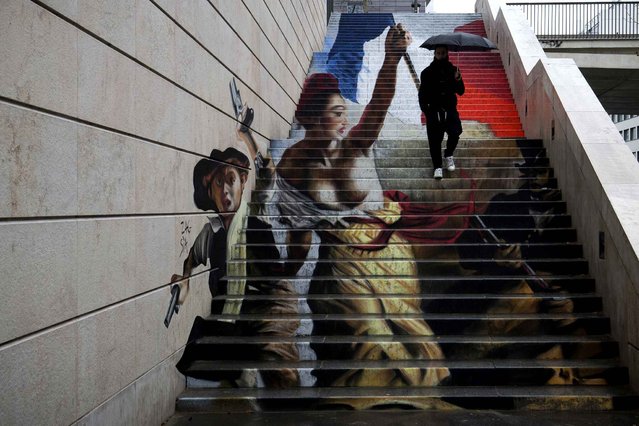
A man passes by an unfinished street art graffiti made in a stairway by French street artists Zag and Sia in Paris on March 1, 2016. The two artists drew inspiration from famous “Liberty Leading the People” (La Liberte guidant le peuple) painting by French Eugene Delacroix commemorating the July Revolution of 1830 and viewed as a symbol of the French Republic. (Photo by Joel Saget/AFP Photo)

A man passes by an unfinished street art graffiti made in a stairway by French street artists Zag and Sia in Paris on March 1, 2016. The two artists drew inspiration from famous “Liberty Leading the People” (La Liberte guidant le peuple) painting by French Eugene Delacroix commemorating the July Revolution of 1830 and viewed as a symbol of the French Republic. (Photo by Joel Saget/AFP Photo)
Details
04 Mar 2016 12:31:00
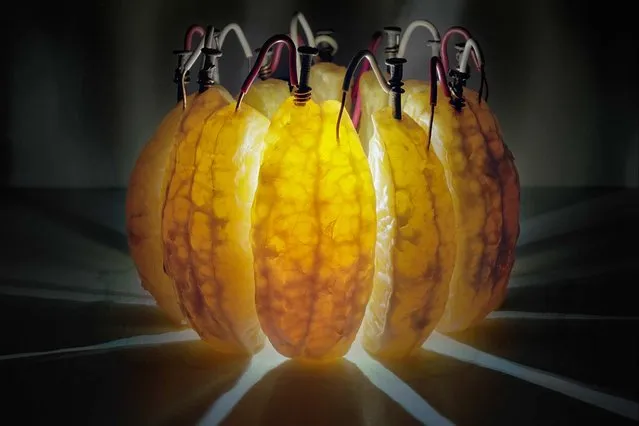
Wedges of an orange generate enough current and electrical juice – 3.5 volts – to power an LED. The fruit’s citric acid helps electrons flow from galvanized nails to copper wire in this 14-hour exposure. This image was published in September’s Visions of Earth, a trio of photos that appear in each issue of National Geographic. (Photo by Caleb Charland/National Geographic)

Wedges of an orange generate enough current and electrical juice – 3.5 volts – to power an LED. The fruit’s citric acid helps electrons flow from galvanized nails to copper wire in this 14-hour exposure. This image was published in September’s Visions of Earth, a trio of photos that appear in each issue of National Geographic. (Photo by Caleb Charland/National Geographic)
Details
06 Jan 2014 12:09:00
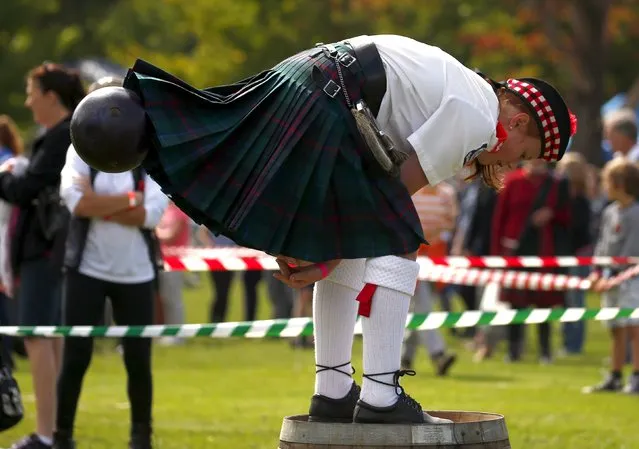
A competitor wearing a kilt and standing on a barrel throws a bowling ball between her legs during the 'Brigaball' contest at the annual Bundanoon Highland Gathering, showcasing traditional Scottish events, held in the town of Bundanoon, located southwest of Sydney, April 9, 2016. (Photo by David Gray/Reuters)

A competitor wearing a kilt and standing on a barrel throws a bowling ball between her legs during the “Brigaball” contest at the annual Bundanoon Highland Gathering, showcasing traditional Scottish events, held in the town of Bundanoon, located southwest of Sydney, April 9, 2016. (Photo by David Gray/Reuters)
Details
11 Apr 2016 11:20:00
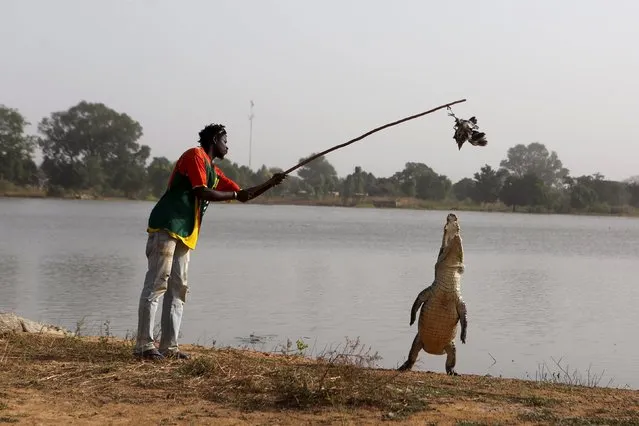
A guide dangles a live chicken in front of a crocodile in the village of Bazoule, Burkina Faso, December 4, 2015. The villagers believe the crocodiles that live there are sacred. (Photo by Joe Penney/Reuters)

A guide dangles a live chicken in front of a crocodile in the village of Bazoule, Burkina Faso, December 4, 2015. The villagers believe the crocodiles that live there are sacred. (Photo by Joe Penney/Reuters)
Details
07 Dec 2015 08:06:00
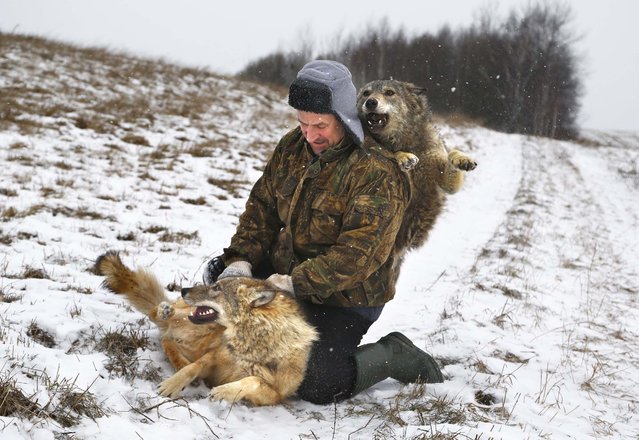
Belarusian Sergei Selekh plays with his 6-month-old tamed wolves on the outskirts of the village of Gaina, 45 kilometers (28 miles) north of Belarus capital Minsk, Wednesday, December 31, 2014. Selekh owns a farmstead, where sheep, wolves and an ethnographic museum serve as entertainment for guests. (Photo by Sergei Grits/AP Photo)

Belarusian Sergei Selekh plays with his 6-month-old tamed wolves on the outskirts of the village of Gaina, 45 kilometers (28 miles) north of Belarus capital Minsk, Wednesday, December 31, 2014. Selekh owns a farmstead, where sheep, wolves and an ethnographic museum serve as entertainment for guests. (Photo by Sergei Grits/AP Photo)
Details
03 Jan 2015 12:51:00
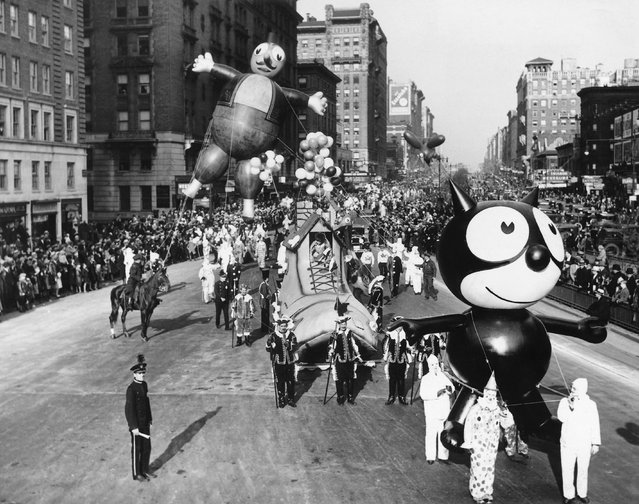
A Felix the Cat balloon and other parade floats and balloons are led down Broadway during the annual Macy's Thanksgiving Day Parade; ca. 1900s, Broadway, Manhattan, New York City, New York State, USA. (Photo by Underwood & Underwood/Corbis)

A Felix the Cat balloon and other parade floats and balloons are led down Broadway during the annual Macy's Thanksgiving Day Parade; ca. 1900s, Broadway, Manhattan, New York City, New York State, USA. (Photo by Underwood & Underwood/Corbis)
Details
27 Nov 2014 15:09:00
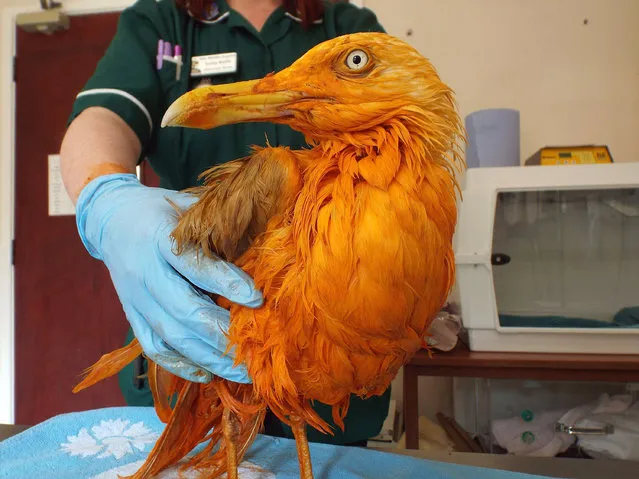
A seagull who turned bright orange after he plunged into a vat of chicken tikka masala in Beckford, England on June 9, 2016. The bird fell into a container of the food while trying to scavenge a piece of meat from a food factory bin in Wales. (Photo by Vale Wildlife Hospital/PA Wire)

A seagull who turned bright orange after he plunged into a vat of chicken tikka masala in Beckford, England on June 9, 2016. The bird fell into a container of the food while trying to scavenge a piece of meat from a food factory bin in Wales. (Photo by Vale Wildlife Hospital/PA Wire)
Details
12 Jun 2016 10:11:00