Loading...
Done
One of three young oriental small-clawed otters eats a meatball on June 18, 2015 in a zoo in Dresden, eastern Germany. The oriental small-clawed otter female Fussi gave birth to 3 healthy pups. Its pups now leave their burrow to explore the environment. (Photo by Arno Burgi/AFP Photo/DPA)

One of three young oriental small-clawed otters eats a meatball on June 18, 2015 in a zoo in Dresden, eastern Germany. The oriental small-clawed otter female Fussi gave birth to 3 healthy pups. Its pups now leave their burrow to explore the environment. (Photo by Arno Burgi/AFP Photo/DPA)
Details
29 Jun 2015 12:27:00
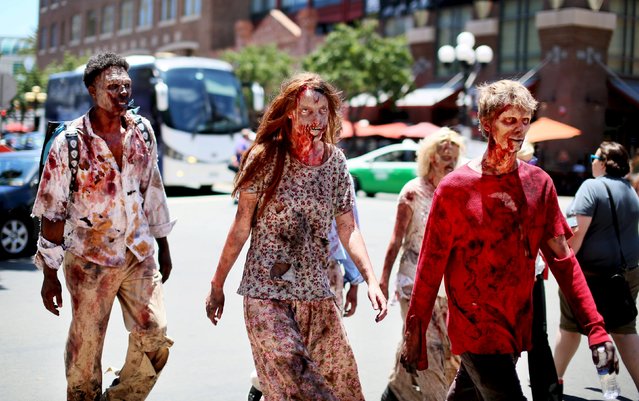
Attnedees dressed in Zombie outfits walk down the Gaslamp Quarter outside of the 2015 Comic-Con International in San Diego, California July 8, 2015. (Photo by Sandy Huffaker/Reuters)

Attnedees dressed in Zombie outfits walk down the Gaslamp Quarter outside of the 2015 Comic-Con International in San Diego, California July 8, 2015. (Photo by Sandy Huffaker/Reuters)
Details
09 Jul 2015 12:27:00
In this Tuesday, July 14, 2015, photo, Phoe Thaw, center, a member of the White New Blood lethwei fighters club, a Myanmar traditional martial-arts club which practices a rough form of kickboxing, stretches during a practice session in their gym on a street in Oakalarpa, north of Yangon, Myanmar. (Photo by Gemunu Amarasinghe/AP Photo)

In this Tuesday, July 14, 2015, photo, Phoe Thaw, center, a member of the White New Blood lethwei fighters club, a Myanmar traditional martial-arts club which practices a rough form of kickboxing, stretches during a practice session in their gym on a street in Oakalarpa, north of Yangon, Myanmar. Three of the club's members competed this summer on a stage a world away from the street gym: a mixed-martial-arts “One Championship” event broadcast globally on cable television networks, where fighters could receive $1,000 for each fight, according to coach Myint Zaw who started the traditional fighters' club 15 years ago. (Photo by Gemunu Amarasinghe/AP Photo)
Details
07 Sep 2015 14:00:00
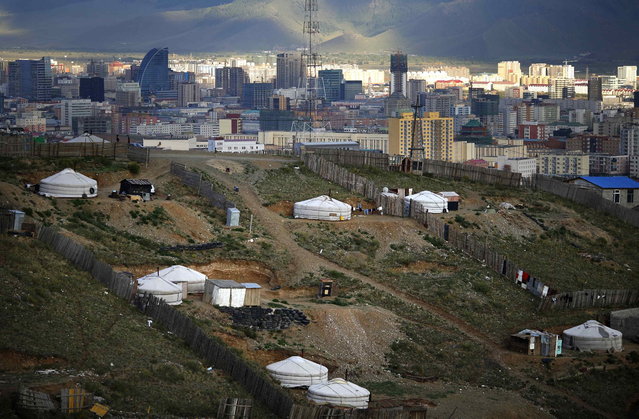
Gers, traditional Mongolian tents, are seen on a hill in an area known as a ger district in Ulan Bator June 26, 2013. (Photo by Carlos Barria/Reuters)

Gers, traditional Mongolian tents, are seen on a hill in an area known as a ger district in Ulan Bator June 26, 2013. Approximately 60 percent of the population of Ulan Bator live in settlements known as ger districts and in many cases residents have limited access to basic services such as water and sanitation. According to a 2010 National Population Center census, every year between thirty and forty thousand people migrate from the countryside to the capital Ulan Bator. Ger districts in the city have been expanding rapidly in recent years. Mongolia is the world's least densely populated country, with 2.8 million people spread across an area around three times the size of France. (Photo by Carlos Barria/Reuters)
Details
11 Aug 2013 11:45:00
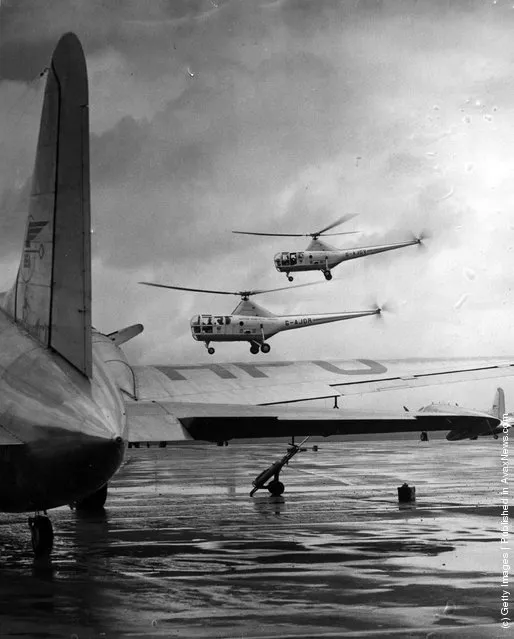
Sikorsky H-5 helicopters

“Igor Sikorsky (May 25, 1889 – October 26, 1972), born Igor Ivanovich Sikorsky was a Russian American pioneer of aviation in both helicopters and fixed-wing aircraft. He designed and flew the world's first multi-engine fixed-wing aircraft, the Russky Vityaz in 1913, and the first airliner, Ilya Muromets, in 1914. After immigrating to the United States in 1919, Sikorsky founded the Sikorsky Aircraft Corporation in 1923, and developed the first of Pan American Airways' ocean-conquering flying boats in the 1930s. In 1939 Sikorsky designed and flew the Vought-Sikorsky VS-300, the first viable American helicopter, which pioneered the rotor configuration used by most helicopters today. Sikorsky would modify the design into the Sikorsky R-4, which became the world's first mass-produced helicopter in 1942”. – Wikipedia

Photo: Westland Sikorsky H-5's, used by British European Airways Helicopters, which fly between London and Birmingham. The Sikorsky H-5, (aka R-5, S-51, HO3S-1, or Horse) (R-5 until 1948; company designation VS-327) is a helicopter built by Sikorsky Aircraft Corporation, formerly used by the United States Air Force, and its predecessor, the United States Army Air Forces, as well as the United States Navy and United States Coast Guard (with the designations HO2S and HO3S). (Photo by Harrison /Topical Press Agency/Getty Images). 22nd May 1951

Details
06 Sep 2011 10:18:00
Takeoka Chisaka, Hiroshima, Japan. “One morning in August 1945, I was walking home from the night shift at a factory in Hiroshima. As I reached my door, there was a huge explosion. When I came to, my head was bleeding and I had been blasted 30m away”. (Photo and caption by Sasha Maslov)

Takeoka Chisaka, Hiroshima, Japan. “One morning in August 1945, I was walking home from the night shift at a factory in Hiroshima. As I reached my door, there was a huge explosion. When I came to, my head was bleeding and I had been blasted 30m away. The atomic bomb had detonated. When I found my mother, her eyes were badly burned. A doctor said they had to come out, but he didn’t have the proper tools so used a knife instead. It was hellish. I became a peace-worker after the war. In the 1960s, at a meeting at the UN, I met one of the people who created the atomic bomb. He apologised”. (Photo and caption by Sasha Maslov)
Details
11 May 2015 11:56:00
In this photo provided by Mickey Nuttall, members of an international team of skydivers join hands, flying head-down to build their world record skydiving formation, Friday, July 31, 2015, over Ottawa, Ill. (Photo by Jason Peters via AP Photo)

In this photo provided by Mickey Nuttall, members of an international team of skydivers join hands, flying head-down to build their world record skydiving formation, Friday, July 31, 2015, over Ottawa, Ill. (Photo by Jason Peters via AP Photo)
Details
01 Aug 2015 12:45:00
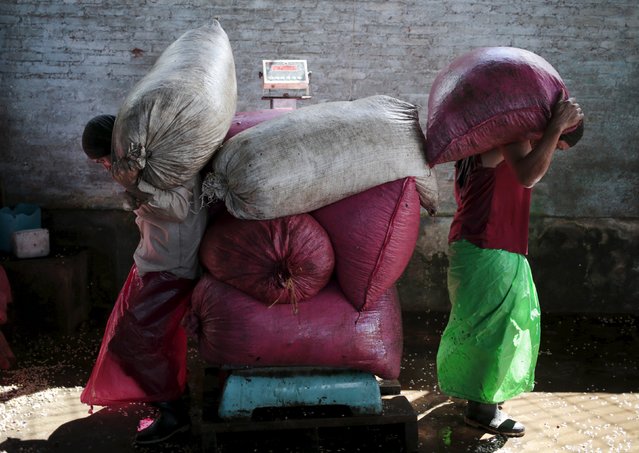
Workers carry sacks of coffee beans at a warehouse at the Nogales farm in Jinotega, Nicaragua January 7, 2016. (Photo by Oswaldo Rivas/Reuters)

Workers carry sacks of coffee beans at a warehouse at the Nogales farm in Jinotega, Nicaragua January 7, 2016. Soaring temperatures in Central America due to climate change are forcing farmers to pull up coffee trees and replace them with cocoa, spurring a revival in the cultivation of a crop once so essential to the region's economy. (Photo by Oswaldo Rivas/Reuters)
Details
20 Jan 2016 08:00:00