Loading...
Done


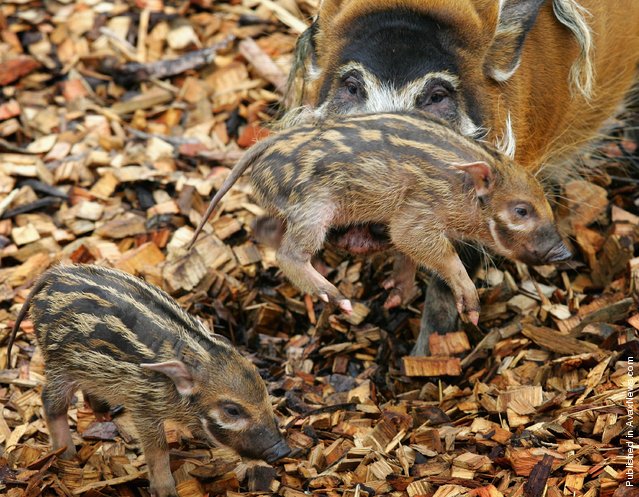
“The Red River Hog (Potamochoerus porcus), also known as the Bush Pig (but not to be confused with P. larvatus, common name “Bushpig”), is a wild member of the pig family living in Africa, with most of its distribution in the Guinean and Congolian forests. It is rarely seen away from rainforests, and generally prefers areas near rivers or swamps.

Red River Hogs eat grass, berries, roots, insects, molluscs, small vertebrates and carrion. They are capable of causing damage to plantations. Red River Hogs typically live in herds of 6-20 members led by a dominant boar. Sows rear 3-6 piglets at a time.”

Photo: Two 17 day old red river hoglet twins forage for food next to their mother Bahiti at London Zoo on August 23, 2007 in London, England. Red River hoglets inhabit the forests and swamps of West and Central Africa. The recent additions to the London Zoo pig pen have been eagerly awaited by zoo keepers. (Photo by Chris Jackson/Getty Images)
Details
18 Mar 2011 15:15:00


“Chameleons (family Chamaeleonidae) are a distinctive and highly specialized clade of lizards. They are distinguished by their parrot-like zygodactylous feet, their separately mobile and stereoscopic eyes, their very long, highly modified, and rapidly extrudable tongues, their swaying gait, the possession by many of a prehensile tail, crests or horns on their distinctively shaped heads, and the ability of some to change color. Uniquely adapted for climbing and visual hunting, the approximately 160 species of chameleon range from Africa, Madagascar, Spain and Portugal, across south Asia, to Sri Lanka, have been introduced to Hawaii, California and Florida, and are found in warm habitats that vary from rain forest to desert conditions”. – Wikipedia

Photo: A woman with the latest fashion accessory, a chameleon. (Photo by Fox Photos/Getty Images). Circa 1926
Details
20 Mar 2011 15:45:00


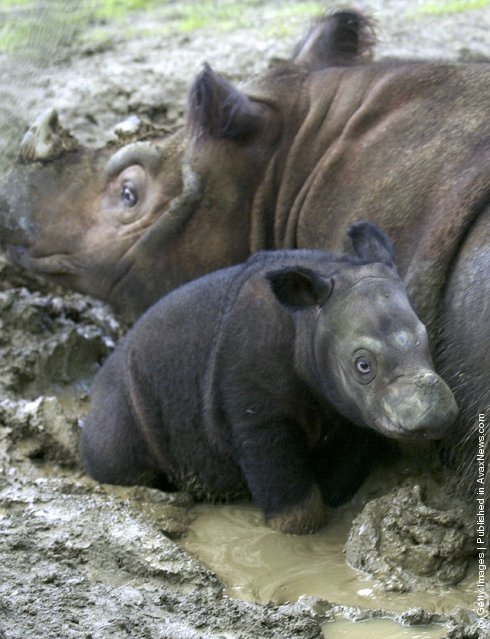
“The Sumatran Rhinoceros (Dicerorhinus sumatrensis) is a member of the family Rhinocerotidae and one of five extant rhinoceroses. It is the only extant species of the genus Dicerorhinus. It is the smallest rhinoceros, standing about 120–145 centimetres (3.9–4.76 ft) high at the shoulder, with a body length of 250 centimetres (8.2 ft) and weight of 500–800 kilograms (1,100–1,800 lb). Like the African species, it has two horns; the larger is the nasal horn, typically 15–25 centimetres (5.9–9.8 in), while the other horn is typically a stub. A coat of reddish-brown hair covers most of the Sumatran Rhino's body”. – Wikipedia

Photo: Emi, a Sumatran rhinoceros lies in the mud with her three-week-old female calf at the Cincinnati Zoo and Botanical Garden August 19, 2004 in Cincinnati, Ohio. Emi made history by becoming the first Sumatran rhino to produce two calves in captivity. (Photo by Mike Simons/Getty Images)
Details
22 Jun 2011 12:37:00
Rougine, a 19-year-old female Arab fighter among the Syrian Democratic Forces, made up of US-backed Kurdish and Arab fighters, stands in fatigues embracing another colleague near the village of al-Torshan, 20 km on the outskirts of Raqa on February 6, 2017. Unlike Syria's Kurds, who have emphasised gender equality in both their militias and nascent autonomous governing institutions in north and northeast Syria, the Arab tribes in the same region are among the more conservative segments of the country's population, and most Arab families find the concept of female fighters “hard to accept”. (Photo by Delil Souleiman/AFP Photo)

Rougine, a 19-year-old female Arab fighter among the Syrian Democratic Forces, made up of US-backed Kurdish and Arab fighters, stands in fatigues embracing another colleague near the village of al-Torshan, 20 km on the outskirts of Raqa on February 6, 2017. (Photo by Delil Souleiman/AFP Photo)
Details
13 Feb 2017 00:05:00
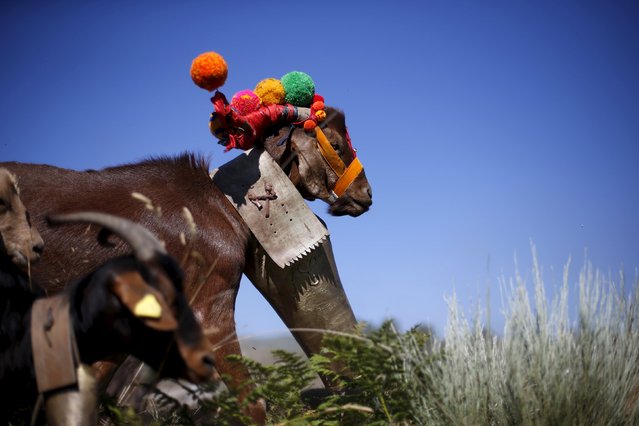
Sheep walk as they are herded to summer pastures in Serra da Estrela, near Seia, Portugal June 27, 2015. (Photo by Rafael Marchante/Reuters)

Sheep walk as they are herded to summer pastures in Serra da Estrela, near Seia, Portugal June 27, 2015. In late June, shepherds young and old in the Seia region of central Portugal start guiding sheep, goats and cattle to the Serra da Estrela, the country’s highest mountains, in search of better pastures. There they stay until the end of September. Modern-day shepherds may have mobile phones to keep in touch with family and friends, but their lifestyle has changed little for centuries. The sound of cowbells and the bark of longhaired mastiffs starts early in the morning as the animals – often decorated with traditional woollen balls on their horns – are herded up steep, narrow paths. (Photo by Rafael Marchante/Reuters)
Details
14 Jul 2015 13:48:00
People take pictures as an Airbus Beluga XL transport plane lands during its first flight event in Colomiers near Toulouse, France, July 19, 2018. Airbus employees were asked to vote on possible designs for the craft, which ended up being painted to resemble a cartoon cetacean. “The six designs we proposed for consideration by employees respected our brand identity while running from the conventional to the unconventional, even adding a touch of fun”, said Tim Orr, head of branding at Airbus. (Photo by Regis Duvignau/Reuters)

People take pictures as an Airbus Beluga XL transport plane lands during its first flight event in Colomiers near Toulouse, France, July 19, 2018. The Beluga XL, the new cargo plane of the Airbus family has taken off from Blagnac, in the south of France, for its first test flight. The launch of the aircraft triggered thunderous applause in an audience of more than 10,000 people, mostly employees and subcontractors of the European aircraft manufacturer. (Photo by Regis Duvignau/Reuters)
Details
20 Jul 2018 07:30:00
Children, wearing red neckerchiefs, a symbol of the Pioneer Organization, salute during a ceremony for the inauguration of 18 new members at a local school in the southern settlement of Kazminskoye in Stavropol region, Russia, November 19, 2015. Early pro-communist youth movements, which appeared in Russia after the 1917 Bolshevik revolution, were reformed into the Pioneer Organization of the Soviet Union. (Photo by Eduard Korniyenko/Reuters)

Children, wearing red neckerchiefs, a symbol of the Pioneer Organization, salute during a ceremony for the inauguration of 18 new members at a local school in the southern settlement of Kazminskoye in Stavropol region, Russia, November 19, 2015. Early pro-communist youth movements, which appeared in Russia after the 1917 Bolshevik revolution, were reformed into the Pioneer Organization of the Soviet Union. While the organization lost its dominance among students in post-Soviet Russia, some educational institutions and families still carry on this tradition. (Photo by Eduard Korniyenko/Reuters)
Details
22 Nov 2015 08:01:00
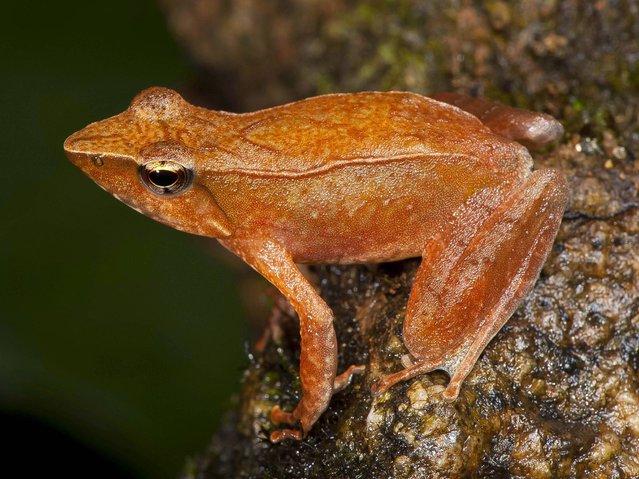
Orange dancing frog discovered by a team headed by University of Delhi professor Sathyabhama Das Biju in the jungle mountains of southern India. (Photo by Satyabhama Das Biju/AP Photo)

This undated photograph shows one of the 14 new species of so-called dancing frogs discovered by a team headed by University of Delhi professor Sathyabhama Das Biju in the jungle mountains of southern India. The study listing the new species brings the number of known Indian dancing frogs to 24 and attempts the first near-complete taxonomic sampling of the single-genus family found exclusively in southern India's lush mountain range called the Western Ghats, which stretches 1,600 kilometers (990 miles) from the west state of Maharashtra down to the country's southern tip. (Photo by Satyabhama Das Biju/AP Photo)
Details
09 May 2014 08:50:00