In this Monday, September 23, 2019, a woman waits for alms as she sits with her child in a street on the outskirts of Kabul, Afghanistan. (Photo by Ebrahim Noroozi/AP Photo)
A Kurdish fighter from the People's Protection Units (YPG) fires his rifle at Islamic State militants as he runs across a street in Raqqa, Syria, July 2017. (Photo by Goran Tomasevic/Reuters)
A girl bathes her dog, next to her sister on a street of the San Agustin neighborhood of Caracas, Venezuela, Monday, April 3, 2023. (Photo by Matias Delacroix/AP Photo)
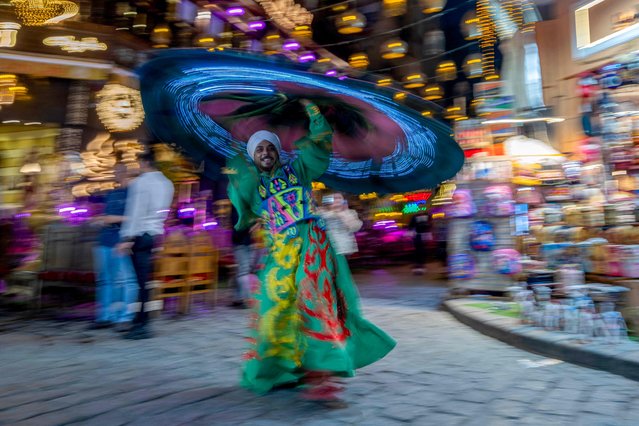
An Egyptian dancer performs the Tanoura outside a coffee shop at al-Muizz street in the old Islamic quarter of Cairo on August 29, 2024. (Photo by Khaled Desouki/AFP Photo)
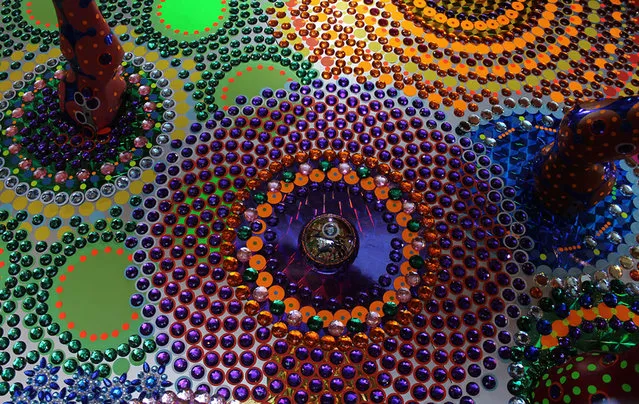
Dutch artist Suzan Drummen‘s large-scale floor installations are mesmerizing and complex circular patterns made out of mirrors and brightly colored glass. The fractal-like arrangements feature ornate and elaborate circles growing exponentially out of each other and vibrant rings of spiraling colors winding into the surface of the floor. They are composed of crystals, chromed metal, precious stones, mirrors and optical glass. A sensory experience, and visually stimulating, the glittering installations play with the architecture of the space — climbing up walls and sweeping across the surfaces — examining the idea of illusion and optical effects.
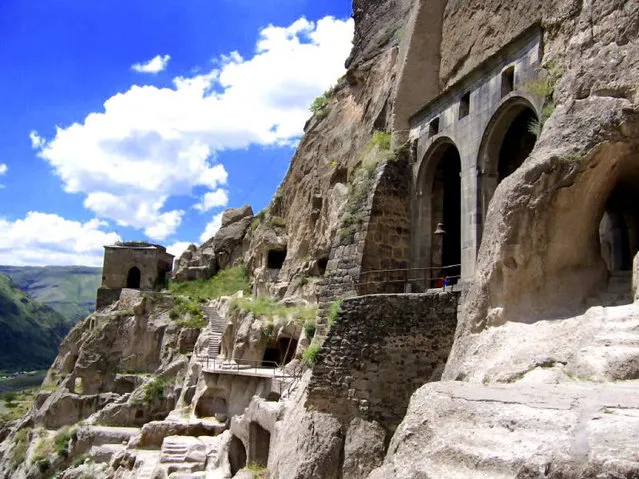
Vardzia is a cave monastery site in southern Georgia, excavated from the slopes of the Erusheti Mountain on the left bank of the Mtkvari River, thirty kilometres from Aspindza. The main period of construction was the second half of the twelfth century. The caves stretch along the cliff for some five hundred metres and in up to nineteen tiers. The Church of the Dormition, dating to the 1180s during the golden age of Tamar and Rustaveli, has an important series of wall paintings. The site was largely abandoned after the Ottoman takeover in the sixteenth century. Now part of a state heritage reserve, the extended area of Vardzia-Khertvisi has been submitted for future inscription on the UNESCO World Heritage List
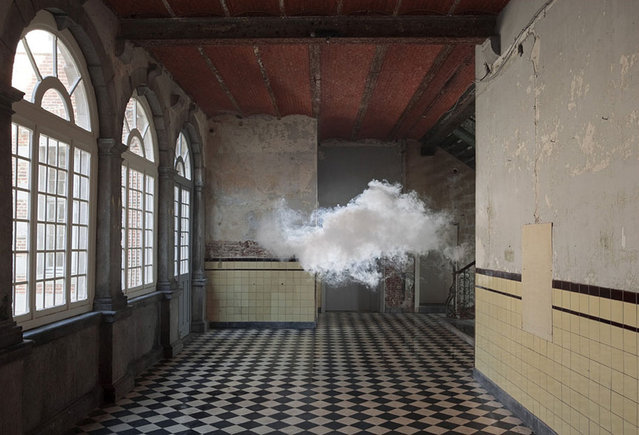
Dutch artist Berndnaut Smilde is interested in the ephemeral -- impermanent states of being which he documents through photographs. For Nimbus II, he used a smoke machine, combined with moisture and dramatic lighting to create a hovering indoor cloud in the empty setting of a sixteenth-century chapel in Hoorn, a small town in Holland. “I imagined walking into a museum hall with just empty walls. The place even looked deserted. On the one hand I wanted to create an ominous situation. You could see the cloud as a sign of misfortune. You could also read it as an element out of the Dutch landscape paintings in a physical form in a classical museum hall.”