Loading...
Done
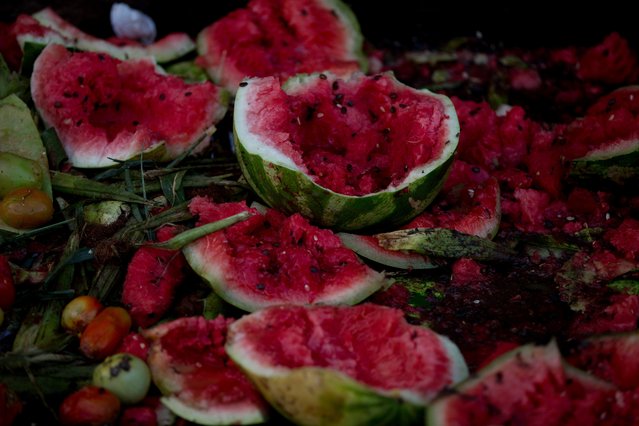
In this May 31, 2016 photo, pieces of watermelon litter the trash area of the Coche public market in Caracas, Venezuela. Staples such as corn flour and cooking oil are subsidized, costing pennies at the strongest of two official exchange rates. But fruit and vegetables have become an unaffordable luxury for many Venezuelan families. (Photo by Fernando Llano/AP Photo)

In this May 31, 2016 photo, pieces of watermelon litter the trash area of the Coche public market in Caracas, Venezuela. Staples such as corn flour and cooking oil are subsidized, costing pennies at the strongest of two official exchange rates. But fruit and vegetables have become an unaffordable luxury for many Venezuelan families. (Photo by Fernando Llano/AP Photo)
Details
08 Jun 2016 10:21:00
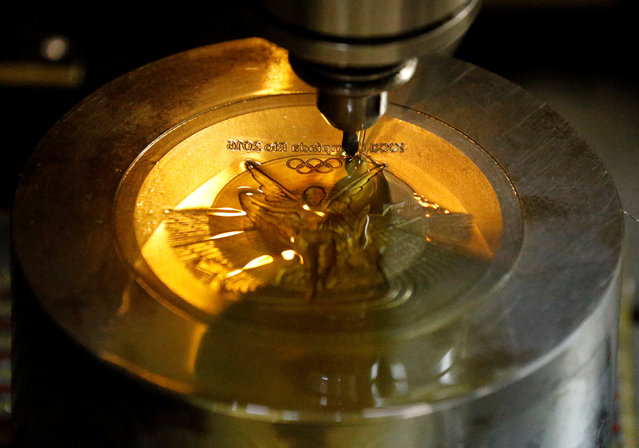
A machine works on a Rio 2016 Olympic medal at the Casa da Moeda do Brasil (Brazilian Mint) in Rio de Janeiro, Brazil, June 28, 2016. (Photo by Sergio Moraes/Reuters)

A machine works on a Rio 2016 Olympic medal at the Casa da Moeda do Brasil (Brazilian Mint) in Rio de Janeiro, Brazil, June 28, 2016. The Casa da Moeda do Brasil is the Brazilian mint, owned by the Brazilian government and administratively subordinated to the Ministry of Finances. It was established in 1694. (Photo by Sergio Moraes/Reuters)
Details
30 Jun 2016 11:31:00
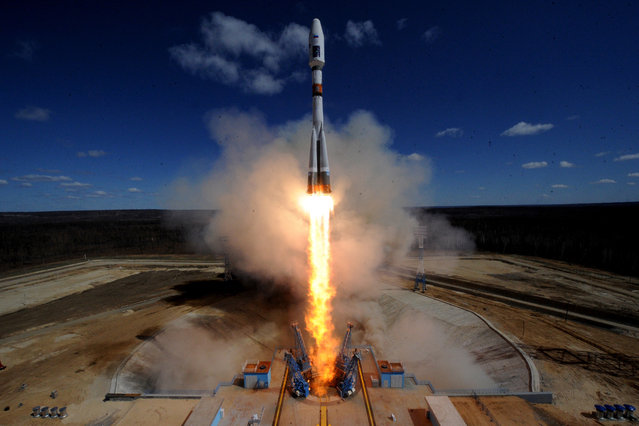
A Russian Soyuz 2.1a rocket carrying Lomonosov, Aist-2D and SamSat-218 satellites lifts off from the launch pad at the new Vostochny Cosmodrome outside the city of Uglegorsk, about 200 kilometers (125 miles) from the city of Blagoveshchensk in the far eastern Amur region Thursday, April 28, 2016. (Photo by Kirill Kudryavtsev/Pool Photo via AP Photo)

A Russian Soyuz 2.1a rocket carrying Lomonosov, Aist-2D and SamSat-218 satellites lifts off from the launch pad at the new Vostochny Cosmodrome outside the city of Uglegorsk, about 200 kilometers (125 miles) from the city of Blagoveshchensk in the far eastern Amur region Thursday, April 28, 2016. The launch of the first rocket from Russia's new space facility has been delayed after a last-minute problem. (Photo by Kirill Kudryavtsev/Pool Photo via AP Photo)
Details
28 Apr 2016 12:20:00
Black Nazarene devotees clamber on top of one another to to touch the cross on January 9, 2015 in Manila, Philippines. The Feast of the Black Nazarene culminates in a day long procession on January 9 as barefoot devotees march to see and touch the image of the Black Nazarene. (Photo by Dondi Tawatao/Getty Images)

Black Nazarene devotees clamber on top of one another to to touch the cross on January 9, 2015 in Manila, Philippines. The Feast of the Black Nazarene culminates in a day long procession on January 9 as barefoot devotees march to see and touch the image of the Black Nazarene. The Black Nazarene is a dark wood sculpture of Jesus brought to the Philippines in 1606 from Spain and considered miraculous by Filipino devotees. The event falls a week ahead of the visit of Pope Francis who will travel to Leyte and Manila during his visit to the Philippines from January 15–19. The visit is expected to attract crowds in the millions as Filipino Catholics flock to catch a glimpse of the leader of the Catholic Church. The Philippines is the only Catholic majority nation in Asia with around 90 percent of the population professing the faith. (Photo by Dondi Tawatao/Getty Images)
Details
11 Jan 2015 13:46:00
A street cleaner demonstrates his martial arts skills in front of a closed shop near Beijing's Tiananmen Square September 2, 2015 as the capital prepares for tomorrow's parade. (Photo by Damir Sagolj/Reuters)

A street cleaner demonstrates his martial arts skills in front of a closed shop near Beijing's Tiananmen Square September 2, 2015 as the capital prepares for tomorrow's parade. (Photo by Damir Sagolj/Reuters)
Details
07 Sep 2015 12:35:00
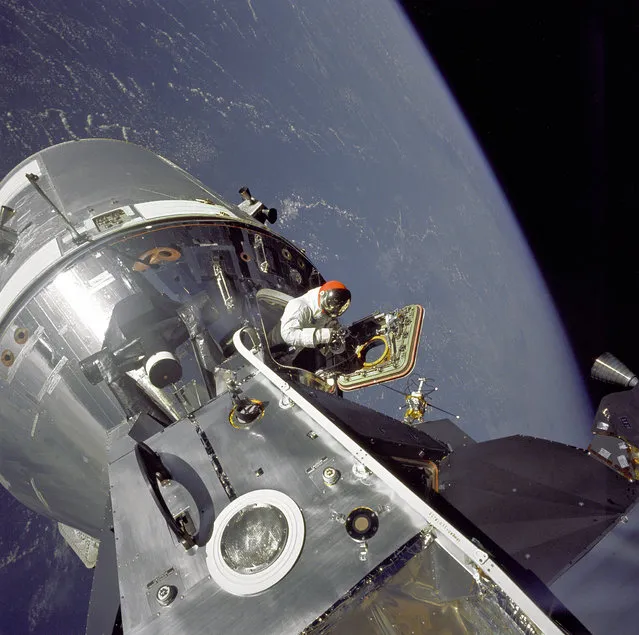
Apollo 9 Command/Service Modules (CSM) nicknamed “Gumdrop” and Lunar Module (LM), nicknamed “Spider” are shown docked together as Command Module pilot David R. Scott stands in the open hatch. Astronaut Russell L. Schweickart, Lunar Module pilot, took this photograph of Scott during his EVA as he stood on the porch outside the Lunar Module. Apollo 9 was an Earth orbital mission designed to test docking procedures between the CSM and LM as well as test fly the Lunar Module in the relative safe confines of Earth orbit. (Photo by NASA)

Apollo 9 Command/Service Modules (CSM) nicknamed “Gumdrop” and Lunar Module (LM), nicknamed “Spider” are shown docked together as Command Module pilot David R. Scott stands in the open hatch. Astronaut Russell L. Schweickart, Lunar Module pilot, took this photograph of Scott during his EVA as he stood on the porch outside the Lunar Module. Apollo 9 was an Earth orbital mission designed to test docking procedures between the CSM and LM as well as test fly the Lunar Module in the relative safe confines of Earth orbit. (Photo by NASA)
Details
20 Jul 2014 11:47:00
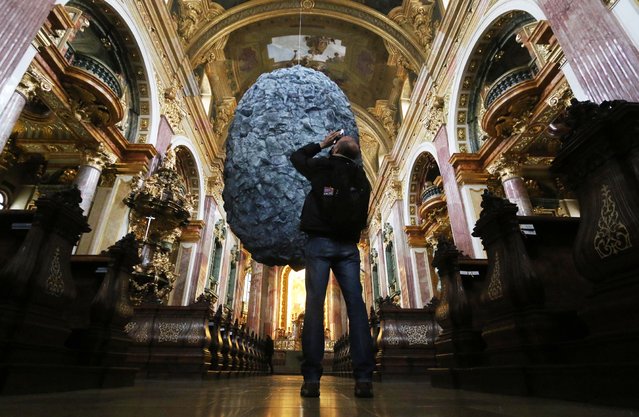
A visitor takes a photo of a boulder plastic made of synthetic material called “To be in Limbo” hangs from the ceiling of the 20 meter high Jesuit Church in Vienna, Austria, Tuesday, November 25, 2014. (Photo by Ronald Zak/AP Photo)

A visitor takes a photo of a boulder plastic made of synthetic material called “To be in Limbo” hangs from the ceiling of the 20 meter high Jesuit Church in Vienna, Austria, Tuesday, November 25, 2014. The eight meter high, hollow and 700 kilogram heavy sculpture from the artists group Steinbrener/Dempf and Huber is supposed to symbolize faith and its threatening moments. The installation will remain until April 19, 2015 and then move to a church in Hamburg, Germany. (Photo by Ronald Zak/AP Photo)
Details
29 Nov 2014 12:08:00
On August 31, 2012, a long filament of solar material that had been hovering in the sun's atmosphere, the corona, erupted out into space at 4:36 p.m. EDT. The coronal mass ejection, or CME, traveled at over 900 miles per second. The CME did not travel directly toward Earth, but did connect with Earth's magnetic environment, or magnetosphere, causing aurora to appear on the night of Monday, September 3. (Photo by NASA/GSFC/SDO)

On August 31, 2012, a long filament of solar material that had been hovering in the sun's atmosphere, the corona, erupted out into space at 4:36 p.m. EDT. The coronal mass ejection, or CME, traveled at over 900 miles per second. The CME did not travel directly toward Earth, but did connect with Earth's magnetic environment, or magnetosphere, causing aurora to appear on the night of Monday, September 3. (Photo by NASA/GSFC/SDO via The Atlantic)
Details
14 Sep 2012 09:01:00