An air tanker flies low over a wildfire burning on the edge of the Cariboo region city of Williams Lake, British Columbia, Canada on July 21, 2024. (Photo by Spencer Stratton/Handout via Reuters)
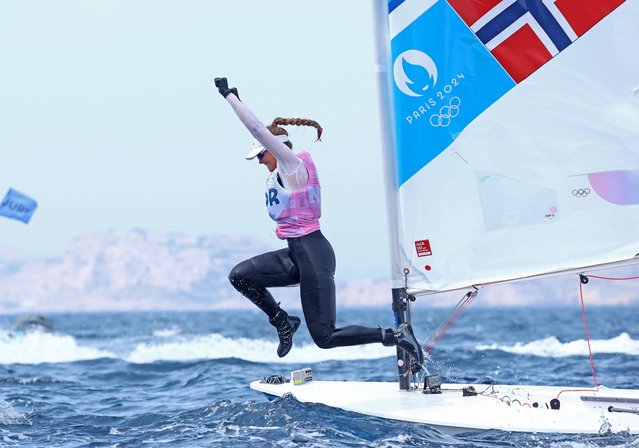
Bronze medallist Norway's Line Flem Hoest jumps into the water as she celebrates at the end of the women's ILCA 6 single-handed dinghy medal race during the Paris 2024 Olympic Games sailing competition at the Roucas-Blanc Marina in Marseille on August 7, 2024. (Photo by Lisi Niesner/Reuters)
Sweden's Sweden's Henrik von Eckermann, riding King Edward, during the Equestrian Team Jumping finals, at the 2024 Summer Olympics, Friday, August 2, 2024, in Versailles, France. (Photo by Mosa'ab Elshamy/AP Photo)
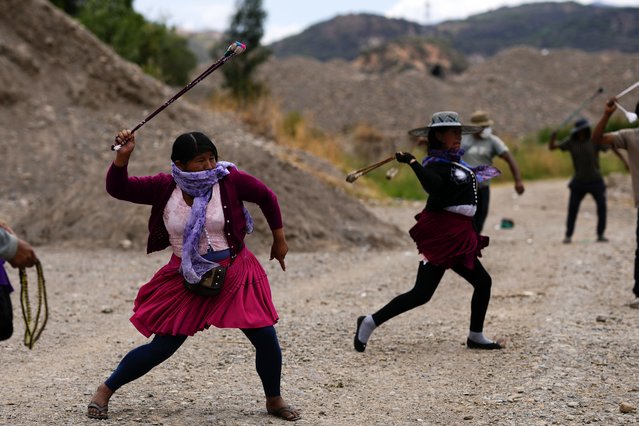
Protesters practice using slings as they block a road in support of former President Evo Morales in the face of an investigation opened against him for the alleged abuse of a minor while in office, in Parotani, Bolivia, Thursday, October 31, 2024. (Photo by Juan Karita/AP Photo)
French tennis champion Suzanne Lenglen (1899–1938) high-kicking during a doubles match at the Wimbledon Lawn Tennis Championships. (Photo by Kirby/Topical Press/Getty Images). 1924
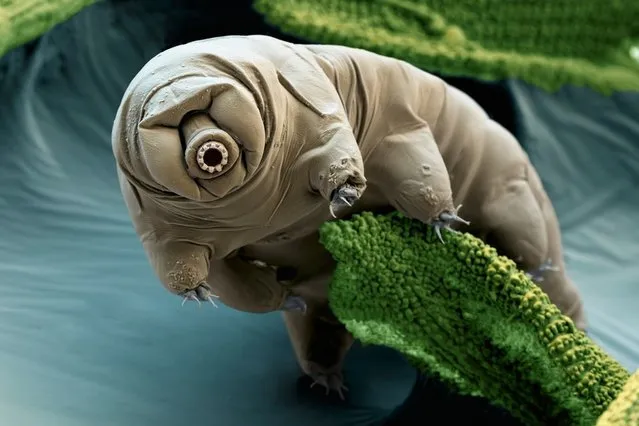
“Tardigrades (commonly known as waterbears or moss piglets) are small, water-dwelling, segmented animals with eight legs. Tardigrades were first discovered in 1773 by Johann August Ephraim Goeze, who called them kleiner Wasserbär, meaning “little water bear” in German. The name Tardigrada means “slow walker” and was given by Lazzaro Spallanzani in 1777. The name water bear comes from the way they walk, reminiscent of a bear's gait. The biggest adults may reach a body length of 1.5 millimetres (0.059 in), the smallest below 0.1 mm. Freshly hatched tardigrades may be smaller than 0.05 mm”. – Wikipedia. Photo: Tardigrades. (Photo by SPL/East News)
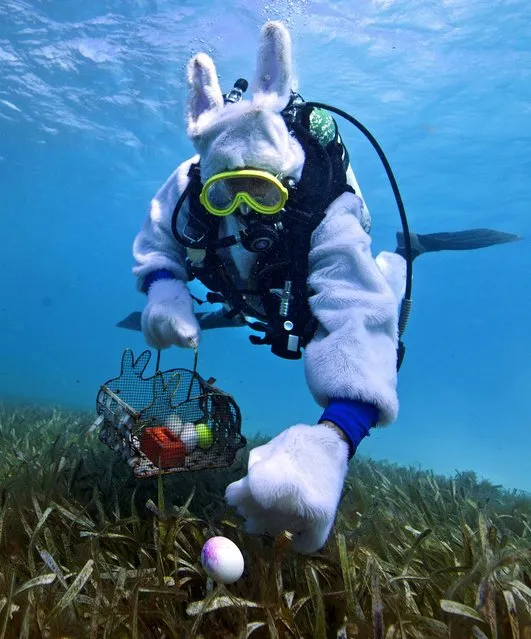
Spencer Slate, costumed as a scuba-diving Easter bunny, is shown in this handout photo provided by the Florida Keys News Bureau as he hides eggs amid eel grass, in the Florida Keys National Marine Sanctuary off Key Largo, Florida March 31, 2013. About 80 adults and children participated in an Underwater Easter Egg Hunt, seeking real hard-boiled eggs painted with non-toxic food coloring to avoid adverse effects on the marine ecosystem. (Photo by Bob Care/Reuters/Florida Keys News Bureau)