Loading...
Done
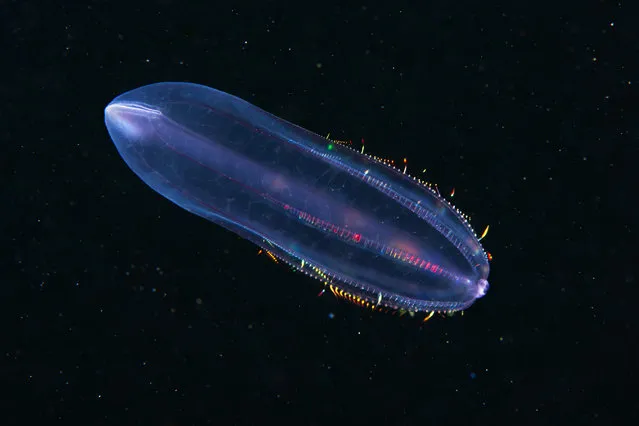
A Comb jelly – Beroe cucumis. (Photo by Alexander Semenovs/Caters News)

Underwater photographer Alexander Semenovs has snapped some of the most stunning, fragile life forms anywhere on planet Earth. Shot in deep, dark conditions, the images continue to provide an insight into what lies beneath, with glowing creatures appearing a lot like aliens in the pitch-black water. Semenovs has shot the likes of bioluminescent jellyfish, aggressive-looking worms and many species that leave a lot to the imagination. The 30-year-old from Moscow does the majority of his work in the White Sea, near the Arctic Circle. Here: A Comb jelly – Beroe cucumis. (Photo by Alexander Semenovs/Caters News)
Details
23 Nov 2015 08:06:00
We Build Tomorrow – Sagrada Familia 2026 ( VIDEO )

For more than a century, the Barcelona skyline has been graced (or marred, depending on who’s talking) by the spectacle of the Basilica designed by Anton Gaudi, first started in 1882. If you want to know what it’ll look like when finished, don’t fret — 2026 is right around the corner. Or you can watch this video, released last week on YouTube by Basílica de la Sagrada Família and titled simply “2026 We Build Tomorrow,” a 3-D artists’ rendering of the building stages through completion.
(If 144 years sounds like a long time to finish a cathedral, keep in mind that there were decades that they didn’t work on it — and that Notre Dame de Paris took 182 years, although the 13th century Parisians didn’t have diesel-powered industrial cranes.) Now, if only the video could show us what the admission and hours will be in 2026 (and how to avoid the inevitable long lines).
Details
11 Jan 2014 10:59:00
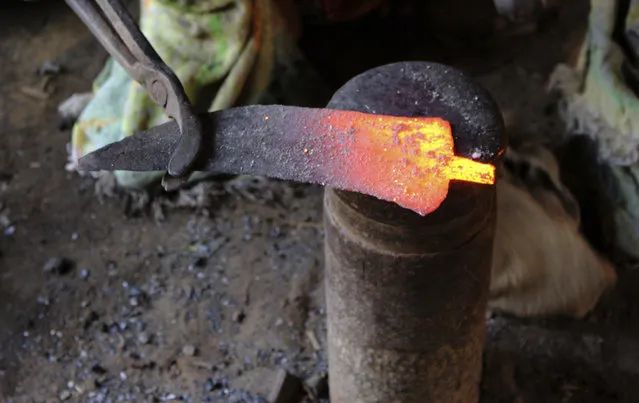
In this October 6, 2018, photo, a craftsman makes daggers or “Jambiyya” in Yemeni Arabic, made out of remains of missiles, at his workshop, in Hajjah, Yemen. (Photo by Hammadi Issa/AP Photo)

In this October 6, 2018, photo, a craftsman makes daggers or “Jambiyya” in Yemeni Arabic, made out of remains of missiles, at his workshop, in Hajjah, Yemen. Missiles raining on Yemen from the jets of the Saudi-led coalition fighting Houthi rebels are killing thousands of civilians and militiamen alike, but amid crashing economy, some Yemenis see the bright side of it: they make daggers out of the fragments of the missiles for ordinary men traditionally wear for prestige and a show of courage. (Photo by Hammadi Issa/AP Photo)
Details
10 Oct 2018 00:01:00
Ice cream cone head. (Photo by James Ostrer/Caters News)

“An artist has slammed junk food culture by creating shocking portraits of models covered in burgers, fries and even ketchup. Some of James Ostrer’s pictures resemble one of Willy Wonka’s nightmares as he uses liquorice for eyes and strawberry bootlaces for hair. In others, the 35-year-old smears his models’ faces with tears of ketchup and uses burgers, fries and sausages for facial features. James made the mouth-watering monstrosities to show the rampant consumption of junk food and how it affects our moods”. – Caters News
Details
15 Aug 2014 09:29:00
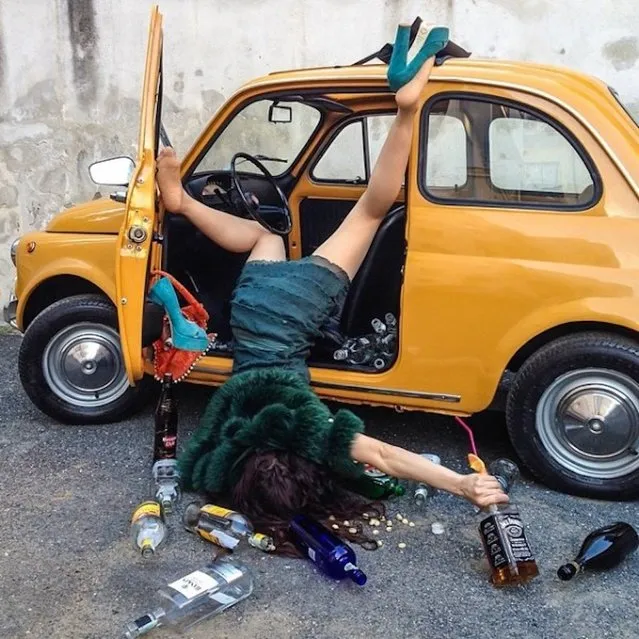
In Extremis By Sandro Giordano

There is something strangely appealing about the set of pictures created by Sandro Giordano in a series “In Extremis (Bodies With No Regret)”. Could it be the absurdity of the situation? Or the fact that our brain tries to make up some bizarre story to justify what is happening in the pictures? Of course it is impossible to explain why a pair of tennis players ended up lying flat on the ground with a pack of bananas hanging on the net, even if we forget about the tennis racket lodged in the neck of one of the players. Nevertheless, it is fun to recreate these scenes in your mind just seconds before the tragedy took place. (Photo by Sandro Giordano)
Details
18 Oct 2014 07:09:00
A visitor looks at a Morris Mini-Minor Car on display at the Victoria and Albert museums' new major exhibition

A visitor looks at a Morris Mini-Minor Car on display at the Victoria and Albert museums' new major exhibition, “British Design 1948-2012: Innovation In The Modern Age” on March 28, 2012 in London, England. This car, which was designed by Alec Issigonis, was the first one off the production line. The exhibition showcases some of the most iconic product design, fashion, furniture, graphics, architecture and fine art from the last 60 years, and opens to the public from March 31, 2012. (Photo by Dan Kitwood/Getty Images)
Details
31 Mar 2012 09:56:00
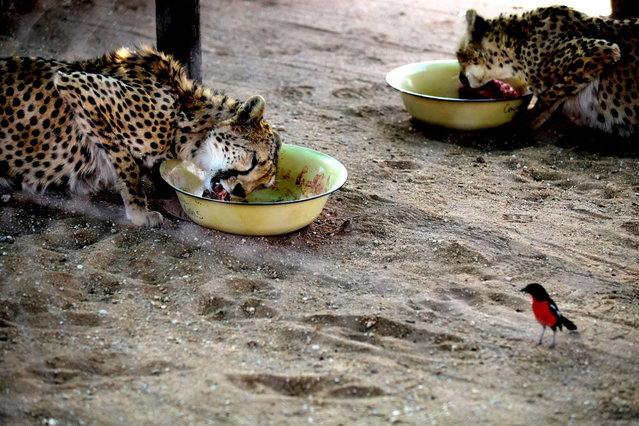
Young cheetahs eat meat at The Cheetah Conservation Fund (CCF) center in Otjiwarongo, Namibia, on August 13, 2013. The CCF started breeding Anatolian livestock dogs to promote cheetah-friendly farming after some 10,000 big cats – the current total worldwide population – were killed or moved off farms in the 1980s.  Up to 1,000 cheetahs were being killed a year, mostly by farmers who saw them as livestock killers. But the use of dogs has slashed losses for sheep and goat farmers and led to less retaliation against the vulnerable cheetah. (Photo by Jennifer Bruce/AFP Photo)

Young cheetahs eat meat at The Cheetah Conservation Fund (CCF) center in Otjiwarongo, Namibia, on August 13, 2013. The CCF started breeding Anatolian livestock dogs to promote cheetah-friendly farming after some 10,000 big cats – the current total worldwide population – were killed or moved off farms in the 1980s. Up to 1,000 cheetahs were being killed a year, mostly by farmers who saw them as livestock killers. But the use of dogs has slashed losses for sheep and goat farmers and led to less retaliation against the vulnerable cheetah. (Photo by Jennifer Bruce/AFP Photo)
Details
29 Aug 2013 10:56:00
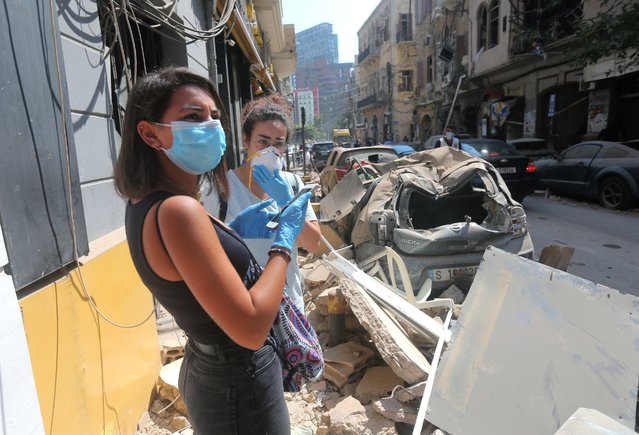
Young Lebanese women wearing protective masks and gloves against the coronavirus pandemic, stand on August 5, 2020 amid the rubble in Beirut's Gimmayzeh commercial district which was heavily damaged by the previous day's powerful explosion that tore through Lebanon's capital, resulting from the ignition of a huge depot of ammonium nitrate at the city's main port. Rescuers searched for survivors in Beirut after a cataclysmic explosion at the port sowed devastation across entire neighbourhoods, killing more than 100 people, wounding thousands and plunging Lebanon deeper into crisis. The blast, which appeared to have been caused by a fire igniting 2,750 tonnes of ammonium nitrate left unsecured in a warehouse, was felt as far away as Cyprus, some 150 miles (240 kilometres) to the northwest. (Photo by AFP Photo/Stringer)

Young Lebanese women wearing protective masks and gloves against the coronavirus pandemic, stand on August 5, 2020 amid the rubble in Beirut's Gimmayzeh commercial district which was heavily damaged by the previous day's powerful explosion that tore through Lebanon's capital, resulting from the ignition of a huge depot of ammonium nitrate at the city's main port. Rescuers searched for survivors in Beirut after a cataclysmic explosion at the port sowed devastation across entire neighbourhoods, killing more than 100 people, wounding thousands and plunging Lebanon deeper into crisis. The blast, which appeared to have been caused by a fire igniting 2,750 tonnes of ammonium nitrate left unsecured in a warehouse, was felt as far away as Cyprus, some 150 miles (240 kilometres) to the northwest. (Photo by AFP Photo/Stringer)
Details
10 Aug 2020 00:05:00