Loading...
Done


“The Range Rover Evoque is a compact hatchback in production since 2011 from Land Rover. The production model was announced on July 1, 2010, and it designed to address the requirement for reduced CO2 emissions. A near production concept of the crossover SUV was unveiled at the North American International Auto Show as the Land Rover LRX in January 2008, and production began in 2011”. – Wikipedia

Photo: George Lamb attends the launch of the new Range Rover Evoque at Halewood Operations at Jaguar Land Rover on July 4, 2011 in Liverpool, England. The Range Rover Evoque started production on July 4th at Halewood Operations. (Photo by Ian Gavan/Getty Images for Range Rover)
Details
06 Jul 2011 10:31:00
People visit an art installation “Alley of Flying Umbrellas” in central St. Petersburg, Russia, May 15, 2015. Art installation inspired by “Umbrella Sky Project” of Portuguese town of Agueda and was made of 500 colored umbrellas. (Photo by Anatoly Maltsev/EPA)

People visit an art installation “Alley of Flying Umbrellas” in central St. Petersburg, Russia, May 15, 2015. Art installation inspired by “Umbrella Sky Project” of Portuguese town of Agueda and was made of 500 colored umbrellas. (Photo by Anatoly Maltsev/EPA)
Details
19 May 2015 12:13:00
Extreme On Water By Kurt Arrigo

Kurt Arrigo is Malta’s most eminent and one of the world’s finest marine photographers. ­­His illustrious and diverse career has seen him capture dramatic action at elite international sporting events.
Details
24 Aug 2015 10:22:00
Revelers dance at the Old Settler's Music Festival in Driftwood, Texas, U.S. on April 22, 2017. (Photo by Mohammad Khursheed/Reuters)

Revelers dance at the Old Settler's Music Festival in Driftwood, Texas, U.S. on April 22, 2017. (Photo by Mohammad Khursheed/Reuters)
Details
23 Apr 2017 09:04:00
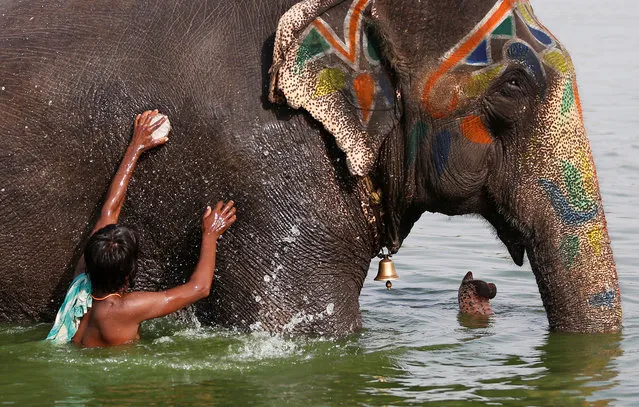
A mahout bathes his elephant in the river Sabarmati on a hot summer day in Ahmedabad, India May 21, 2017. (Photo by Amit Dave/Reuters)

A mahout bathes his elephant in the river Sabarmati on a hot summer day in Ahmedabad, India May 21, 2017. (Photo by Amit Dave/Reuters)
Details
31 May 2017 06:42:00
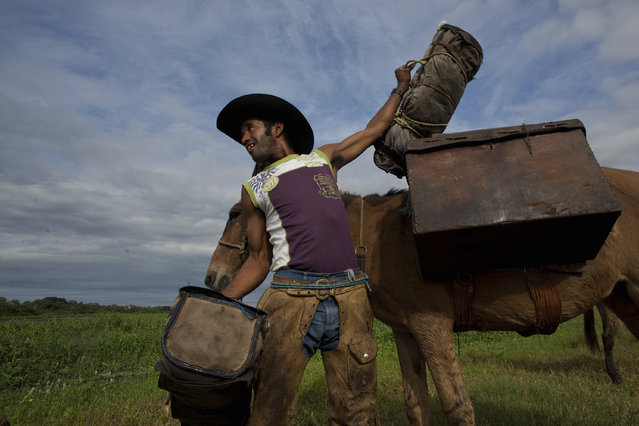
In this May 17, 2017 photo, cowboy cook Odair Batista carries a case with food in Corumba, the Pantanal wetlands of Mato Grosso do Sul state, Brazil. Dressed with leather chaps on top of their jeans, stetson hats and a machete attached to their waists, before setting off, the men finish their breakfast with Terere, an herbal “mate” beverage served ice cold in an ox drinking horn. (Photo by Eraldo Peres/AP Photo)

In this May 17, 2017 photo, cowboy cook Odair Batista carries a case with food in Corumba, the Pantanal wetlands of Mato Grosso do Sul state, Brazil. Dressed with leather chaps on top of their jeans, stetson hats and a machete attached to their waists, before setting off, the men finish their breakfast with Terere, an herbal “mate” beverage served ice cold in an ox drinking horn. (Photo by Eraldo Peres/AP Photo)
Details
12 Jun 2017 09:00:00
A general view of atmosphere at the annual VOLT Festival in Sopron, 208 kms west of Budapest, Hungary on June 30, 2017. (Photo by Sandor Csudai/Rockstar Photographers)

A general view of atmosphere at the annual VOLT Festival in Sopron, 208 kms west of Budapest, Hungary on June 30, 2017. (Photo by Sandor Csudai/Rockstar Photographers)
Details
03 Jul 2017 09:00:00
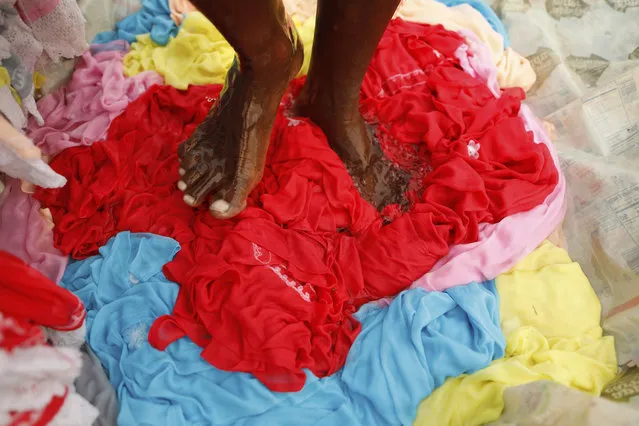
A dhobi, or a washerman washes cloths on the banks of the River Gomti in Lucknow, India, Saturday, September 12, 2020. Dhobis are traditional laundry workers who wash clothes by hand and dry them in the sun, an occupation which has been in existence for generations. Most cities in India have a Dhobi Ghat, or washermen's area, where the city's pile of clothes is laundered. This practice is still popular in India, despite of modern technology. Around 1,000 families work in Lucknow's Dhobi Ghat. However, in light of the novel coronavirus, their wages have decreased drastically. With each family earning around US$100-200 per month. (Photo by Rajesh Kumar Singh/AP Photo)

A dhobi, or a washerman washes cloths on the banks of the River Gomti in Lucknow, India, Saturday, September 12, 2020. Dhobis are traditional laundry workers who wash clothes by hand and dry them in the sun, an occupation which has been in existence for generations. Most cities in India have a Dhobi Ghat, or washermen's area, where the city's pile of clothes is laundered. This practice is still popular in India, despite of modern technology. Around 1,000 families work in Lucknow's Dhobi Ghat. However, in light of the novel coronavirus, their wages have decreased drastically. With each family earning around US$100-200 per month. (Photo by Rajesh Kumar Singh/AP Photo)
Details
25 Sep 2020 00:03:00