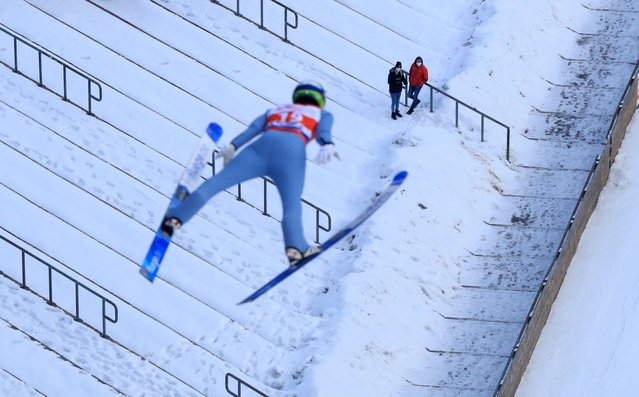
Spectators watch Austria's Stefan Kraft in action during the Viessmann FIS Ski Jumping World Cup Willingen on January 31, 2021 in Willingen, Germany. (Photo by Wolfgang Rattay/Reuters)
Runners wearing full solid-coloured bodysuits take part in a marathon in Tel Aviv, Israel February 26, 2016. Tens of thousands took part in the event, which saw streets closed off from Rokach Boulevard in the north to Jaffa’s Jerusalem Boulevard in the south. Other than the main 42-kilometer (26-mile) run, the day’s events also included a half-marathon route, several shorter circuits, a handcycle race for the handicapped and a mini-marathon for kids of a single kilometer (0.6 miles). (Photo by Amir Cohen/Reuters)
In this Sunday, February 22, 2015 file photo, Matthias Mayer of Austria, the winner, is airborne during an alpine ski World Cup men's super-G event, in Saalbach Hinterglemm, Austria. (Photo by Giovanni Auletta/AP Photo)
Giulia Steingruber of Switzerland competes in the Vault apparatus final during day nine of the Artistic Gymnastics World Championships Tokyo 2011 at Tokyo Metropolitan Gymnasium on October 15, 2011 in Tokyo, Japan. (Photo by Adam Pretty/Getty Images)
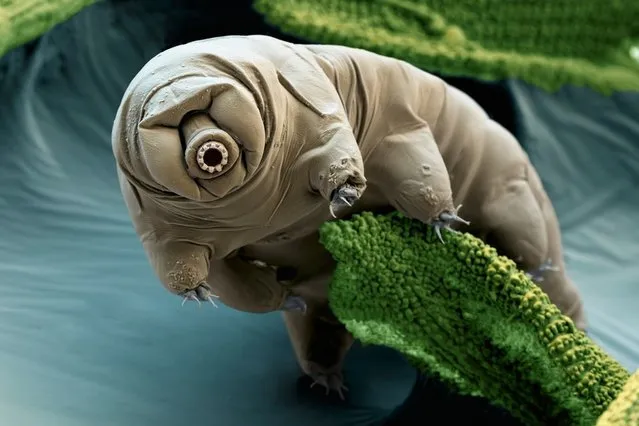
“Tardigrades (commonly known as waterbears or moss piglets) are small, water-dwelling, segmented animals with eight legs. Tardigrades were first discovered in 1773 by Johann August Ephraim Goeze, who called them kleiner Wasserbär, meaning “little water bear” in German. The name Tardigrada means “slow walker” and was given by Lazzaro Spallanzani in 1777. The name water bear comes from the way they walk, reminiscent of a bear's gait. The biggest adults may reach a body length of 1.5 millimetres (0.059 in), the smallest below 0.1 mm. Freshly hatched tardigrades may be smaller than 0.05 mm”. – Wikipedia. Photo: Tardigrades. (Photo by SPL/East News)
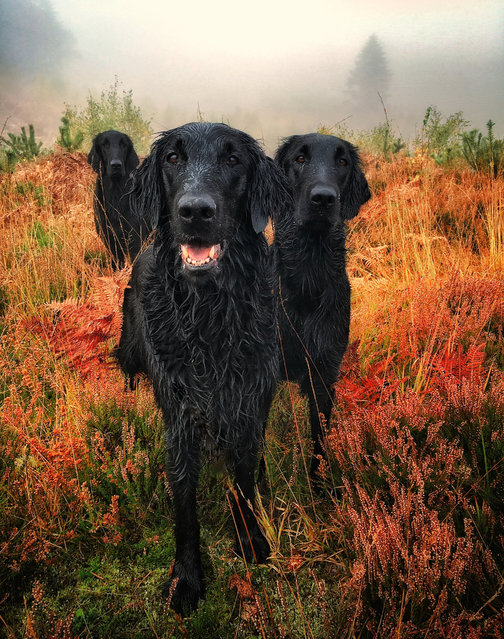
First place, Portrait. Three flat-coated retrievers – Crew, Darcie and Pagan – by Carol Durrant from the UK. (Photo by Carol Durrant/Dog Photographer of the Year 2018)