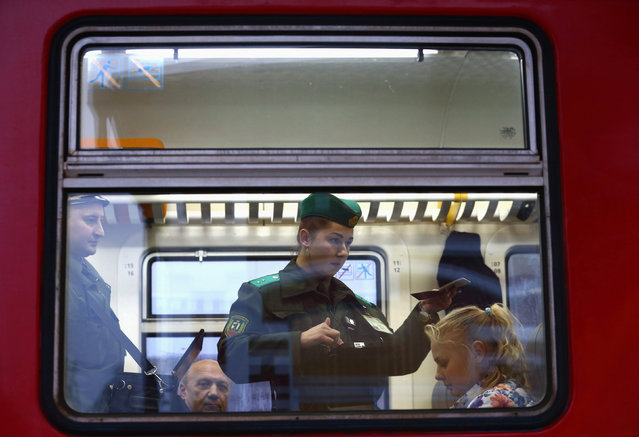
A Belarussian border guard checks a passenger's passport in a train after it arrived from Lithuania, at the railway station Gudogai, Belarus, November 22, 2016. (Photo by Vasily Fedosenko/Reuters)
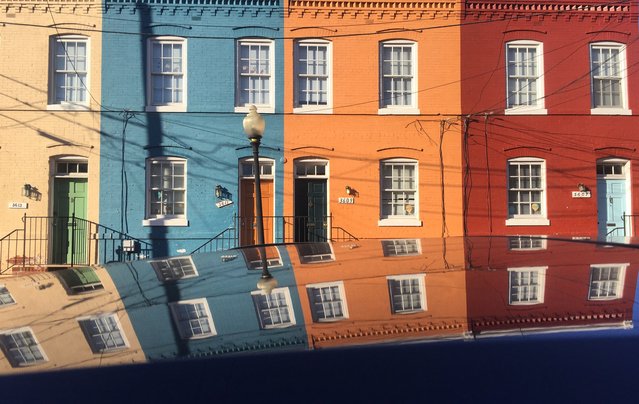
A group of colorful row houses are reflected on to the top of a black car parked on 3600 block of N street in the Georgetown section of Washington DC, February 16, 2017. (Photo by John McDonnell/The Washington Post)
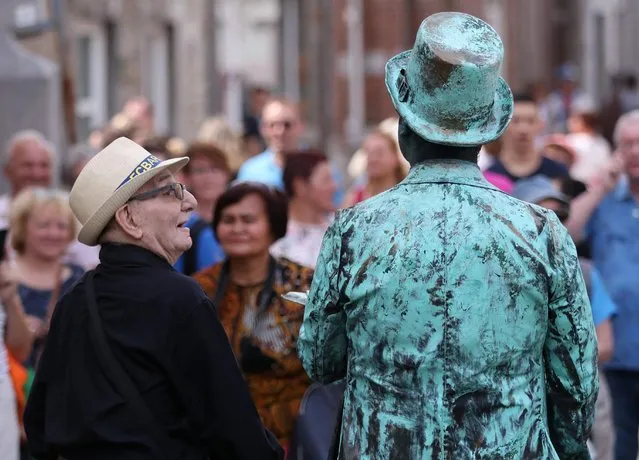
An artist takes part in the festival “Statues en Marche” in Marche-en-Famenne, Belgium, July 20, 2019. Living statues are a common sight in many city centers, but it is rare to see such a diverse range of this peculiar form of street art for which performers must keep still for painfully long periods of time to create the desired illusion. (Photo by Yves Herman/Reuters)
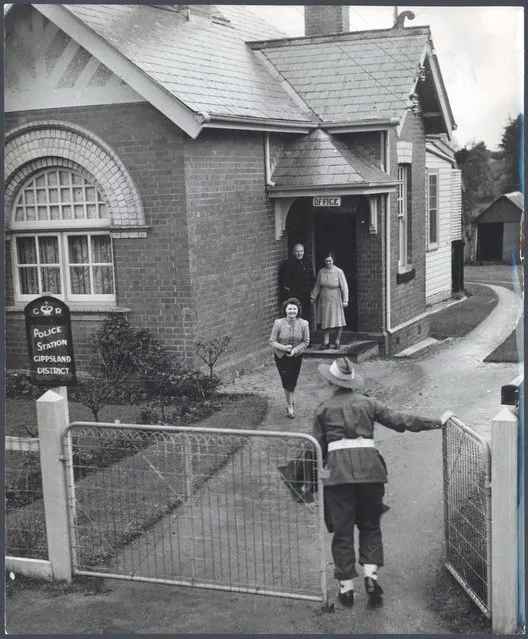
Private Wallace Tratford arrives home on leave, Drouin, Victoria, ca. 1944. A.I.F. Private Wallace Tratford, son of 1st Constable James Tratford, Drouin's only policeman (responsible for area of 105 square miles; 3,000 people), arrives home on his first leave from New Guinea battlefronts since he was married.
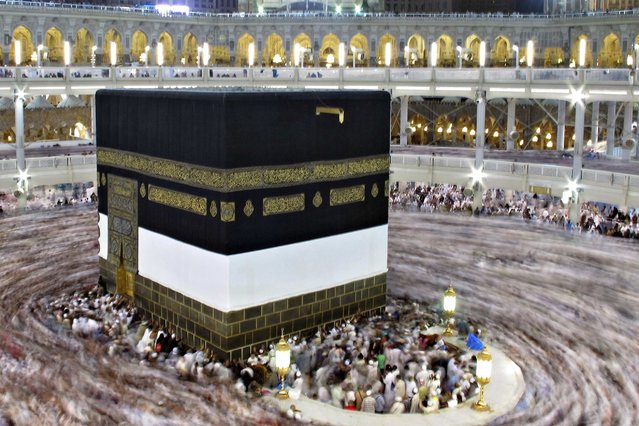
Muslim pilgrims pray around the holy Kaaba at the Grand Mosque, during the annual haj pilgrimage in Mecca September 30, 2014. (Photo by Muhammad Hamed/Reuters)
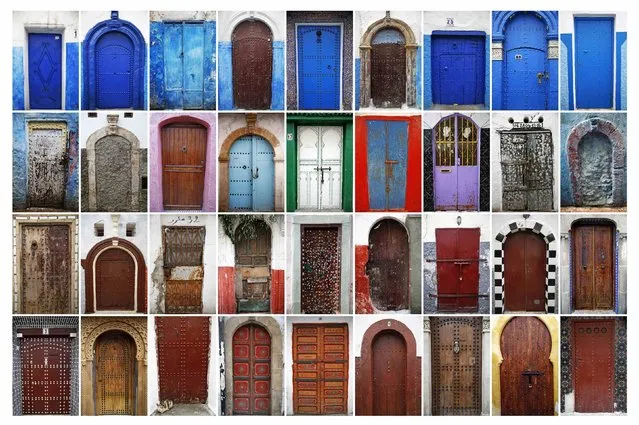
A combination photo shows some of the colourful doors seen in Rabat's Medina and Kasbah of the Udayas, September 2014. UNESCO made Rabat a World Heritage Site two years ago and media and tour operators call it a “must-see destination”. But it seems the tourist hordes have yet to find out. While visitors are getting squeezed through the better-known sites of Marrakesh and Fez, the old part of Rabat - with its beautiful Medina and Kasbah of the Udayas - remains an almost unspoiled oasis of calm. Smaller and more compact, its labyrinths of streets, passages and dead ends are a treasure trove of shapes and colours, of moments begging to be caught by the photographer's lens. (Photo by Damir Sagolj/Reuters)