Loading...
Done
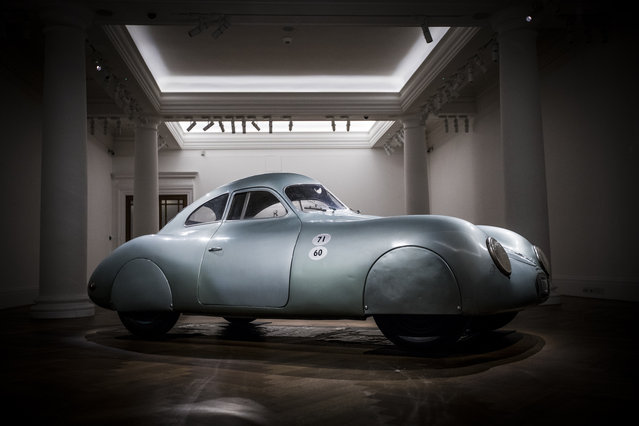
The oldest car to wear the Porsche badge goes on view at Sotheby's on May 21, 2019 in London, England. The only surviving 1939 Porsche Type 64 Berlin-Rome, No. 3, this rare piece of motoring history was the personal car of Ferdinand and Ferry Porsche, predating the first production Porsche, the 356. The car is on view at Sotheby's in London from 21st -24th May prior to being offered for sale by RM Sotheby's in Monterey, California, 15-17th August 2019, with an estimate in excess of $20 million. (Photo by Tristan Fewings/Getty Images for Sotheby's)

The oldest car to wear the Porsche badge goes on view at Sotheby's on May 21, 2019 in London, England. The only surviving 1939 Porsche Type 64 Berlin-Rome, No. 3, this rare piece of motoring history was the personal car of Ferdinand and Ferry Porsche, predating the first production Porsche, the 356. The car is on view at Sotheby's in London from 21st -24th May prior to being offered for sale by RM Sotheby's in Monterey, California, 15-17th August 2019, with an estimate in excess of $20 million. (Photo by Tristan Fewings/Getty Images for Sotheby's)
Details
23 May 2019 00:07:00
Runners wearing full solid-coloured bodysuits take part in a marathon in Tel Aviv, Israel February 26, 2016. Tens of thousands took part in the event, which saw streets closed off from Rokach Boulevard in the north to Jaffa’s Jerusalem Boulevard in the south. Other than the main 42-kilometer (26-mile) run. (Photo by Amir Cohen/Reuters)

Runners wearing full solid-coloured bodysuits take part in a marathon in Tel Aviv, Israel February 26, 2016. Tens of thousands took part in the event, which saw streets closed off from Rokach Boulevard in the north to Jaffa’s Jerusalem Boulevard in the south. Other than the main 42-kilometer (26-mile) run, the day’s events also included a half-marathon route, several shorter circuits, a handcycle race for the handicapped and a mini-marathon for kids of a single kilometer (0.6 miles). (Photo by Amir Cohen/Reuters)
Details
27 Feb 2016 10:29:00


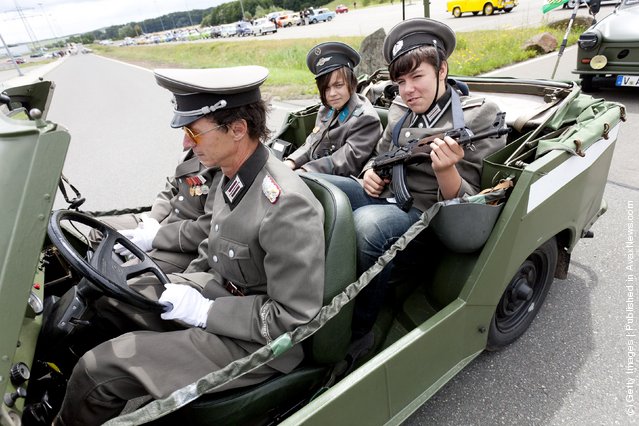
“The Trabant is a car that was produced by former East German auto maker VEB Sachsenring Automobilwerke Zwickau in Zwickau, Sachsen. It was the most common vehicle in East Germany, and was also exported to countries both inside and outside the communist bloc. The main selling points was that it had room for four adults and luggage in a compact, light and durable shell and that it was fast (when introduced) and durable. With its mediocre performance, smoky two-stroke engine, and production shortages, the Trabant is often cited as an example of the disadvantages of centralized planning; on the other hand, it is regarded with derisive affection as a symbol of the failed former East Germany and of the fall of communism (in former West Germany, as many East Germans streamed into West Berlin and West Germany in their Trabants after the opening of the Berlin Wall in 1989). It was in production without any significant changes for nearly 30 years with 3,096,099 Trabants produced in total”. – Wikipedia

Photo: Enthusiasts weared in uniforms of the former eastern german army trive in a military Trabant car as fans and owners of East German-era Trabant cars gather at the 2011 International Trabantfahrer Treffen (International Trabant Drivers Meeting) on June 26, 2011 in Zwickau, Germany. The Trabant, also known as the Trabi, was among the main cars produced in communist East Germany and built by VEB Sachsenring Automobilwerke in Zwickau for 30 years until 1989. Today the car has cult status for many followers and one company, IndiKar, is even seeking to revive the brand in a modern, electric version. (Photo by Carsten Koall/Getty Images)

Details
27 Jun 2011 12:21:00
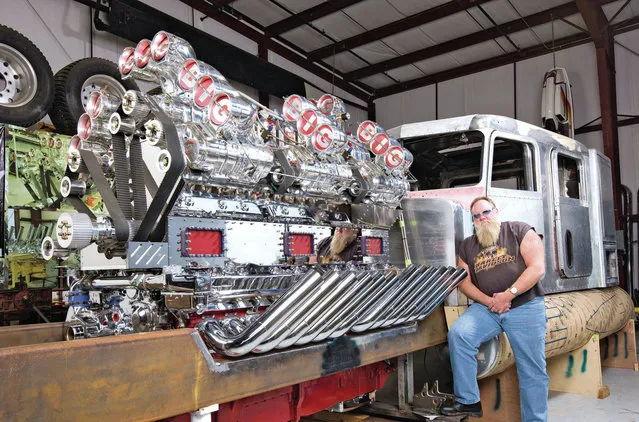
Supercharged 24 Cylinder Engine

This thing has 24 cylinders, 1,704 cubic inches, 12 GMC superchargers (blowers), 8 nitrous bottles and it runs! Why build such a beast? “Because I can,” Harrah says. There’s no other reason to take a 24V71 and build an intake manifold that weighs 1,000 pounds and mount eight 6-71 superchargers on top of four others. This is a V24 Detroit Diesel (normally used to power ships) which is two V12 Detroits joined together nose to nose with splined cranks.
Details
26 Aug 2014 18:40:00
A sugar cane worker poses while working in a field at Pakchong district in Ratchaburi province, Thailand March 22, 2016. (Photo by Jorge Silva/Reuters)

A sugar cane worker poses while working in a field at Pakchong district in Ratchaburi province, Thailand March 22, 2016. The El Nino weather phenomenon has played havoc with crops across Southeast Asia and beyond. Thailand, the world's second-largest sugar exporter, will ship 20 percent less of the sweetener to international markets this year than last, and farmers fear the damage already inflicted on young cane plants could make next year worse. (Photo by Jorge Silva/Reuters)
Details
02 Apr 2016 09:49:00
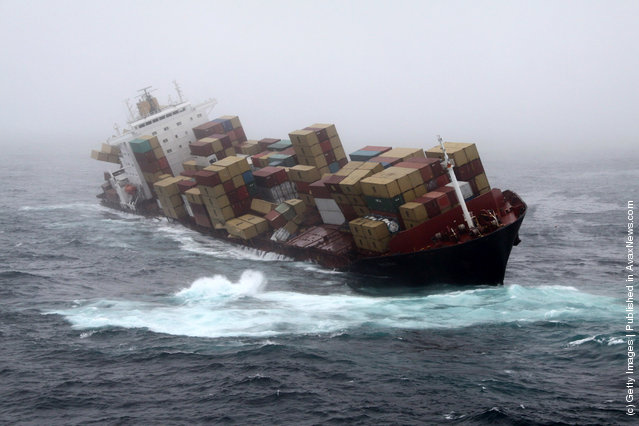
Authorities Fear MV Rena May Break-Up In Rough Seas

In this handout provided by Maritime New Zealand, MV Rena is battered by strong seas as it is stuck on Astrolabe Reef, on November 2, 2011 in Tauranga, New Zealand. The stricken vessel encountered a three metre swell, which led authorities to fear it may finally break up. Rena struck the reef on October 5, and has spilled 350 tonnes of oil, and almost 100 shipping containers. (Photo by Graeme Brown/Maritime New Zealand via Getty Images)
Details
02 Nov 2011 10:50:00
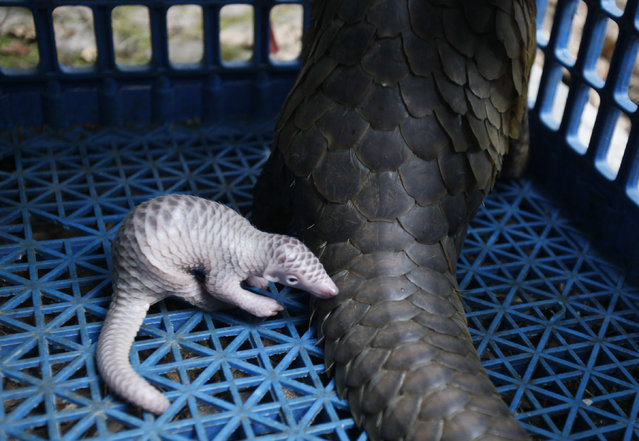
A baby pangolin sits with its mother inside a cage prior to their release into the wild in Sibolangit, North Sumatra, Indonesia, Monday, April 27, 2015. (Photo by Binsar Bakkara/AP Photo)

A baby pangolin sits with its mother inside a cage prior to their release into the wild in Sibolangit, North Sumatra, Indonesia, Monday, April 27, 2015. The anteaters are part of dozens of live pangolins and around five tons (11,000 lbs) of pangolin meat ready to be shipped abroad confiscated in a police a raid last week. (Photo by Binsar Bakkara/AP Photo)
Details
29 Apr 2015 06:16:00
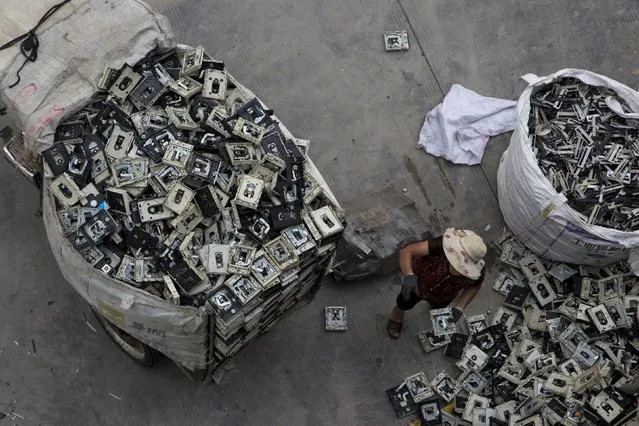
A worker distributes electronic waste at a government managed recycling centre at the township of Guiyu in China's southern Guangdong province June 10, 2015. (Photo by Tyrone Siu/Reuters)

A worker distributes electronic waste at a government managed recycling centre at the township of Guiyu in China's southern Guangdong province June 10, 2015. The town of Guiyu in the economic powerhouse of Guangdong province in China has long been known as one of the world’s largest electronic waste dump sites. At its peak, some 5,000 workshops in the village recycle 15,000 tonnes of waste daily including hard drives, mobile phones, computer screens and computers shipped in from across the world. (Photo by Tyrone Siu/Reuters)
Details
04 Jul 2015 10:28:00