Loading...
Done
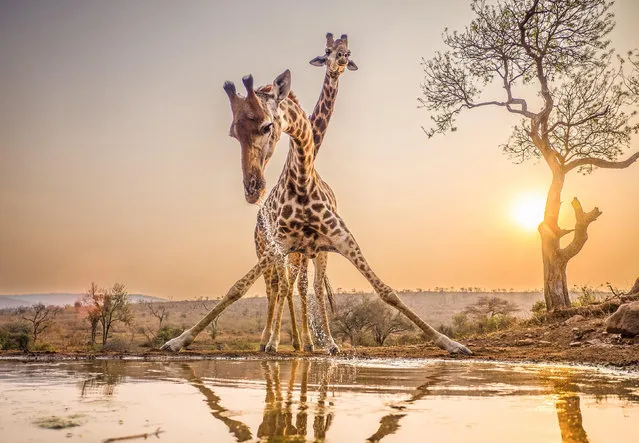
A giraffe appears almost to be doing the splits as it bends to drink at a watering hole on a reserve in Mkuze, South Africa in September 2023. (Photo by Peter Batty/Solent News)

A giraffe appears almost to be doing the splits as it bends to drink at a watering hole on a reserve in Mkuze, South Africa in September 2023. (Photo by Peter Batty/Solent News)
Details
27 Dec 2023 20:10:00
Sandstone sculpted by water and wind erosion is seen in a slot canyon, one of hundreds that surround Lake Powell near Page, Arizona, May 26, 2015. (Photo by Rick Wilking/Reuters)

Sandstone sculpted by water and wind erosion is seen in a slot canyon, one of hundreds that surround Lake Powell near Page, Arizona, May 26, 2015. Lake Powell on the Colorado River provides water for Nevada, Arizona and California. A severe drought in recent years, combined with withdrawals that many believe are not sustainable, has reduced its levels to only about 42 percent of its capacity. (Photo by Rick Wilking/Reuters)
Details
26 Nov 2015 08:01:00
Residents cross over an improvised bridge after a landslide sent mud and water crashing onto homes close to the municipality of Salgar in Antioquia department, Colombia May 19, 2015. (Photo by Jose Miguel Gomez/Reuters)

Residents cross over an improvised bridge after a landslide sent mud and water crashing onto homes close to the municipality of Salgar in Antioquia department, Colombia May 19, 2015. A landslide sent mud and water crashing onto homes in a town in Colombia's northwest mountains on Monday, killing at least 50 people and injuring dozens, officials said. (Photo by Jose Miguel Gomez/Reuters)
Details
20 May 2015 09:15:00
Camel herders scoop up water in plastic buckets from one of the few watering holes in the area, to water their animals near the drought-affected village of Bandarero, near Moyale town on the Ethiopian border, in northern Kenya, Friday, March 3, 2017. The U.N. humanitarian chief, Stephen O'Brien, toured Bandarero village on Friday and called on the international community to act to “avert the very worst of the effects of drought and to avert a famine to make sure we don't go from what is deep suffering to a catastrophe”. (Photo by Ben Curtis/AP Photo)

Camel herders scoop up water in plastic buckets from one of the few watering holes in the area, to water their animals near the drought-affected village of Bandarero, near Moyale town on the Ethiopian border, in northern Kenya, Friday, March 3, 2017. The U.N. humanitarian chief, Stephen O'Brien, toured Bandarero village on Friday and called on the international community to act to “avert the very worst of the effects of drought and to avert a famine to make sure we don't go from what is deep suffering to a catastrophe”. (Photo by Ben Curtis/AP Photo)
Details
05 Mar 2017 00:03:00
The Weird Shaped Trees Of Axel Erlandson

Axel Erlandson (December 15, 1884 – April 28, 1964) was a Swedish American farmer who shaped trees as a hobby, and opened a horticultural attraction in 1947 advertised as "See the World's Strangest Trees Here," and named "The Tree Circus."
The trees appeared in the column of Robert Ripley's Believe It or Not! twelve times. Erlandson sold his attraction shortly before his death. The trees were moved to Gilroy Gardens in 1985.
Details
20 Sep 2013 11:38:00


Retired teacher Geoff Ostling displays his tattooed skin at a portrait session at his home in Petersham on May 11, 2009 in Sydney, Australia. The 62-year old has pledged to donate his skin to the National Gallery in Canberra after his death. Ostling, who did not get his first tattoo until he was in his forties, is now covered in the artwork by artist eX de Merci from neck to ankle with the theme 'all the flowers of a Sydney garden'. (Photo by Lisa Maree Williams/Getty Images)
Details
15 Jun 2011 10:22:00
“The champage encounter”. (Photo by Max Ellis/Caters News)

“Photographer Max Ellis has become an internet star – after posting wacky photos of squirrels in hilarious situations, from being sent flying through the air in fear by a Buckaroo to lifting weights. Max places his self-made creations in his garden in Teddington, London, and then painstakingly waits hours – and sometimes days – for his subjects to get into the exact position to capture his shot. In another scene an inquisitive squirrel is sent backwards in surprise as a bottle of champagne pops its cork and in others a squirrel appears to saw his friend in half just like the famous magic trick”. – Caters News
Details
09 May 2014 11:03:00


“The aye-aye (Daubentonia madagascariensis) is a lemur, a strepsirrhine primate native to Madagascar that combines rodent-like teeth and a special thin middle finger to fill the same ecological niche as a woodpecker. It is the world's largest nocturnal primate, and is characterized by its unusual method of finding food; it taps on trees to find grubs, then gnaws holes in the wood and inserts its narrow middle finger to pull the grubs out. The only other animal species known to find food in this way is the striped possum. From an ecological point of view the aye-aye fills the niche of a woodpecker as it is capable of penetrating wood to extract the invertebrates within”. – Wikipedia

Photo: In this handout image from Bristol Zoo is seen the first captive bred aye-aye in the UK named “Kintana” (meaning star in Malagasy) April 15, 2005 at Bristol Zoo Gardens, England. The zoo announced today only the second baby aye-aye to be hand-reared in the world (the first was in Jersey Zoo) and has now made his first public appearance since his birth on 11 February 2005. (Photo by Rob Cousins/Bristol Zoo via Getty Images)
Details
13 Apr 2011 13:33:00