Loading...
Done
Georgia Russell

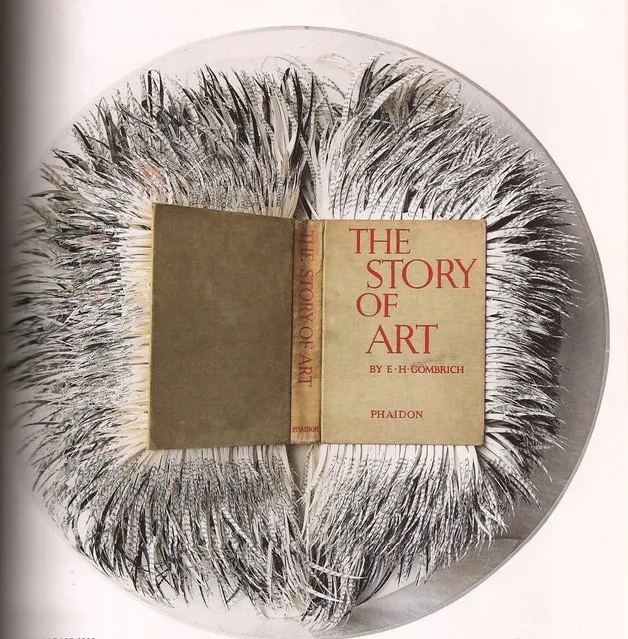
Georgia Russell is a Scottish artist who slashes, cuts and dissects printed matter, transforming books, music scores, maps, newspapers and photographs into patterned abstractions that leave a resemblance of the original but transport it to another time and place where everything is fragmented, and always in flux.
Details
05 Jun 2012 12:53:00
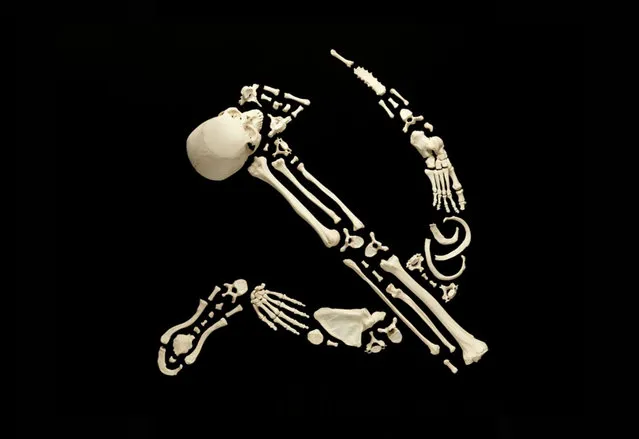
Human Bone

Hammer & Sickle

Francois Robert bought a skeleton from a school in the mid-90s, and started to creat this series of art works named "Stop the Violence" since 2007 after conceived a long time.
Details
11 Jun 2012 08:40:00
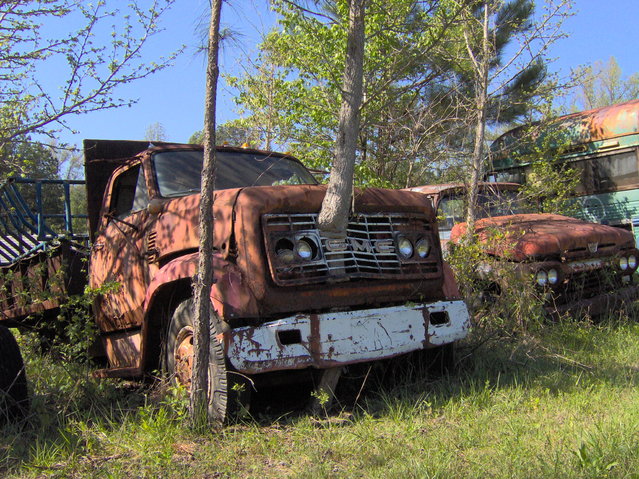
Time, Car, Rust

GMC truck
Details
17 Sep 2012 13:44:00
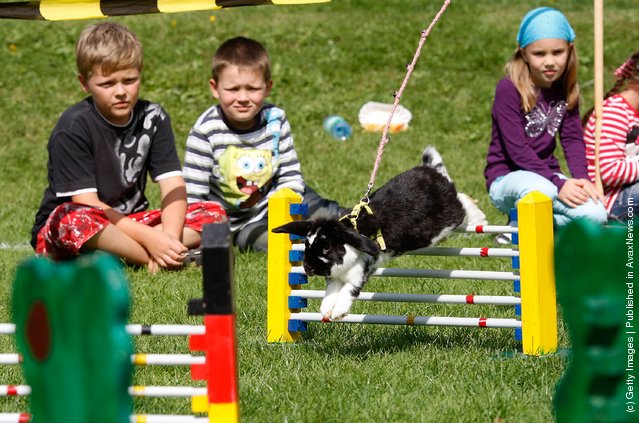
Rabbit Sport Tournament

Children watch a rabbit, jumping over a hurdle at an obstacle course the 5th Open Rabbit Sport Tournament (5. offene Kaninchensport Turnier) on August 28, 2011 in Rommerz near Fulda, Germany. Eighty rabbits competed in light-weight, middle-weight and jumping-for-points categories at today's tournament in Rommerz that is based on Kanin Hop, or Rabbit Hopping. Rabbit Hopping is a growing trend among pet rabbit owners in Central Europe and the first European Championships are scheduled to be held later this year in Switzerland. (Photo by Ralph Orlowski/Getty Images)
Details
29 Aug 2011 14:44:00
Russian support personnel work to help get Expedition 29 crew members out of the Soyuz TMA-02M spacecraft shortly after the capsule landed

Russian support personnel work to help get Expedition 29 crew members out of the Soyuz TMA-02M spacecraft shortly after the capsule landed with Expedition 29 Commander Mike Fossum, and Flight Engineers Sergei Volkov and Satoshi Furukawa on November 22, 2011 outside of the town of Arkalyk, Kazakhstan. NASA Astronaut Fossum, Russian Cosmonaut Volkov and JAXA (Japan Aerospace Exploration Agency) Astronaut Furukawa are returning from more than five months onboard the International Space Station (ISS) where they served as members of the Expedition 28 and 29 crews. (Photo by Bill Ingalls/NASA via Getty Images)
Details
22 Nov 2011 13:41:00
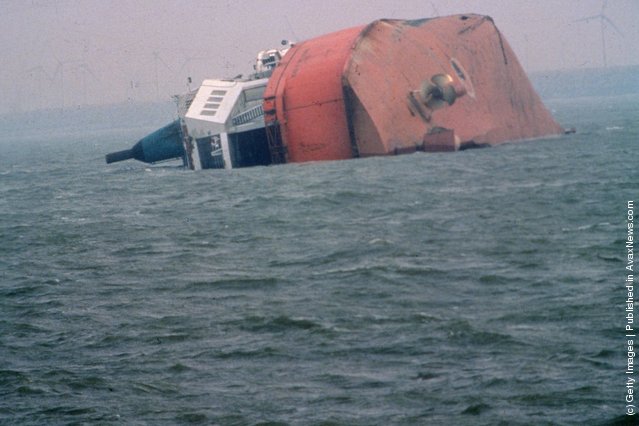
The wreck of the Herald of Free Enterprise, which capsized near Zeebrugge on the 6th of March 1987

“MS Herald of Free Enterprise was a roll-on roll-off (RORO) car and passenger ferry owned by Townsend Thoresen. She was one of three ships commissioned by the company to operate on the Dover–Calais route across the English Channel. The ferry capsized on the night of 6 March 1987, moments after leaving the Belgian port of Zeebrugge, killing 193 passengers and crew. This was the deadliest maritime disaster involving a British ship in peacetime since the sinking of the Iolaire in 1919”. – Wikipedia

Photo: The wreck of the Herald of Free Enterprise, which capsized near Zeebrugge on the 6th of March 1987. (Photo by Hulton Archive/Getty Images). 1987
Details
06 Mar 2012 13:26:00
A boy looks for scrap metal using an improvised magnetic tool near a construction site in New Delhi, India, March 21, 2016. (Photo by Cathal McNaughton/Reuters)

A boy looks for scrap metal using an improvised magnetic tool near a construction site in New Delhi, India, March 21, 2016. (Photo by Cathal McNaughton/Reuters)
Details
09 Jul 2016 09:50:00
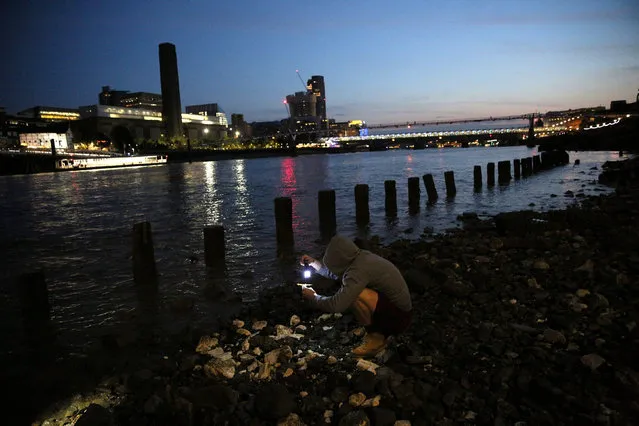
A mudlark uses a torch to look for items on the bank of the River Thames in London, Britain June 06, 2016. Mudlarking is believed to trace its origins to the 18th and 19th century, when scavengers searched the Thames' shores for items to sell. These days, history and archaeology fans are the ones hoping to find old relics such as coins, ceramics, artifacts or everyday items from across centuries. They wait for the low tide and then scour specific areas of exposed shores. "If you're in a field you could be out all day long, with the river you're restricted to about two or three hours," mudlark Nick Stevens said. While many just use the naked eye for their searches, others rely on metal detectors for which a permit from the Port of London Authority is needed. Digging also requires consent. (Photo by Neil Hall/Reuters)

A mudlark uses a torch to look for items on the bank of the River Thames in London, Britain June 06, 2016. Mudlarking is believed to trace its origins to the 18th and 19th century, when scavengers searched the Thames' shores for items to sell. These days, history and archaeology fans are the ones hoping to find old relics such as coins, ceramics, artifacts or everyday items from across centuries. their finds with the Portable Antiquities Scheme. Any item over 300 years old must be recorded. (Photo by Neil Hall/Reuters)
Details
27 Aug 2016 10:43:00