Loading...
Done
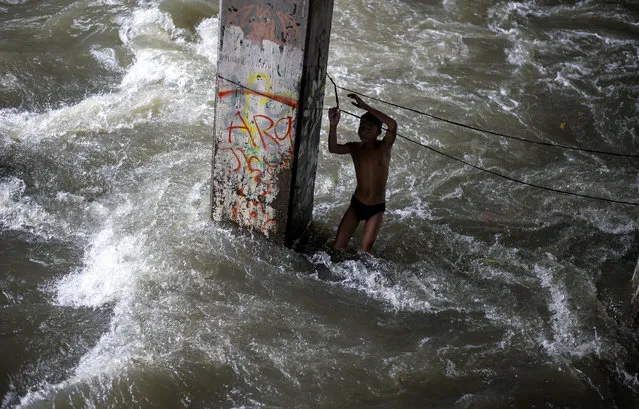
A boy plays in a swollen creek under a bridge in Manila on October 16, 2016. Typhoon Sarika lashed the main Philippine island of Luzon on October 16, flattening homes and toppling trees and power pylons as more than 12,000 people fled to safer ground, officials said. Shanties built beside a river, under a creek are the usual victims of floodings. (Photo by Noel Celis/AFP Photo)

A boy plays in a swollen creek under a bridge in Manila on October 16, 2016. Typhoon Sarika lashed the main Philippine island of Luzon on October 16, flattening homes and toppling trees and power pylons as more than 12,000 people fled to safer ground, officials said. Shanties built beside a river, under a creek are the usual victims of floodings. (Photo by Noel Celis/AFP Photo)
Details
17 Oct 2016 10:00:00
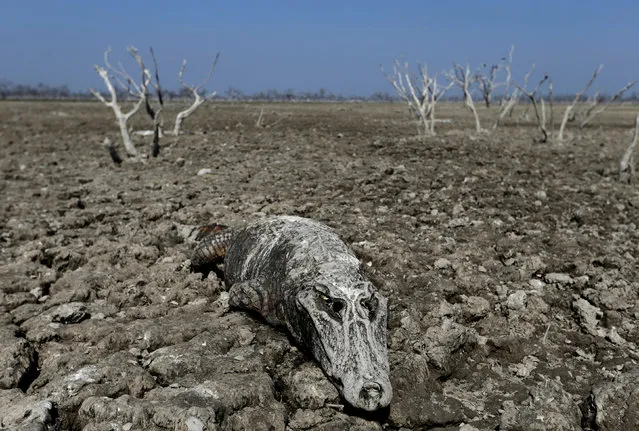
The carcass of a yacare caiman lies in the dried-up river bed of the Pilcomayo river in Boqueron, Paraguay, August 14, 2016. In Paraguay, alongside the Pilcomayo River, black vultures flew over a shrinking pond where a group of crocodilian reptiles known as yacare caimans sought refuge. Water from the river, which divides Paraguay and Argentina in the area of the Gran Chaco, was scarce. This is not an uncommon sight in the region of General Diaz, about 700 kilometres (435 miles) northwest of the country's capital Asuncion, where the Pilcomayo's waters form lakes and streams that give life to capybaras, birds and caimans. “The river's situation is critical. No water is forecast to enter the basin until December, as happens every year”, said Alcides Gonzalez, a resident of the area. (Photo by Jorge Adorno/Reuters)

The carcass of a yacare caiman lies in the dried-up river bed of the Pilcomayo river in Boqueron, Paraguay, August 14, 2016. In Paraguay, alongside the Pilcomayo River, black vultures flew over a shrinking pond where a group of crocodilian reptiles known as yacare caimans sought refuge. Water from the river, which divides Paraguay and Argentina in the area of the Gran Chaco, was scarce. This is not an uncommon sight in the region of General Diaz, about 700 kilometres (435 miles) northwest of the country's capital Asuncion, where the Pilcomayo's waters form lakes and streams that give life to capybaras, birds and caimans. (Photo by Jorge Adorno/Reuters)
Details
03 Nov 2016 12:40:00
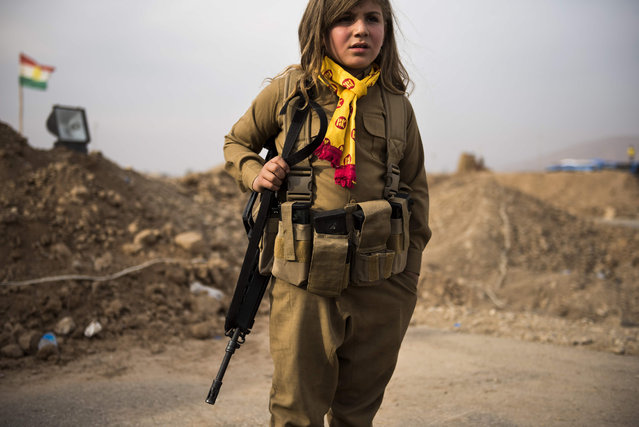
A Kurdish girl wears her relative's assault rifle and ammunition belt as she waits at the  Iraqi Kurdish Shaqouli checkpoint, some 35 kilometres east of Mosul, on November 10, 2016. Since the start of the Mosul offensive the Kurds have moved their border some 10 kms closer to Iraq's second city, marking it out with a line in the sand. (Photo by Odd Andersen/AFP Photo)

A Kurdish girl wears her relative's assault rifle and ammunition belt as she waits at the Iraqi Kurdish Shaqouli checkpoint, some 35 kilometres east of Mosul, on November 10, 2016. Since the start of the Mosul offensive the Kurds have moved their border some 10 kms closer to Iraq's second city, marking it out with a line in the sand. (Photo by Odd Andersen/AFP Photo)
Details
11 Nov 2016 08:02:00
A girl sits on a pile of rubbish at landfill site on the outskirts of Sanaa, Yemen November 16, 2016. (Photo by Mohamed al-Sayaghi/Reuters)

A girl sits on a pile of rubbish at landfill site on the outskirts of Sanaa, Yemen November 16, 2016. (Photo by Mohamed al-Sayaghi/Reuters)
Details
17 Nov 2016 11:34:00
Russian artist Maria Gasanova adjusts her make-up as she finishes “The Siberian Beauty” body art work from her “The Alive Painting” series before the opening ceremony of the Cultural Universiade as part of preparation for the 2019 Winter Universiade Krasnoyarsk, in the Siberian city of Krasnoyarsk, Russia, December 9, 2016. (Photo by Ilya Naymushin/Reuters)

Russian artist Maria Gasanova adjusts her make-up as she finishes “The Siberian Beauty” body art work from her “The Alive Painting” series before the opening ceremony of the Cultural Universiade as part of preparation for the 2019 Winter Universiade Krasnoyarsk, in the Siberian city of Krasnoyarsk, Russia, December 9, 2016. (Photo by Ilya Naymushin/Reuters)
Details
10 Dec 2016 09:06:00
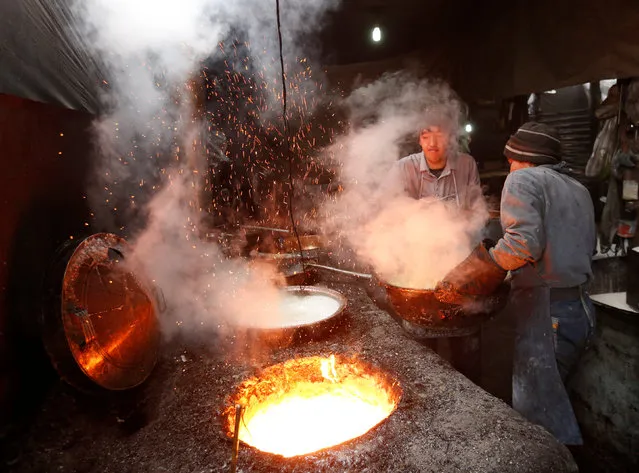
Afghan men work in a small sweets factory in Kabul, Afghanistan January 5, 2017. (Photo by Mohammad Ismail/Reuters)

Afghan men work in a small sweets factory in Kabul, Afghanistan January 5, 2017. (Photo by Mohammad Ismail/Reuters)
Details
11 Jan 2017 14:49:00
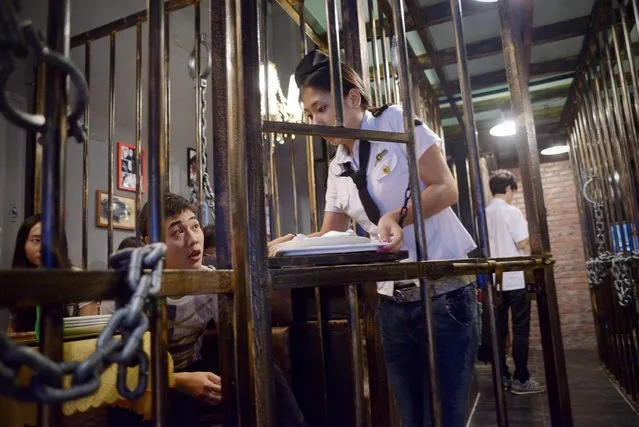
This picture taken on September 9, 2014 shows a waiteress handing over food to customers at a prison themed restaurant in Tianjin. As more themed restaurants are popular in China, a “prison style” restaurent in Tianjin is aimed at reminding people to observe the law and to be good citizens. (Photo by Wang Zhao/AFP Photo)

This picture taken on September 9, 2014 shows a waiteress handing over food to customers at a prison themed restaurant in Tianjin. As more themed restaurants are popular in China, a “prison style” restaurent in Tianjin is aimed at reminding people to observe the law and to be good citizens. (Photo by Wang Zhao/AFP Photo)
Details
14 Sep 2014 10:14:00
A cat with a “stegosaurus spine” design cut into its fur is seen next to a dog at a pet shop, in Tainan, Taiwan June 19, 2016. Lee Mei-chen, Taiwanese hairdresser turned pet groomer, shaves paw prints, lion faces and characters from Japanese brand Hello Kitty on to animal backs. The teddy bear design is one of the most complex in the furry repertoire. Ou Shih-jou, owner of the salon where Lee works in southern Taiwan, said the quirky pet patterns came from owners wanting something different to the normal summer shave, with designs determined by the natural assets of the pets. (Photo by Tyrone Siu/Reuters)

A cat with a “stegosaurus spine” design cut into its fur is seen next to a dog at a pet shop, in Tainan, Taiwan June 19, 2016. Lee Mei-chen, Taiwanese hairdresser turned pet groomer, shaves paw prints, lion faces and characters from Japanese brand Hello Kitty on to animal backs. The teddy bear design is one of the most complex in the furry repertoire. Photo by Tyrone Siu/Reuters)
Details
23 Jun 2016 12:30:00