Actress Edy Williams attends the 58th Annual Academy Awards on March 24, 1986 at Dorothy Chandler Pavilion in Los Angeles, California. (Photo by Ron Galella/WireImage)
The arctic hare, or polar rabbit, is a species of hare which is adapted largely to polar and mountainous habitats. The arctic hare survives with a thick coat of fur and usually digs holes in the ground or under snow to keep warm and sleep. Arctic hares look like rabbits but have shorter ears, are taller when standing, and, unlike rabbits, can thrive in cold climates. They can travel together with many other hares, sometimes huddling with dozens or more, but are usually found alone, taking, in some cases, more than one partner. The arctic hare can run up to 60 kilometres per hour (40 mph). Its predators include the arctic wolf, arctic fox, and ermine.
Romanian singing duo Gabriella and Monica Irimia, The Cheeky Girls prforms in Falkirk, Scotland on May 4, 2003. (Photo by Michael Schofield/News Group Newspapers Ltd)
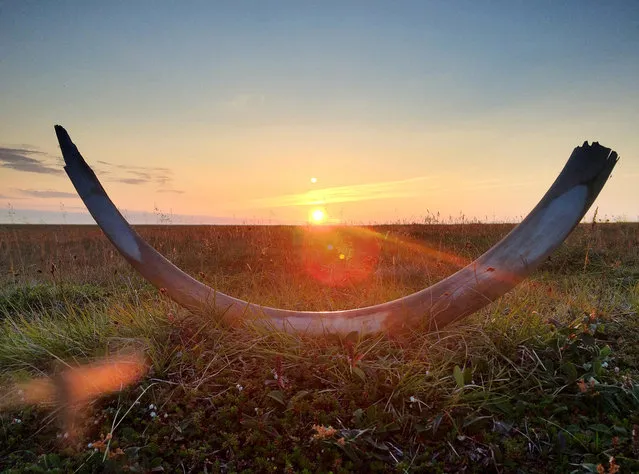
The tusk of a woolly mammoth that lived some 18,000 years ago, from which researchers sequenced the extinct mammal's entire genome, is seen in northeastern Siberia in this photo from 2015. (Photo by Love Dalen/Handout via Reuters)
Hundreds of flamingos take flight in the Rift Valley in East Africa early September 2024. The birds gather in the region’s saline lakes to eat the blue-green algae that grows in abundance. The red-orange pigment in the algae is what gives them their distinctive pink plumage. They also use the site to breed. (Photo by Alexandre and Chloe Bes/Naturagency/Solent News)
A boy shoots a World War II machine gun armed with blanks at an weapon exhibition during a military show near Kirovsk, about 30 kilometers (19 miles) east of St. Petersburg, Russia, Sunday, January 21, 2018. (Photo by Dmitri Lovetsky/AP Photo)