Loading...
Done
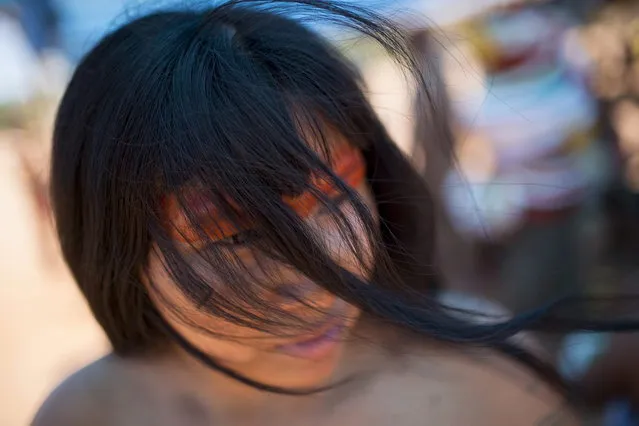
A Waura Indian woman watches the activities of this year's “quarup”, a ritual held over several days to honour in death a person of great importance to them, in Xingu National Park, Mato Grosso State, August 24, 2013. This year the Waura tribe is honouring their late cacique (chief) Atamai, who died in 2012 and helped created the Xingu Park, and his important contribution in facilitating communication between white Brazilians and Indians. (Photo by Ueslei Marcelino/Reuters)

A Waura Indian woman watches the activities of this year's “quarup”, a ritual held over several days to honour in death a person of great importance to them, in Xingu National Park, Mato Grosso State, August 24, 2013. This year the Waura tribe is honouring their late cacique (chief) Atamai, who died in 2012 and helped created the Xingu Park, and his important contribution in facilitating communication between white Brazilians and Indians. (Photo by Ueslei Marcelino/Reuters)
Details
04 Sep 2013 08:48:00
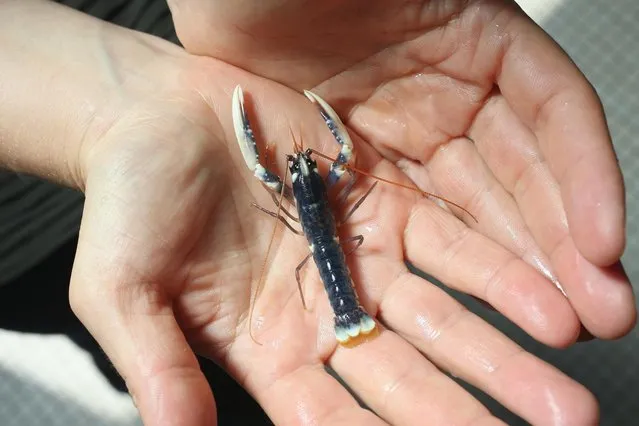
Isabel Schmalenbach, an environmental scientist with the Helgoland Biological Institute (Biologische Anstalt Helgoland), part of the Alfred Wegener Institute for Polar and Marine Research, holds a one-year old baby European lobster (Homarus gammarus) raised at the institute on August 3, 2013 on Helgoland Island, Germany. (Photo by Sean Gallup/Getty Images)

Isabel Schmalenbach, an environmental scientist with the Helgoland Biological Institute (Biologische Anstalt Helgoland), part of the Alfred Wegener Institute for Polar and Marine Research, holds a one-year old baby European lobster (Homarus gammarus) raised at the institute on August 3, 2013 on Helgoland Island, Germany. Later in the day Schmalenbach and her colleagues released a total of 415 one-year old lobsters into the North Sea as part of an effort to repopulate the lobster population around Helgoland (also called Heligoland). In the 19th century local fishermen caught up to 80,000 lobsters a year in the surrounding waters, combined with the heavy allied bombing of the island during and after World War II, as well as other environmental factors, decimated the lobster population. (Photo by Sean Gallup)
Details
05 Aug 2013 08:39:00
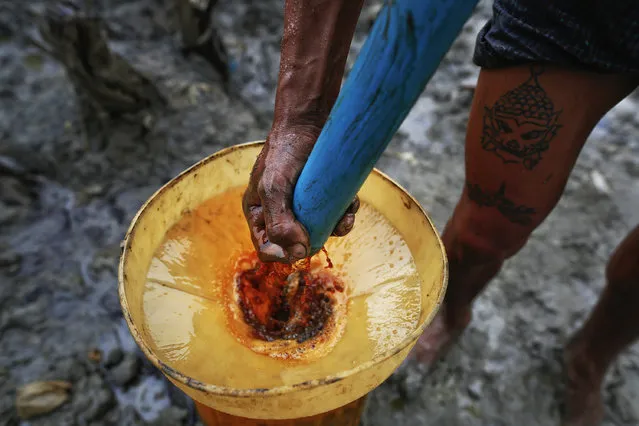
Ko Min, 26, manually extracts oil from one of three 300 feet deep wells he works on in the Minhla township of the Magwe district October 27, 2013. Everyday, Ko Min makes around $30 extracting crude oil from three small wells after he bought rights to use them for close to $1000 from a farmer who owns the land. (Photo by Damir Sagolj/Reuters)

Ko Min, 26, manually extracts oil from one of three 300 feet deep wells he works on in the Minhla township of the Magwe district October 27, 2013. Everyday, Ko Min makes around $30 extracting crude oil from three small wells after he bought rights to use them for close to $1000 from a farmer who owns the land. In Myanmar, an impoverished country rich with natural resources, people from poor communities find ways to supplement their income by exploiting such resources, such as the Minhla township, traditionally rich with oil, often using primitive and dangerous methods. (Photo by Damir Sagolj/Reuters)
Details
21 Apr 2014 10:06:00
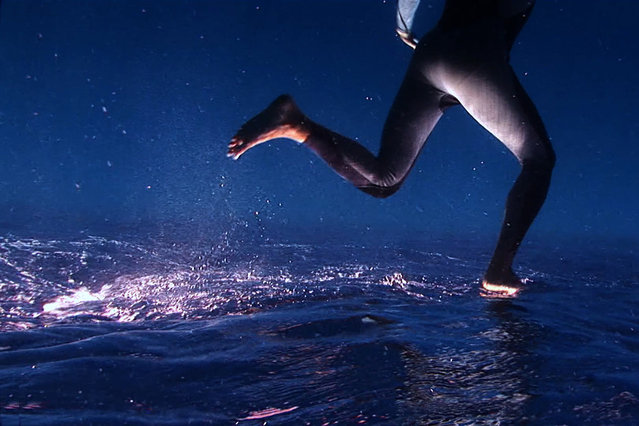
A freediver uses weights, yoga and camera tricks to create the illusion of walking underwater for a film which took three years to shoot and was completed in 2013 in El Hierro, Canary Islands. Like a scene from a Hollywood science-fiction movie, this trick footage shows a man apparently walking on water. The underwater film was shot by biologist Armiche Ramos and brothers Armando and Francisco del Rosario, who used their expertise in freediving to create the illusion. (Photo by Ocean Brothers/Barcroft Media/ABACAPress)

A freediver uses weights, yoga and camera tricks to create the illusion of walking underwater for a film which took three years to shoot and was completed in 2013 in El Hierro, Canary Islands. Like a scene from a Hollywood science-fiction movie, this trick footage shows a man apparently walking on water. The underwater film was shot by biologist Armiche Ramos and brothers Armando and Francisco del Rosario, who used their expertise in freediving to create the illusion. No computer graphics were involved in the production, with the team relying solely on their own skills – and a few hidden secrets. (Photo by Ocean Brothers/Barcroft Media/ABACAPress)
Details
25 Nov 2014 11:05:00
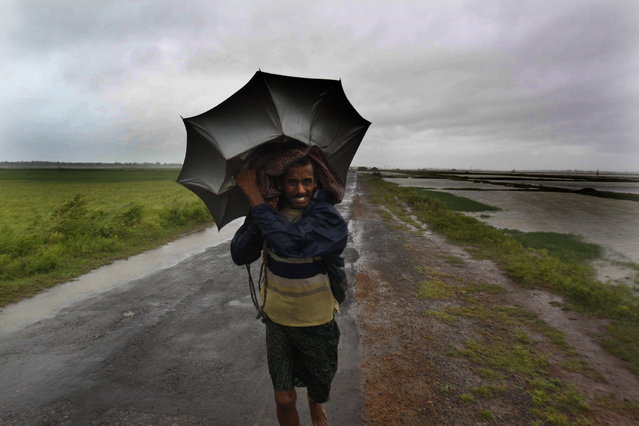
An Indian villager braving strong winds and rain walk to a safer place, in village Podampeta, in Ganjam district about 200 kilometers  (125 miles) from the eastern Indian city Bhubaneswar, India, Saturday, October 12, 2013. Strong winds and heavy rains pounded India's eastern coastline Saturday, as hundreds of thousands of people took shelter from a massive, powerful Cyclone Phailin expected to reach land in a few hours. (Photo by Biswaranjan Rout/AP Photo)

An Indian villager braving strong winds and rain walk to a safer place, in village Podampeta, in Ganjam district about 200 kilometers (125 miles) from the eastern Indian city Bhubaneswar, India, Saturday, October 12, 2013. Strong winds and heavy rains pounded India's eastern coastline Saturday, as hundreds of thousands of people took shelter from a massive, powerful Cyclone Phailin expected to reach land in a few hours. (Photo by Biswaranjan Rout/AP Photo)
Details
14 Oct 2013 08:44:00
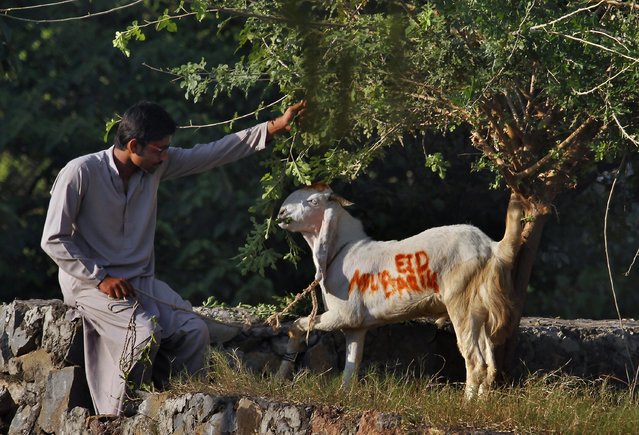
A Pakistani feeds his goat wearing the words “Eid Mubarak” or “Eid Greeting”, to be slaughtered on the Muslim holiday of Eid al-Adha, or “Feast of Sacrifice”, in Islamabad, Pakistan on Tuesday, October 15, 2013. Muslims all over the world are celebrating Eid al-Adha by sacrificing sheep, goats, cows and camels, to commemorate the Prophet Abraham's readiness to sacrifice his son, Ismail, on God's command. (Photo by Anjum Naveed/AP Photo)

A Pakistani feeds his goat wearing the words “Eid Mubarak” or “Eid Greeting”, to be slaughtered on the Muslim holiday of Eid al-Adha, or “Feast of Sacrifice”, in Islamabad, Pakistan on Tuesday, October 15, 2013. Muslims all over the world are celebrating Eid al-Adha by sacrificing sheep, goats, cows and camels, to commemorate the Prophet Abraham's readiness to sacrifice his son, Ismail, on God's command. (Photo by Anjum Naveed/AP Photo)
Details
17 Oct 2013 07:56:00
Wounded Reuters photographer Gleb Garanich, who was injured by riot police, takes pictures as riot police block protesters during a scuffle at a demonstration in support of EU integration at Independence Square in Kiev November 30, 2013. Riot police in the Ukrainian capital Kiev used batons and stun grenades to disperse hundreds of pro-Europe protesters from the city's main Independence Square early on Saturday, witnesses said. (Photo by Reuters/Stringer)

Wounded Reuters photographer Gleb Garanich, who was injured by riot police, takes pictures as riot police block protesters during a scuffle at a demonstration in support of EU integration at Independence Square in Kiev November 30, 2013. Riot police in the Ukrainian capital Kiev used batons and stun grenades to disperse hundreds of pro-Europe protesters from the city's main Independence Square early on Saturday, witnesses said. (Photo by Reuters/Stringer)
Details
04 Dec 2013 08:14:00
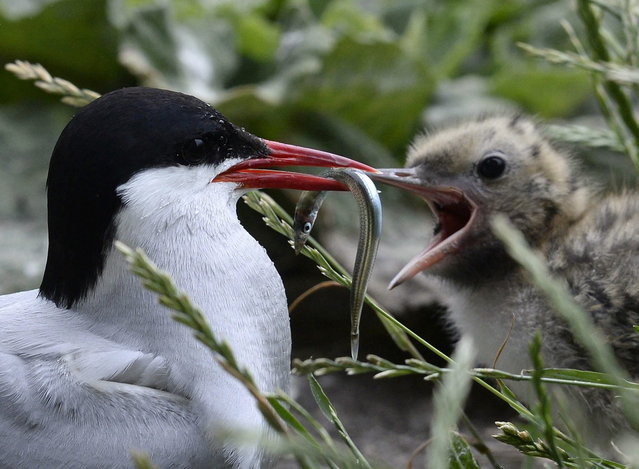
An arctic tern feeds its chick on the Farne Islands off the Northumberland coast, northern England July 8, 2013. (Photo by Nigel Roddis/Reuters)

An arctic tern feeds its chick on the Farne Islands off the Northumberland coast, northern England July 8, 2013. The Farne Islands, which lie off the coast of northeast England, are home to a huge array of wildlife. The islands are owned and protected by the British conservation charity, the National Trust, which says they host some 23 species of seabird, as well as a substantial colony of grey seals, who come to have their pups there in the autumn. Every five years the National Trust carries out a census of the islands' population of puffins, and this year's survey showed there were almost 40,000 nesting pairs on the islands – an 8 percent rise from 2008. (Photo by Nigel Roddis/Reuters)
Details
11 Dec 2013 09:21:00