Loading...
Done
A government employee reacts as she is sprayed with disinfectant before entering a government office building to curb the spread of COVID-19 on March 19, 2020 in Pasig city, Metro Manila, Philippines. The Philippine government has sealed off Luzon, the country's largest and most populous island, to prevent the spread of COVID-19. Land, sea, and air travel has been suspended, while government work, schools, businesses, and public transportation have been ordered shut in a bid to keep some 55 million people at home. The Philippines' Department of Health has so far confirmed 217 cases of the new coronavirus in the country, with at least 17 recorded fatalities. (Photo by Ezra Acayan/Getty Images)

A government employee reacts as she is sprayed with disinfectant before entering a government office building to curb the spread of COVID-19 on March 19, 2020 in Pasig city, Metro Manila, Philippines. The Philippine government has sealed off Luzon, the country's largest and most populous island, to prevent the spread of COVID-19. Land, sea, and air travel has been suspended, while government work, schools, businesses, and public transportation have been ordered shut in a bid to keep some 55 million people at home. The Philippines' Department of Health has so far confirmed 217 cases of the new coronavirus in the country, with at least 17 recorded fatalities. (Photo by Ezra Acayan/Getty Images)
Details
07 Jan 2021 00:05:00
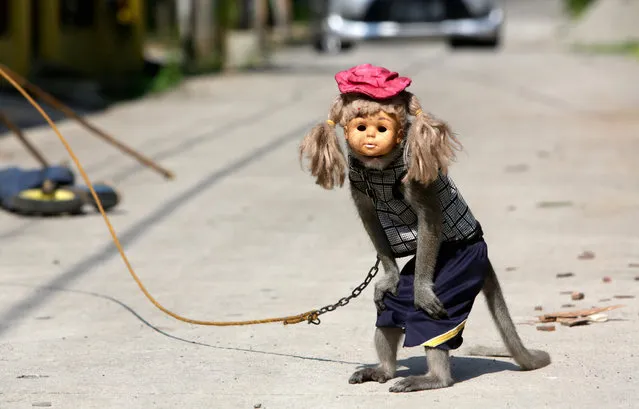
A chained male monkey in a costume and wearing a toy mask performs at a street in Depok, West Java, Indonesia, 30 September 2021. A performing monkey in a street, known as “Topeng Monyet” (lit. Monkey Mask), is a popular form of cheap entertainment in Indonesia, especially on the island of Java. During a street monkey show, a trainer issues orders by pulling the chain tied around the primate's neck, forcing it to perform tricks such as wearing a mask or riding a toy motorcycle. The Indonesian government in 2013 banned the Topeng Monyet in the capital Jakarta to improve public order and ending animal abuse. However, monkey performances are still popular in several other parts of the country, such as West Java, especially after the government lowered the level of Enforcement of Restrictions on Community Activities (PPKM) in a number of areas during the COVID-19 pandemic. (Photo by Adi Weda/EPA/EFE)

A chained male monkey in a costume and wearing a toy mask performs at a street in Depok, West Java, Indonesia, 30 September 2021. A performing monkey in a street, known as “Topeng Monyet” (lit. Monkey Mask), is a popular form of cheap entertainment in Indonesia, especially on the island of Java. (Photo by Adi Weda/EPA/EFE)
Details
16 Oct 2021 09:08:00
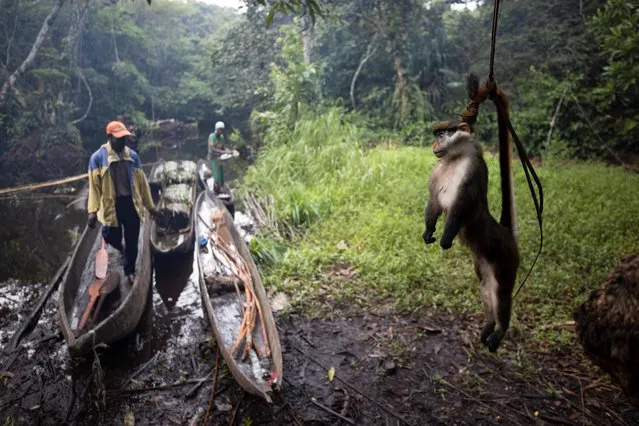
A dead red-tailed monkey hangs by its tail above the ground, in order to keep it away from ants, in the forest near the city of Mbandaka, Democratic Republic of the Congo, April 5, 2019. Bushmeat hunters are emptying Central Africa's forests at a high rate, researchers say. A growing appetite for wild meat in cities has ramped up the scale of hunting. Research shows around 6 million tonnes of bushmeat are sourced annually from the Congo Basin, whose forest spans across six countries and is second in size only to the Amazon. (Photo by Thomas Nicolon/Reuters)

A dead red-tailed monkey hangs by its tail above the ground, in order to keep it away from ants, in the forest near the city of Mbandaka, Democratic Republic of the Congo, April 5, 2019. Bushmeat hunters are emptying Central Africa's forests at a high rate, researchers say. A growing appetite for wild meat in cities has ramped up the scale of hunting. Research shows around 6 million tonnes of bushmeat are sourced annually from the Congo Basin, whose forest spans across six countries and is second in size only to the Amazon. (Photo by Thomas Nicolon/Reuters)
Details
14 Oct 2019 00:03:00
World War Two veteran Abla Begaliyev, 91, is seen in an undated handout picture (L), poses for a picture in Arashan (Top R) and at home in Kyrgyzstan April 14, 2015. Begaliyev served in the border guard cavalry from February 1942 until April 1947. Originally from Kyrgyzstan, he fought on the Ukrainian front and relocated to the border with Afghanistan at the end of World War Two. (Photo by Vladimir Pirogov/Reuters/Family handout (L))

World War Two veteran Abla Begaliyev, 91, is seen in an undated handout picture (L), poses for a picture in Arashan (Top R) and at home in Kyrgyzstan April 14, 2015. Begaliyev served in the border guard cavalry from February 1942 until April 1947. Originally from Kyrgyzstan, he fought on the Ukrainian front and relocated to the border with Afghanistan at the end of World War Two. As the world marks the 70th anniversary of the end of World War Two, Reuters photographers the length and breadth of the former Soviet republics (CCCP) captured portraits of Red Army veterans, mostly now in their 80s and 90s, today and through archive pictures at the time. More than 20 million Soviet citizens were killed in the war. (Photo by Vladimir Pirogov/Reuters/Family handout (L))
Details
08 May 2015 14:22:00
A man carries a smoke flare as far-right activists march during the Gay Pride parade on June 12, 2016 in Kiev. More than 700 gay rights activists marched through central Kiev on June 12 amid a massive police presence for the third such gay pride event in the ex-Soviet country where homophobia remains widespread. The June 12 march was the first ever gay pride rally to be held in central Kiev, prompting an unprecedented security operation with several thousand police and National Guard officers lining the route during the event, which lasted around 20 minutes. (Photo by Yuriy Kirnichny/AFP Photo)

A man carries a smoke flare as far-right activists march during the Gay Pride parade on June 12, 2016 in Kiev. More than 700 gay rights activists marched through central Kiev on June 12 amid a massive police presence for the third such gay pride event in the ex-Soviet country where homophobia remains widespread. The June 12 march was the first ever gay pride rally to be held in central Kiev, prompting an unprecedented security operation with several thousand police and National Guard officers lining the route during the event, which lasted around 20 minutes. (Photo by Yuriy Kirnichny/AFP Photo)
Details
13 Jun 2016 11:08:00
People take part in a military exercise for civilians conducted by veterans of the Ukrainian National Guard Azov battalion, amid threat of Russian invasion, in Kyiv, Ukraine on January 30, 2022. According to a survey conducted by the Kiev International Institute of Sociology (KIIS) from December 2021, 50.2 percent of Ukrainians said they would resist in case of a Russian military intervention into their city, town or village. Every third respondent to the poll said they were ready to engage in armed resistance, and 21.7 percent said they were ready to participate in civil resistance actions. (Photo by Gleb Garanich/Reuters)

People take part in a military exercise for civilians conducted by veterans of the Ukrainian National Guard Azov battalion, amid threat of Russian invasion, in Kyiv, Ukraine on January 30, 2022. According to a survey conducted by the Kiev International Institute of Sociology (KIIS) from December 2021, 50.2 percent of Ukrainians said they would resist in case of a Russian military intervention into their city, town or village. Every third respondent to the poll said they were ready to engage in armed resistance, and 21.7 percent said they were ready to participate in civil resistance actions. (Photo by Gleb Garanich/Reuters)
Details
07 Mar 2023 03:30:00
Faruk, 17, a Rohingya refugee trader holds betel leaves which are on sale at a stall in Palong Khali refugee camp near Cox's Bazar, Bangladesh, November 3, 2017. He left his village in Myanmar when the military opened fire towards the Rohingya. “I buy this betel leaf from Palong Khali market, in one bundle there are 160 pieces, I buy it for 80 taka and I sell it for 100 taka. Bangladeshi's and I sell for the same rate in the camp. Outside in the local market it is 80 taka per bundle. My problem is that I don't have money so I can't buy anything to eat, I can't buy fish to eat”, he said. (Photo by Hannah McKay/Reuters)

Faruk, 17, a Rohingya refugee trader holds betel leaves which are on sale at a stall in Palong Khali refugee camp near Cox's Bazar, Bangladesh, November 3, 2017. He left his village in Myanmar when the military opened fire towards the Rohingya. “I buy this betel leaf from Palong Khali market, in one bundle there are 160 pieces, I buy it for 80 taka and I sell it for 100 taka (1 Bangladeshi Taka = 0.012 US Dollar). Bangladeshi's and I sell for the same rate in the camp. Outside in the local market it is 80 taka per bundle. My problem is that I don't have money so I can't buy anything to eat, I can't buy fish to eat”, he said. (Photo by Hannah McKay/Reuters)
Details
27 Nov 2017 08:54:00
A dhobi, or a washerman washes cloths on the banks of the River Gomti in Lucknow, India, Saturday, September 12, 2020. Dhobis are traditional laundry workers who wash clothes by hand and dry them in the sun, an occupation which has been in existence for generations. Most cities in India have a Dhobi Ghat, or washermen's area, where the city's pile of clothes is laundered. This practice is still popular in India, despite of modern technology. Around 1,000 families work in Lucknow's Dhobi Ghat. However, in light of the novel coronavirus, their wages have decreased drastically. With each family earning around US$100-200 per month. (Photo by Rajesh Kumar Singh/AP Photo)

A dhobi, or a washerman washes cloths on the banks of the River Gomti in Lucknow, India, Saturday, September 12, 2020. Dhobis are traditional laundry workers who wash clothes by hand and dry them in the sun, an occupation which has been in existence for generations. Most cities in India have a Dhobi Ghat, or washermen's area, where the city's pile of clothes is laundered. This practice is still popular in India, despite of modern technology. Around 1,000 families work in Lucknow's Dhobi Ghat. However, in light of the novel coronavirus, their wages have decreased drastically. With each family earning around US$100-200 per month. (Photo by Rajesh Kumar Singh/AP Photo)
Details
25 Sep 2020 00:03:00