Loading...
Done


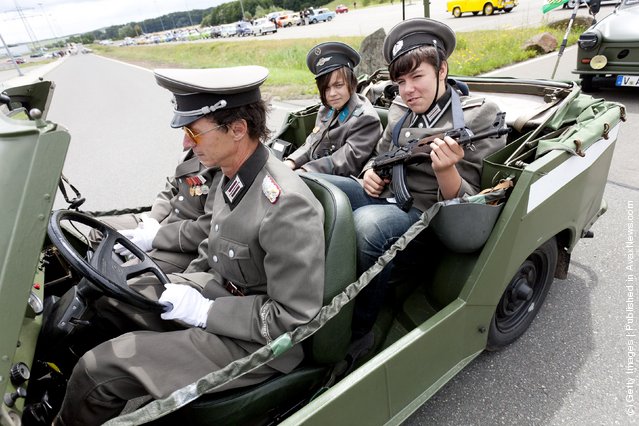
“The Trabant is a car that was produced by former East German auto maker VEB Sachsenring Automobilwerke Zwickau in Zwickau, Sachsen. It was the most common vehicle in East Germany, and was also exported to countries both inside and outside the communist bloc. The main selling points was that it had room for four adults and luggage in a compact, light and durable shell and that it was fast (when introduced) and durable. With its mediocre performance, smoky two-stroke engine, and production shortages, the Trabant is often cited as an example of the disadvantages of centralized planning; on the other hand, it is regarded with derisive affection as a symbol of the failed former East Germany and of the fall of communism (in former West Germany, as many East Germans streamed into West Berlin and West Germany in their Trabants after the opening of the Berlin Wall in 1989). It was in production without any significant changes for nearly 30 years with 3,096,099 Trabants produced in total”. – Wikipedia

Photo: Enthusiasts weared in uniforms of the former eastern german army trive in a military Trabant car as fans and owners of East German-era Trabant cars gather at the 2011 International Trabantfahrer Treffen (International Trabant Drivers Meeting) on June 26, 2011 in Zwickau, Germany. The Trabant, also known as the Trabi, was among the main cars produced in communist East Germany and built by VEB Sachsenring Automobilwerke in Zwickau for 30 years until 1989. Today the car has cult status for many followers and one company, IndiKar, is even seeking to revive the brand in a modern, electric version. (Photo by Carsten Koall/Getty Images)
Details
27 Jun 2011 12:21:00


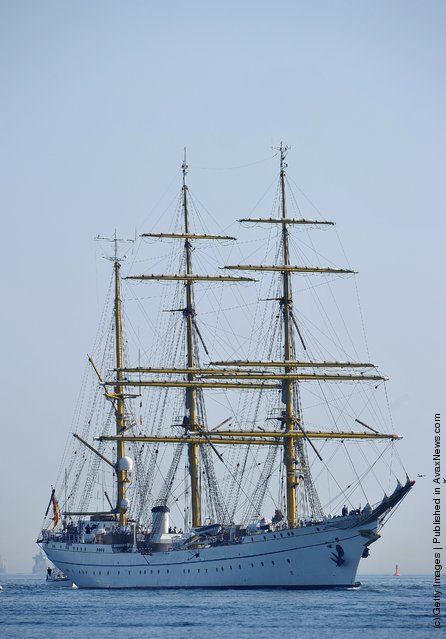
“The Gorch Fock is a tall ship of the German Navy (Deutsche Marine). She is the second ship of that name and a sister ship of the Gorch Fock built in 1933. Both ships are named in honor of the German writer Johann Kinau who wrote under the pseudonym "Gorch Fock" and died in the battle of Jutland/Skagerrak in 1916. The modern-day Gorch Fock was built in 1958 and has since then undertaken 146 cruises (as of October 2006), including one tour around the world in 1988. She is sometimes referred to (unofficially) as the Gorch Fock II to distinguish her from her older sister ship”. – Wikipedia

Photo: The “Gorch Fock” German Navy tall ship sails towards Kiel on May 6, 2011 in Kiel, Germany. The ship returns to Germany following investigations in January while it was in port in Ushuia, Argentina, into allegations of attempted mutiny following the death of a female crew member. German Defense Minister at the time Karl-Theodor zu Guttenberg suspended Captain Norbert Schatz, and though investigators absolved Schatz of wrongdoing, critics charge the investigation was inadequate. The "Gorch Fock" is the German Navy's flagship training vessel. (Photo by Stuart Franklin/Getty Images)
Details
06 May 2011 11:38:00
Historic Hatters of James Lock and Co

Assistant Manager Jayesh Vaghela brushes a vintage silk top hat at Lock & Co. Hatters on March 22, 2011 in London, England. Founded in St. James's in 1676, when Charles II was on the throne, this family owned business has provided hats for Royalty and the gentry for over 300 years. Staff report that sales of formal hats are booming ahead of the wedding of Prince William and Kate Middleton in Westminster Abbey on April 29, 2011.
Details
27 Mar 2011 12:56:00
Peacock Spider Maratus Speciosus by Jurgen Otto

Maratus is a spider genus of the Salticidae family (jumping spiders). These spiders are commonly referred to as peacock spiders due to their colorful abdominal flaps that they display during courtship. In at least one species, Maratus vespertilio, the expansion of the flaps also occurs during ritualised contests between males. All described species, except M. furvus, are endemic to Australia. (Photo by Jurgen Otto)
Details
27 Feb 2014 12:20:00
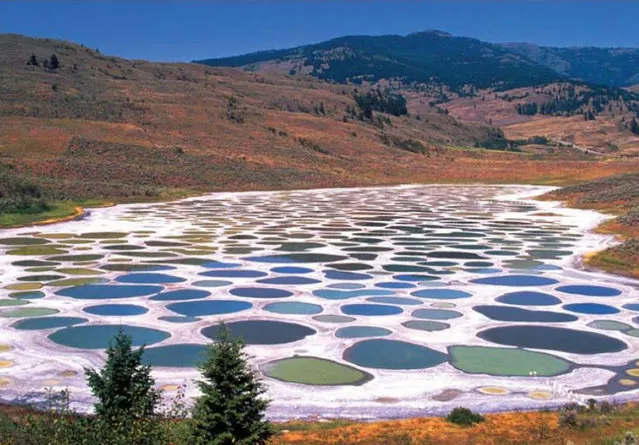
Kliluk, the Spotted Lake, Canada

Originally known to the First Nations of the Okanagan Valley as Khiluk, which was- and remains today revered as a sacred site producing therapeutic waters. During World War I the minerals of Spotted Lake were used in manufacturing ammunition. Later the area came under the control of the Ernest Smith Family, for a term of about 40 years. In 1979 Smith attempted to create interest in a spa at the lake. The First Nations responded with an effort to buy the lake; in October 2001 they finally struck a deal. First Nations arranged the purchase of 22 hectares of land for a total of $720,000, and contributed about 20% of the cost. The Indian Affairs Department paid the remainder.
Details
06 Mar 2015 12:59:00
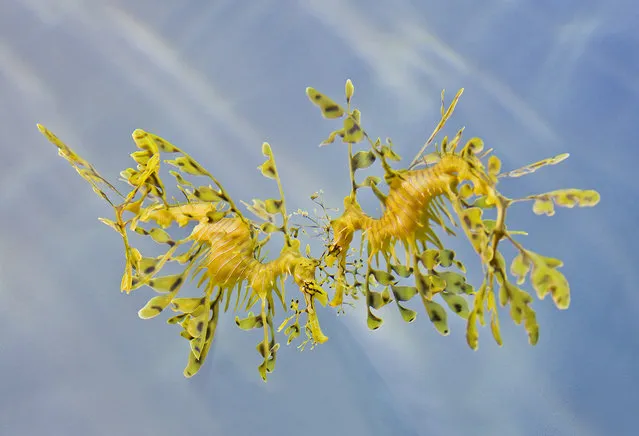
Leafy sea dragon

The leafy seadragon or Glauert's seadragon, Phycodurus eques, is a marine fish in the family Syngnathidae, which also includes the seahorses. It is the only member of the genus Phycodurus. It is found along the southern and western coasts of Australia. The name is derived from the appearance, with long leaf-like protrusions coming from all over the body. These protrusions are not used for propulsion; they serve only as camouflage. The leafy seadragon propels itself by means of a pectoral fin on the ridge of its neck and a dorsal fin on its back closer to the tail end. These small fins are almost completely transparent and difficult to see as they undulate minutely to move the creature sedately through the water, completing the illusion of floating seaweed.
Details
05 Sep 2012 08:51:00
Motorhead fans. (Photo by James Mollison)

“Over three years I photographed fans outside different concerts. I was fascinated by the different tribes of people that attended them, and how people emulated celebrity to form their identity. As I photographed the project I began to see how the concerts became events for people to come together with surrogate “families”, a chance to relive their youth or try and be part of a scene that happened before they were born” – James Mollison.

Photo: Madonna fans. (Photo by James Mollison)
Details
25 Jun 2015 12:45:00
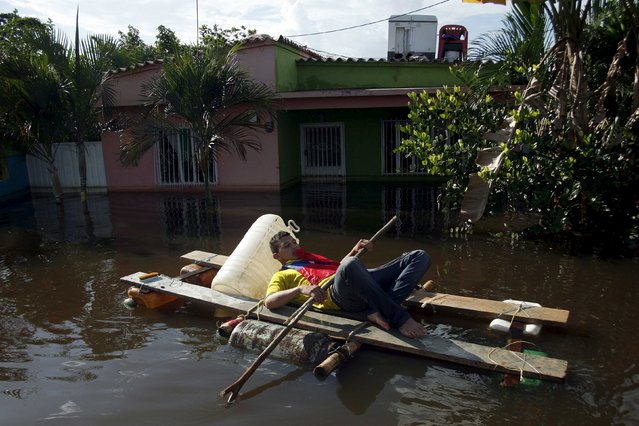
A man paddles a makeshift boat along a flooded street in Guasdualito, in the state of Apure, Venezuela, July 4, 2015. (Photo by Carlos Eduardo Ramirez/Reuters)

A man paddles a makeshift boat along a flooded street in Guasdualito, in the state of Apure, Venezuela, July 4, 2015. A total of 9,000 families have been affected by the overflowing of rivers Arauca and Sarare in Guasdualito, Apure state, because of the heavy rains in recent days in this area of the country, local media reported. (Photo by Carlos Eduardo Ramirez/Reuters)
Details
06 Jul 2015 10:22:00