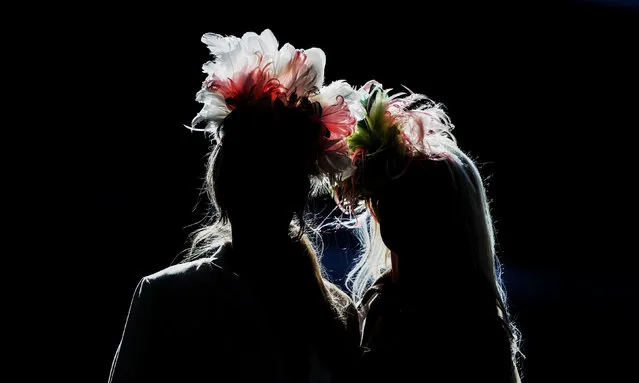
Eddie Ladd and Gwyn Emberton perform as Dylan and Caitlin Thomas in “Caitlin” at the Lauriston Hall, Edinburgh, Scotland on August 25 2017. (Photo by Mary Turner/Reuters)
An injured person is seen after an earthquake hit Port-au-Prince, Haiti, Tuesday, January 12, 2010. A 7.0-magnitude earthquake, the largest ever recorded in the area, rocked Haiti on Tuesday. (Photo by Jorge Cruz/AP Photo)
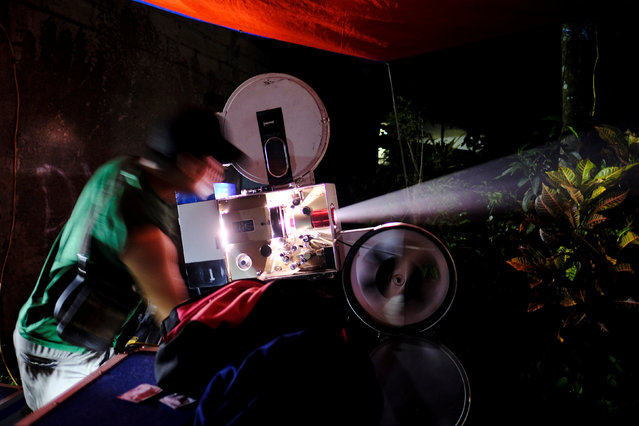
An operator adjusts a film projector during a wedding party in Bogor, Indonesia, February 18, 2017. Indonesian entrepreneur Kamaluddin loves the gritty look of old 35-millimeter film so much that he spends most of his nights screening vintage movies at weddings and parties around Jakarta, the capital. (Photo by Reuters/Beawiharta)
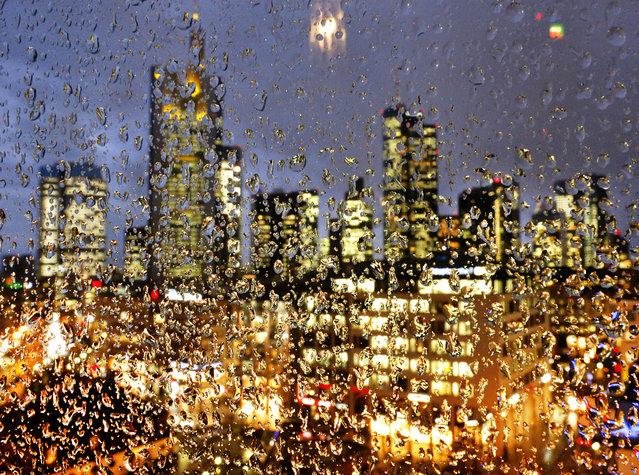
The buildings of the banking district are seen through thousands of rain drops on a glass railing in central Frankfurt, Germany, Wednesday, January 11, 2017. (Photo by Michael Probst/AP Photo)
A girl jumps to touch cherry blossoms in full bloom in Fussa, outskirts Tokyo, Japan, 05 April 2014. Temperatures being very constant made blossoms to keep full bloom for holiday makers. (Photo by Kimimasa Mayama/EPA)
A tourist jumps inside an upside-down house at Fengjing Ancient Town, Jinshan District, south of Shanghai, May 1, 2014. The upside-down house was built as a tourist attraction using everyday household items and furniture. (Photo by Aly Song/Reuters)
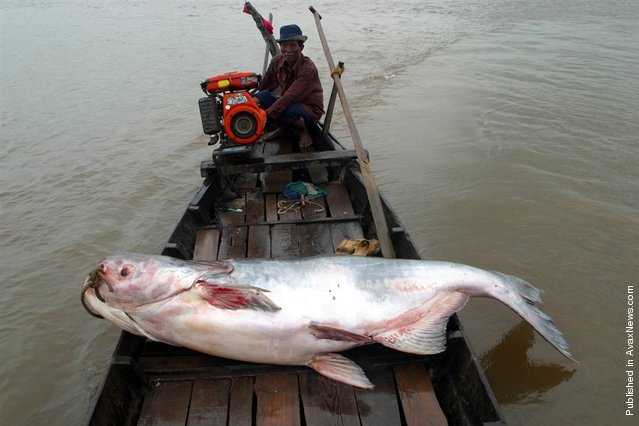
Among the fish populations that could be harmed by the Xayaburi dam in Laos is the critically endangered Mekong giant catfish, considered by the Guinness Book of World Records to be the world’s largest freshwater fish. The fish, which grows to 650 pounds and about 10 feet long, is only found in the Mekong River. It is migratory, moving between downstream habitats in Cambodia upstream to northern Thailand and Laos each year to spawn. Some experts fear the Xayaburi dam could block the migration and drive the giant catfish to extinction. (Photo by Courtesy of Zeb Hogan/University of Nevada, Reno)