Loading...
Done
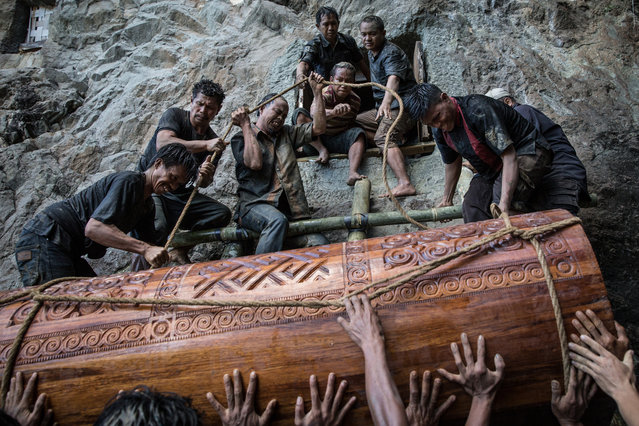
It is said that Torajans are people who “live to die”. For this Indonesian ethnic group, funerals are such extravagant events that they sometimes attract tourists. Families can postpone burials years (and the deceased are considered sick and hosted at home until the funeral) until the family can raise enough money and gather as many relatives as possible. And then it’s a jubilant multiday social event with a parade, dances and animal sacrifices. Agung Parameswara photographed these funerary practices when he traveled to South Sulawesi province, where the Torajans live. But often, their funeral isn’t the last time the dead are seen. In August, crypts are opened, coffins are slid back out and bodies delicately unsheathed. This tender ritual is known as Ma’Nene, which is customarily performed every few years. (Photo by Agung Parameswara/The Washington Post)

It is said that Torajans are people who “live to die”. For this Indonesian ethnic group, funerals are such extravagant events that they sometimes attract tourists. Families can postpone burials years (and the deceased are considered sick and hosted at home until the funeral) until the family can raise enough money and gather as many relatives as possible. And then it’s a jubilant multiday social event with a parade, dances and animal sacrifices. Agung Parameswara photographed these funerary practices when he traveled to South Sulawesi province, where the Torajans live. (Photo by Agung Parameswara/The Washington Post)
Details
06 Oct 2016 09:15:00
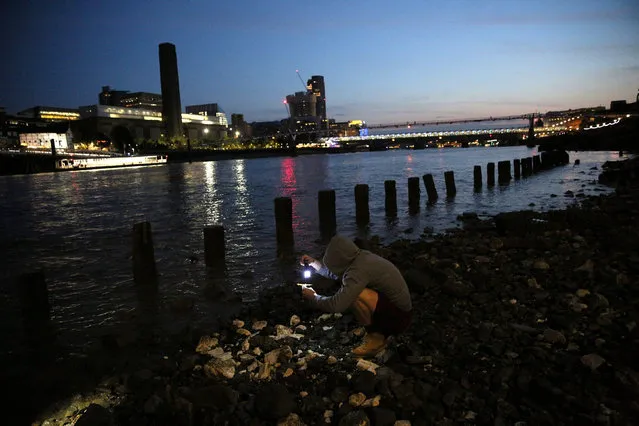
A mudlark uses a torch to look for items on the bank of the River Thames in London, Britain June 06, 2016. Mudlarking is believed to trace its origins to the 18th and 19th century, when scavengers searched the Thames' shores for items to sell. These days, history and archaeology fans are the ones hoping to find old relics such as coins, ceramics, artifacts or everyday items from across centuries. They wait for the low tide and then scour specific areas of exposed shores. "If you're in a field you could be out all day long, with the river you're restricted to about two or three hours," mudlark Nick Stevens said. While many just use the naked eye for their searches, others rely on metal detectors for which a permit from the Port of London Authority is needed. Digging also requires consent. (Photo by Neil Hall/Reuters)

A mudlark uses a torch to look for items on the bank of the River Thames in London, Britain June 06, 2016. Mudlarking is believed to trace its origins to the 18th and 19th century, when scavengers searched the Thames' shores for items to sell. These days, history and archaeology fans are the ones hoping to find old relics such as coins, ceramics, artifacts or everyday items from across centuries. their finds with the Portable Antiquities Scheme. Any item over 300 years old must be recorded. (Photo by Neil Hall/Reuters)
Details
27 Aug 2016 10:43:00
British Holidaymakers seen partying partying in Punta Bella main Street in Magaluf, a major holiday resort on the Spanish island of Majorca this summer, July 2017. (Photo by Splash News and Pictures)

British Holidaymakers seen partying partying in Punta Bella main Street in Magaluf, a major holiday resort on the Spanish island of Majorca this summer, July 2017. (Photo by Splash News and Pictures)
Details
19 Jul 2017 08:34:00
A group of PETA supporters protest Canada Goose's use of coyote fur, with “Canada Goose Kills” painted on their backs in New York, USA on October 18, 2018. (Photo by Erik Pendzich/Rex Features/Shutterstock)

A group of PETA supporters protest Canada Goose's use of coyote fur, with “Canada Goose Kills” painted on their backs in New York, USA on October 18, 2018. (Photo by Erik Pendzich/Rex Features/Shutterstock)
Details
14 Nov 2018 00:01:00
People in funny costumes race down the slope in bathtubs during the 7th Bathtub race at Stoos, Switzerland, on January 19, 2019. (Photo by Urs Flueeler/EPA/EFE/Rex Features/Shutterstock)

People in funny costumes race down the slope in bathtubs during the 7th Bathtub race at Stoos, Switzerland, on January 19, 2019. (Photo by Urs Flueeler/EPA/EFE/Rex Features/Shutterstock)
Details
27 Jan 2019 00:10:00
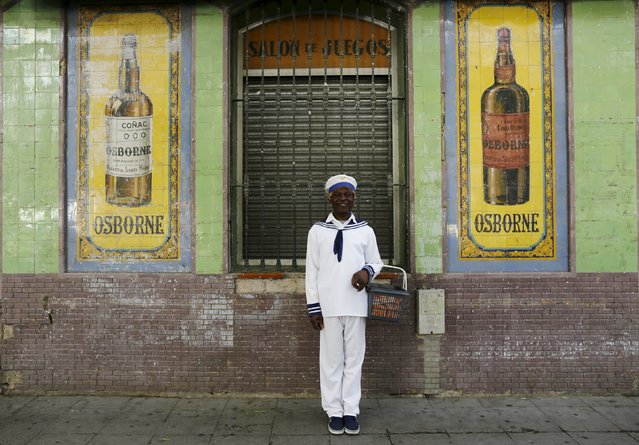
Howard Jackson, a Liberian migrant, poses for a portrait in the Andalusian capital of Seville, southern Spain March 7, 2016. (Photo by Marcelo del Pozo/Reuters)

Howard Jackson, a Liberian migrant, poses for a portrait in the Andalusian capital of Seville, southern Spain March 7, 2016. Jackson escaped civil war and spent three years crossing Africa before reaching Spain. Dressed up in one of his more than 200 costumes, from Peter Pan to Little Red Riding Hood, he is a well-known figure at an intersection entering the Spanish city of Seville where he has sold tissues to motorists for over a decade. Jackson is studying law and wants to become a judge. (Photo by Marcelo del Pozo/Reuters)
Details
24 Mar 2016 12:14:00
A vendor sells chili peppers at his stall at a market in Bangkok, Thailand March 31, 2016. (Photo by Jorge Silva/Reuters)

A vendor sells chili peppers at his stall at a market in Bangkok, Thailand March 31, 2016. (Photo by Jorge Silva/Reuters)
Details
01 Apr 2016 12:09:00
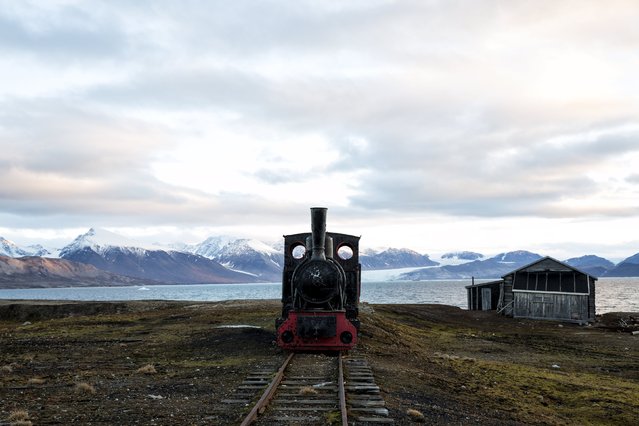
An old locomotive train that was used for transporting coal is preserved as a monument at Ny-Alesund, in Svalbard, Norway, October 11, 2015. (Photo by Anna Filipova/Reuters)

An old locomotive train that was used for transporting coal is preserved as a monument at Ny-Alesund, in Svalbard, Norway, October 11, 2015. A Norwegian chain of islands just 1,200 km (750 miles) from the North Pole is trying to promote new technologies, tourism and scientific research in a shift from high-polluting coal mining that has been a backbone of the remote economy for decades. (Photo by Anna Filipova/Reuters)
Details
29 Jan 2016 13:19:00