Loading...
Done
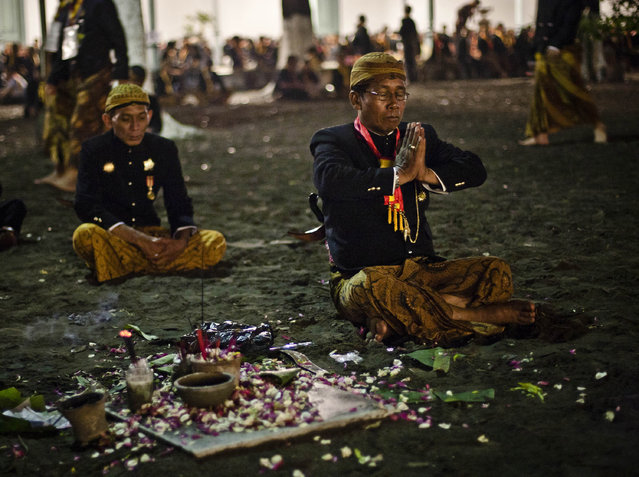
Javanese people pray before rituals night carnival “1st Suro” (Javanese calender) during  Islamic New Year celebrations at Kasunanan Palace on November 14, 2012 in Solo City, Central Java, Indonesia. Javanese will celebrate the national holiday with ceremonies and rituals marking the 1434th Islamic New Year's Eve or “1st Suro”. The parade started from Keraton Kasunanan and is headed by a group of albino buffaloes, known as Kebo Bule. Local people believe that the parade of Heirlooms and Kebo Bule will bring them a better life. (Photo by Ulet Ifansasti)

Javanese people pray before rituals night carnival “1st Suro” (Javanese calender) during Islamic New Year celebrations at Kasunanan Palace on November 14, 2012 in Solo City, Central Java, Indonesia. Javanese will celebrate the national holiday with ceremonies and rituals marking the 1434th Islamic New Year's Eve or “1st Suro”. The parade started from Keraton Kasunanan and is headed by a group of albino buffaloes, known as Kebo Bule. Local people believe that the parade of Heirlooms and Kebo Bule will bring them a better life. (Photo by Ulet Ifansasti)
Details
16 Nov 2012 07:37:00
Disguised participants strike poses on a car during the ancient carnival of Ituren, in the northern Spanish Navarra province on January 30, 2017. The yearly three day festivities, revolving mainly around agriculture and principally sheep hearding, run on the last Sunday, Monday and Tuesday of January where Navarra Valley locals from two villages dress up and participate in a variety of activites as they perform a pilgrimage through each village. (Photo by Ander Gillenea/AFP Photo)

Disguised participants strike poses on a car during the ancient carnival of Ituren, in the northern Spanish Navarra province on January 30, 2017. The yearly three day festivities, revolving mainly around agriculture and principally sheep hearding, run on the last Sunday, Monday and Tuesday of January where Navarra Valley locals from two villages dress up and participate in a variety of activites as they perform a pilgrimage through each village. (Photo by Ander Gillenea/AFP Photo)
Details
31 Jan 2017 10:00:00
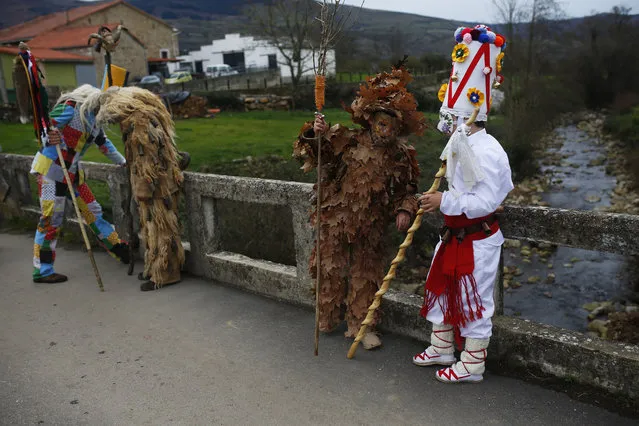
People dressed in costumes have a break while marching during the Vijanera Festival, in the small village of Silio, northern Spain, Sunday, January 3, 2016. The Vijanera masquerade, of pre-Roman origin, is the first carnival of the year in Europe symbolizing the triumph of good over evil and involving the participation of crowds of residents wearing different masks, animal skins and brightly coloured clothing with its own complex function and symbolism and becoming the living example of the survival of archaic cults to nature. (Photo by Francisco Seco/AP Photo)

People dressed in costumes have a break while marching during the Vijanera Festival, in the small village of Silio, northern Spain, Sunday, January 3, 2016. The Vijanera masquerade, of pre-Roman origin, is the first carnival of the year in Europe symbolizing the triumph of good over evil and involving the participation of crowds of residents wearing different masks, animal skins and brightly coloured clothing with its own complex function and symbolism and becoming the living example of the survival of archaic cults to nature. (Photo by Francisco Seco/AP Photo)
Details
04 Jan 2016 10:17:00
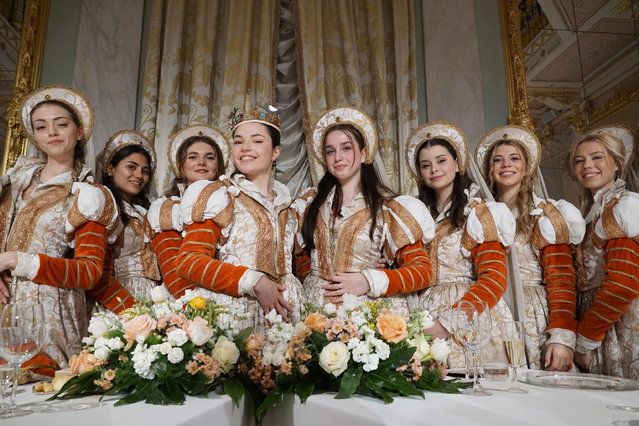
Silvia Zecchin (4L) wearing a crown poses with a group of Maries, at the end of the ceremony that crowned her Maria of Carnival 2024, in Venice, Italy, 13 February 2024. The young student of Political Science at the University of Padua, in addition to teaching rhythmic gymnastics to children, was elected at the end of the Gala Dinner hosted in the Apollinee rooms of the Teatro La Fenice in Venice and hosted by Maurice Agosti and Alice Bars. (Photo by Andrea Merola/EPA)

Silvia Zecchin (4L) wearing a crown poses with a group of Maries, at the end of the ceremony that crowned her Maria of Carnival 2024, in Venice, Italy, 13 February 2024. The young student of Political Science at the University of Padua, in addition to teaching rhythmic gymnastics to children, was elected at the end of the Gala Dinner hosted in the Apollinee rooms of the Teatro La Fenice in Venice and hosted by Maurice Agosti and Alice Bars. (Photo by Andrea Merola/EPA)
Details
24 May 2025 02:16:00


“Sektor gaza” (Russian: Сектор газа) was a Russian rock band formed on 5 December 1987 in the city of Voronezh, Russia. Despite only semi-officially existing (due to obscene lyrics), the group remains popular in Russia today. The group name was taken from an eponymous industrial district of Voronezh (itself named for high levels of environmental contamination). Their music style could be defined as Russian punk, integrated with elements of different musical genres such as rock, rap, and Russian folk. On 4 July 2000, group leader Yuri “Hoy” Klinskih complained of strong pains in his stomach and the left side of his chest. He suffered heart failure shortly thereafter. Klinskikh died in Voronezh (Russia)at the age of 35. He is buried in the Levoberezhniy Cemetery. The group ceased to exist.

About the music video: The First Chechen War, also known as the War in Chechnya, was a conflict between the Russian Federation and the Chechen Republic of Ichkeria, fought from December 1994 to August 1996. After the initial campaign of 1994 – 1995, culminating in the devastating Battle of Grozny, Russian federal forces attempted to seize control of the mountainous area of Chechnya but were set back by Chechen guerrilla warfare and raids on the flatlands in spite of Russia's overwhelming manpower, weaponry, and air support...

Details
24 May 2012 14:38:00
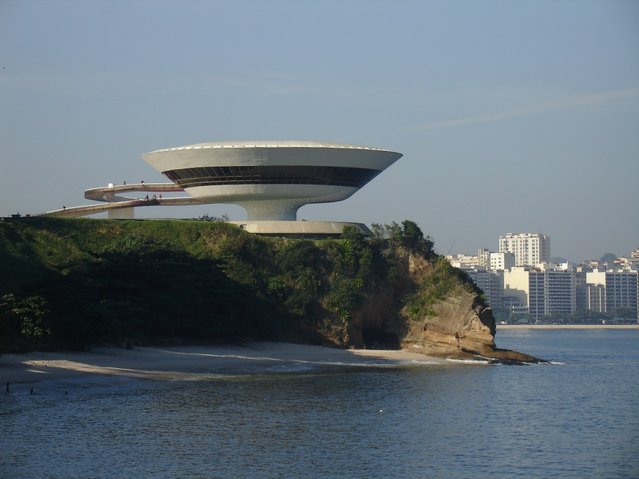
Niterói Contemporary Art Museum

The Niterói Contemporary Art Museum (Museu de Arte Contemporânea de Niterói — MAC) is situated in the city of Niterói, Rio de Janeiro, Brazil, and is one of the city’s main landmarks. It was completed in 1996.
Details
13 Aug 2013 10:18:00
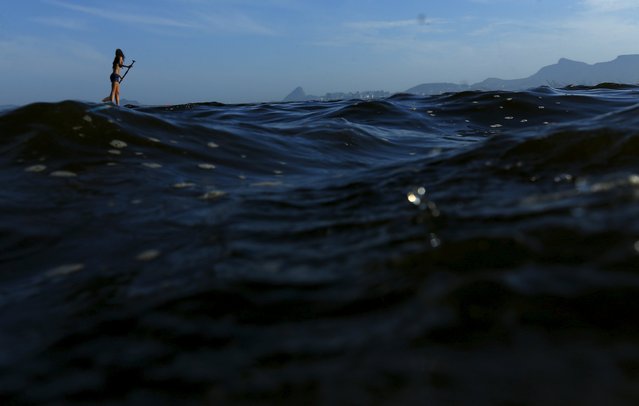
A girl paddles on her stand-up board on the waters of Guanabara bay at Bica beach in Rio de Janeiro Brazil, January 10, 2016. (Photo by Ricardo Moraes/Reuters)

A girl paddles on her stand-up board on the waters of Guanabara bay at Bica beach in Rio de Janeiro Brazil, January 10, 2016. Few features capture the beauty, or the problems, of one of the world's most dramatic urban landscapes like Guanabara Bay - the finger-like inlet that forms the shoreline and harbor for Rio de Janeiro. The bay, which carves into southeast Brazil from the Atlantic Ocean, literally gave Rio its name when Portuguese mariners mistook it for a “rio”, or “river”. Four centuries later, the bay is preparing to welcome another sort of seafarer – Olympic sailors, who will navigate the bay when the 2016 Rio Olympics kick off in August. (Photo by Ricardo Moraes/Reuters)
Details
28 Apr 2016 12:13:00
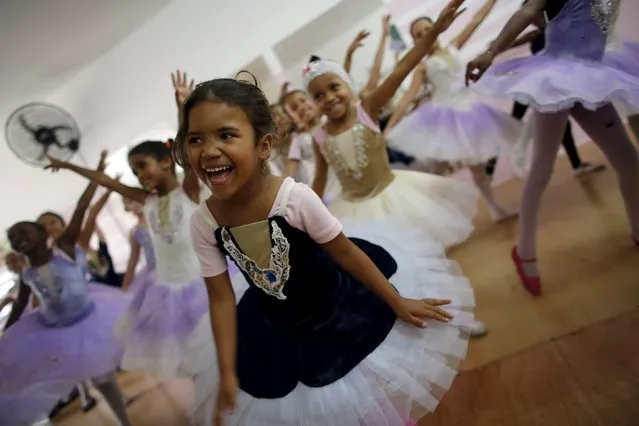
Young girls take ballet lessons at the New Dreams dance studio in the Luz neighborhood known to locals as Cracolandia (Crackland) in Sao Paulo, Brazil, August 14, 2015. (Photo by Nacho Doce/Reuters)

Young girls take ballet lessons at the New Dreams dance studio in the Luz neighborhood known to locals as Cracolandia (Crackland) in Sao Paulo, Brazil, August 14, 2015. For the young girls learning to jump and plie, the dance studio provides a way forward and out of the difficult environment they have grown up in. Brazil is one of the world's highest consuming countries of crack cocaine, and Cracolandia, or “Crack Land”, located in the outskirts of Sao Paulo, is one of the most intense and brutal hubs. (Photo by Nacho Doce/Reuters)
Details
18 Aug 2015 13:59:00