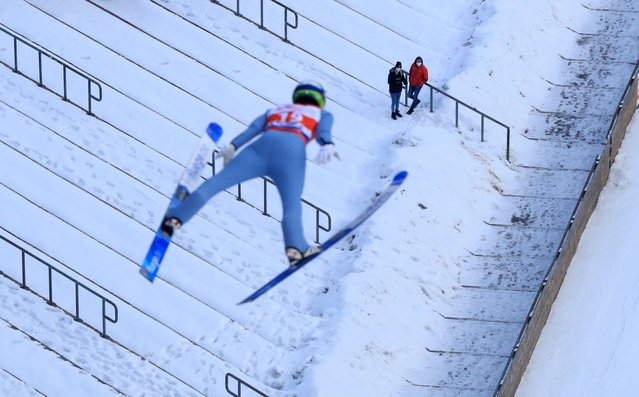
Spectators watch Austria's Stefan Kraft in action during the Viessmann FIS Ski Jumping World Cup Willingen on January 31, 2021 in Willingen, Germany. (Photo by Wolfgang Rattay/Reuters)
Private Wallace Tratford arrives home on leave, Drouin, Victoria, ca. 1944. A.I.F. Private Wallace Tratford, son of 1st Constable James Tratford, Drouin's only policeman (responsible for area of 105 square miles; 3,000 people), arrives home on his first leave from New Guinea battlefronts since he was married.
Marcelo Vieira of Real Madrid celebrates with Sergio Ramos after scoring Real's opening goal during the UEFA Champions League round of 16 second leg match between Real Madrid and Lyon at Estadio Santiago Bernabeu on March 16, 2011 in Madrid, Spain.
Caroline Wozniacki of Denmark serves in her match against Kaia Kanepi of Estonia during day four of the Toray Pan Pacific Open at Ariake Colosseum on September 28, 2011 in Tokyo, Japan. (Photo by Koji Watanabe/Getty Images)
A fan of Colombia wears a tiger costume prior to the FIFA Women's World Cup Australia & New Zealand 2023 Group H match between Germany and Colombia at Sydney Football Stadium on July 30, 2023 in Sydney, Australia. (Photo by Justin Setterfield/Getty Images)
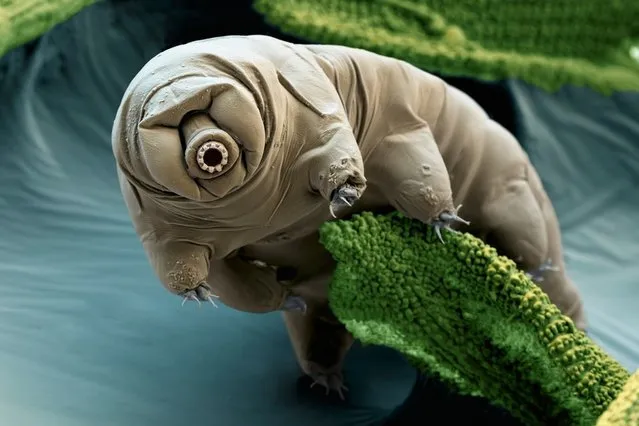
“Tardigrades (commonly known as waterbears or moss piglets) are small, water-dwelling, segmented animals with eight legs. Tardigrades were first discovered in 1773 by Johann August Ephraim Goeze, who called them kleiner Wasserbär, meaning “little water bear” in German. The name Tardigrada means “slow walker” and was given by Lazzaro Spallanzani in 1777. The name water bear comes from the way they walk, reminiscent of a bear's gait. The biggest adults may reach a body length of 1.5 millimetres (0.059 in), the smallest below 0.1 mm. Freshly hatched tardigrades may be smaller than 0.05 mm”. – Wikipedia. Photo: Tardigrades. (Photo by SPL/East News)