Loading...
Done
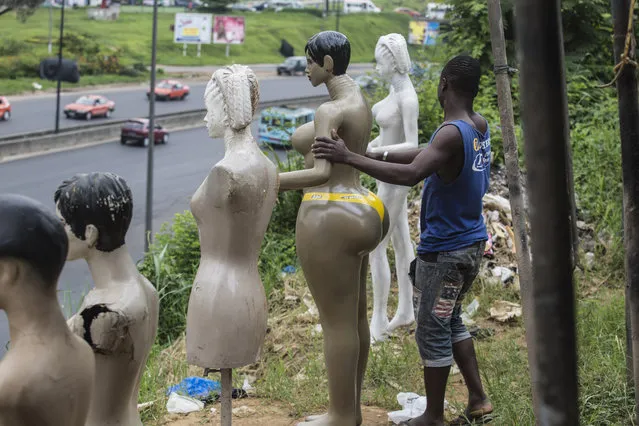
A curvy woman is considered prosperous, healthy and s*xy in Ivory Coast, photographer Joana Choumali explains. Here: An apprentice lines up his work on a roadside. (Photo by Joana Choumali)

Photographer Joana Choumali’s latest project explores body image and beauty by documenting the men building Abidjan’s clothing models. The “Awoulaba” mannequin is a customised model designed with the African ideal of beauty in mind, curvier than the stick-thin examples usually seen in the west. They first appeared in 2011, and have since become a familiar sight outside the numerous clothing shops dotted throughout Ivory Coast’s capital, Abidjan. Here: An apprentice lines up his work on a roadside. (Photo by Joana Choumali)
Details
06 Jun 2016 11:05:00
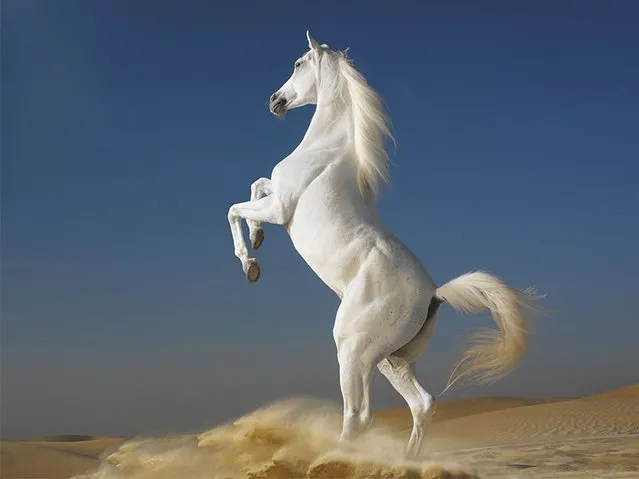
Horse photography By Tim Flach

Famed for his fascination with animals, British photographer Tim Flach places them in the same position as humans, using the pure form of photography. As friends of humans, animals made their contribution to human development, but their existence were nevertheless often neglected in this process. Tim Flach however gave the public an opportunity recognize these friends. The horse, one of Tim Flach’s favorite animals, is portrayed with an imposing elegance in his tribute to this men’s old friend. Tim Flach’s horse moves like music that undulates between serenity and grandeur.
Details
30 May 2014 08:54:00
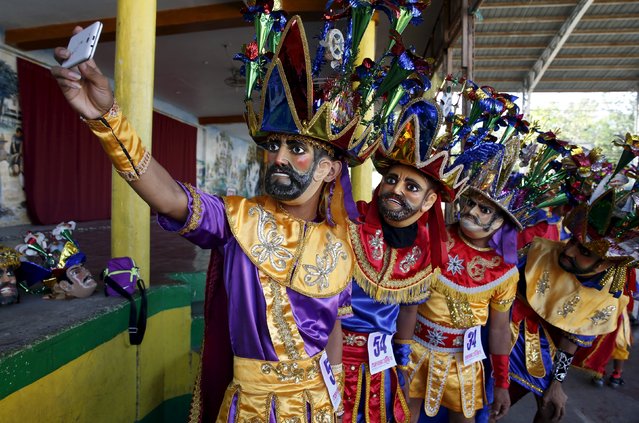
Penitents wearing masks, known locally as “Morions” take a selfie during the start of Holy Week celebrations in Mogpog, Marinduque in central Philippines March 21, 2016. (Photo by Erik De Castro/Reuters)

Penitents wearing masks, known locally as “Morions” take a selfie during the start of Holy Week celebrations in Mogpog, Marinduque in central Philippines March 21, 2016. The Moriones is an annual festival held on Holy Week on the island of Marinduque, Philippines. The “Moriones” are men and women in costumes and masks replicating the garb of biblical Roman soldiers as interpreted by local folks. (Photo by Erik De Castro/Reuters)
Details
22 Mar 2016 11:29:00
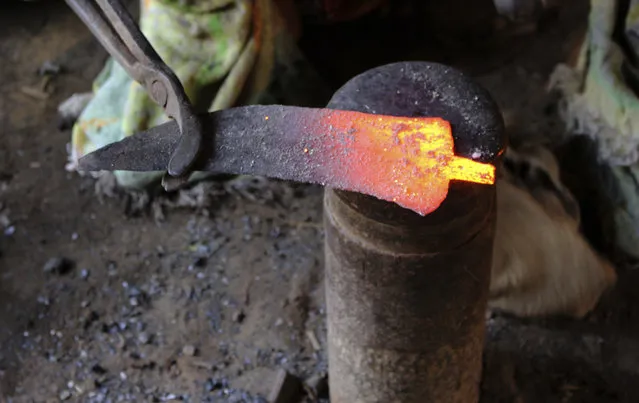
In this October 6, 2018, photo, a craftsman makes daggers or “Jambiyya” in Yemeni Arabic, made out of remains of missiles, at his workshop, in Hajjah, Yemen. (Photo by Hammadi Issa/AP Photo)

In this October 6, 2018, photo, a craftsman makes daggers or “Jambiyya” in Yemeni Arabic, made out of remains of missiles, at his workshop, in Hajjah, Yemen. Missiles raining on Yemen from the jets of the Saudi-led coalition fighting Houthi rebels are killing thousands of civilians and militiamen alike, but amid crashing economy, some Yemenis see the bright side of it: they make daggers out of the fragments of the missiles for ordinary men traditionally wear for prestige and a show of courage. (Photo by Hammadi Issa/AP Photo)
Details
10 Oct 2018 00:01:00
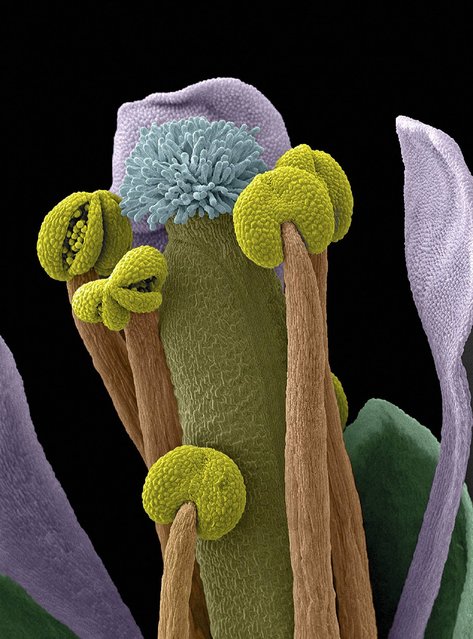
Scanning electron micrograph (SEM) of an Arabidopsis thaliana flower, also commonly known as thale cress. Some of the anthers are open, revealing pollen grains ready for dispersal. Arabidopsis was the first plant to have its entire genome sequenced and is widely used as a model organism in molecular and plant biology. Horizontal width of image is 1200 microns. Magnification 100x. (Photo by Stefan Eberhard/Wellcome Images)

Beautiful, strange and occasionally alarming pictures from the shortlist for this year’s Wellcome image awards – which celebrate the very best in science photography and imaging – from an x-ray of a bat to a micrograph of a kidney stone. The exhibition opens on 12 March at three science centres and the Museum of Science and Industry in Manchester. Photo: Scanning electron micrograph (SEM) of an Arabidopsis thaliana flower, also commonly known as thale cress. Some of the anthers are open, revealing pollen grains ready for dispersal. Arabidopsis was the first plant to have its entire genome sequenced and is widely used as a model organism in molecular and plant biology. Horizontal width of image is 1200 microns. Magnification 100x. (Photo by Stefan Eberhard/Wellcome Images)
Details
11 Mar 2014 05:58:00
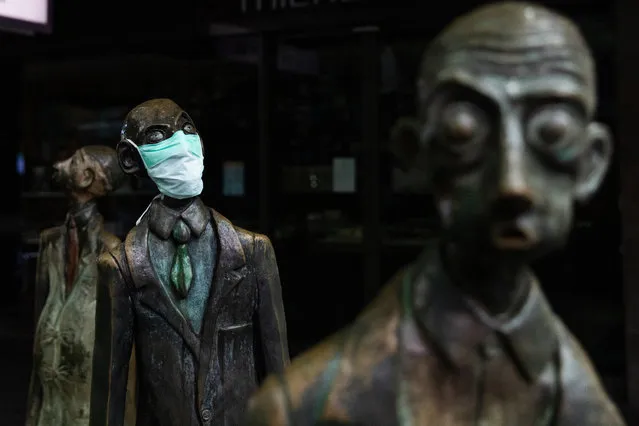
A face mask is placed on one of the 'Three business men who brought lunch' statues on Swanston street on March 29, 2020 in Melbourne, Australia. All international arrivals into Australia from midnight on Saturday will be placed into mandatory quarantine in hotels for 14 days as the Federal Government increases restrictions to stop the spread of COVID-19. All libraries, museums, galleries, beauty salons, tattoo parlours, shopping centre food courts, auctions, open houses, amusement parks, arcades, indoor and outdoor play centres, swimming pools are closed and indoor exercise activities are now banned. This is in addition to the closure of bars, pubs and nightclubs which came into effect on Monday. Restaurants and cafes are restricted to providing takeaway only. Weddings will now be restricted to five people including the couple while funerals are limited to 10 mourners. All Australians are now expected to stay at home except for essential outings such as work, grocery shopping and medical appointments. Exercising outdoors alone is still permitted. Australia now has more than 3,600 confirmed cases of COVID-19 while the death toll now stands at 16. (Photo by Asanka Ratnayake/Getty Images)

A face mask is placed on one of the 'Three business men who brought lunch' statues on Swanston street on March 29, 2020 in Melbourne, Australia. All international arrivals into Australia from midnight on Saturday will be placed into mandatory quarantine in hotels for 14 days as the Federal Government increases restrictions to stop the spread of COVID-19. (Photo by Asanka Ratnayake/Getty Images)
Details
31 Mar 2020 00:07:00
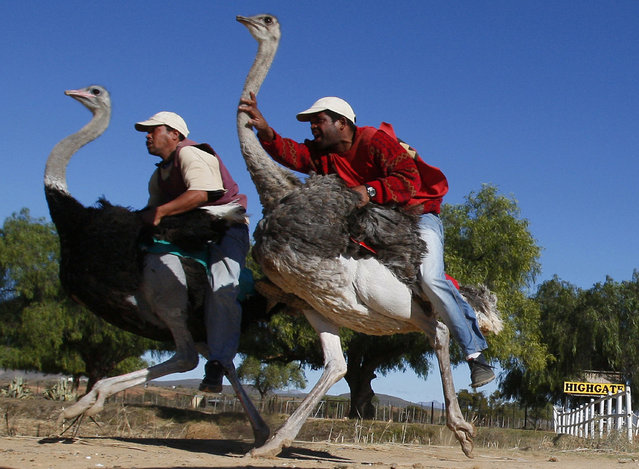
In this Sunday, June 27, 2010 file photo two men compete in an ostrich race at Highgate ostrich farm in Oudtshoorn, South Africa. Clambering onto an ostrich for a ride used to be popular among tourists in a South African town of  Oudtshoorn known of  as the  “ostrich capital of the world”. Not so much anymore. Two major ostrich farms in Oudtshoorn have stopped offering ostrich rides to tourists, responding to concerns about the birds’ welfare. A third farm is sticking with the feature, saying it is regulated and that ostriches do not experience discomfort.. The Highgate farm, however, continues to offer ostrich rides. (Photo by Shuji Kajiyama/AP Photo)

In this Sunday, June 27, 2010 file photo two men compete in an ostrich race at Highgate ostrich farm in Oudtshoorn, South Africa. Clambering onto an ostrich for a ride used to be popular among tourists in a South African town of Oudtshoorn known of as the “ostrich capital of the world”. Not so much anymore. Two major ostrich farms in Oudtshoorn have stopped offering ostrich rides to tourists, responding to concerns about the birds’ welfare. A third farm is sticking with the feature, saying it is regulated and that ostriches do not experience discomfort. The Highgate farm, however, continues to offer ostrich rides. (Photo by Shuji Kajiyama/AP Photo)
Details
20 Jun 2017 07:23:00
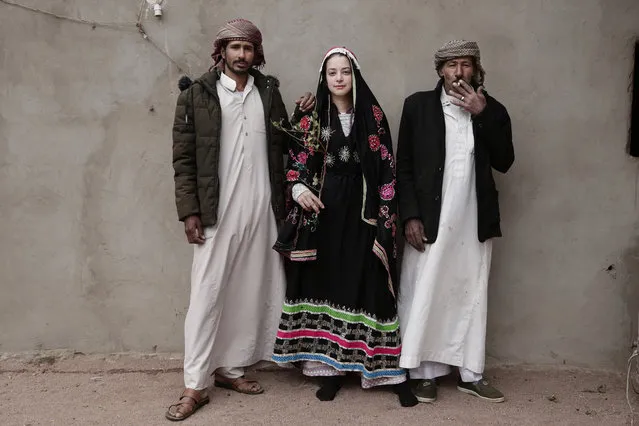
In this March 31, 2019 photo, an Egyptian student borrows a Bedouin wedding dress to pose for a photograph with Bedouin men from the Hamada tribe, in Wadi Sahw, Abu Zenima, in South Sinai, Egypt. Four Bedouin women are for the first time leading tours in Egypt’s Sinai Peninsula, breaking new ground in their deeply conservative community, where women almost never work outside the home or interact with outsiders.  The tourists can only be women, and the tours can’t go overnight. Each day before the sun sets, the group returns to the Hamada’s home village in Wadi Sahu, a narrow desert valley. (Photo by Nariman El-Mofty/AP Photo)

In this March 31, 2019 photo, an Egyptian student borrows a Bedouin wedding dress to pose for a photograph with Bedouin men from the Hamada tribe, in Wadi Sahw, Abu Zenima, in South Sinai, Egypt. Four Bedouin women are for the first time leading tours in Egypt’s Sinai Peninsula, breaking new ground in their deeply conservative community, where women almost never work outside the home or interact with outsiders. The tourists can only be women, and the tours can’t go overnight. Each day before the sun sets, the group returns to the Hamada’s home village in Wadi Sahu, a narrow desert valley. (Photo by Nariman El-Mofty/AP Photo)
Details
11 Apr 2019 00:01:00