Loading...
Done
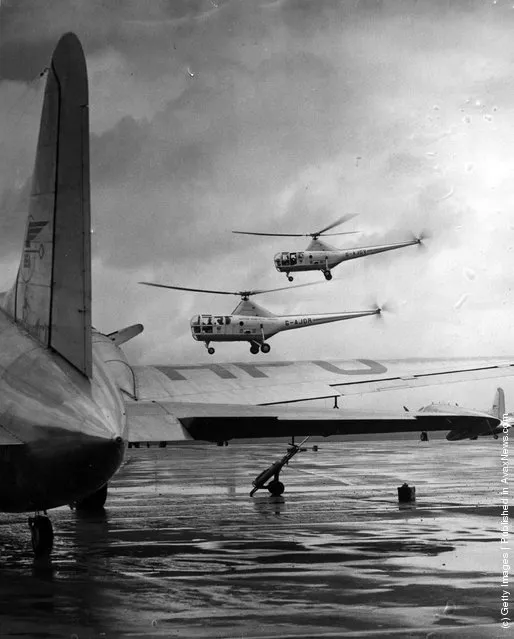
Sikorsky H-5 helicopters

“Igor Sikorsky (May 25, 1889 – October 26, 1972), born Igor Ivanovich Sikorsky was a Russian American pioneer of aviation in both helicopters and fixed-wing aircraft. He designed and flew the world's first multi-engine fixed-wing aircraft, the Russky Vityaz in 1913, and the first airliner, Ilya Muromets, in 1914. After immigrating to the United States in 1919, Sikorsky founded the Sikorsky Aircraft Corporation in 1923, and developed the first of Pan American Airways' ocean-conquering flying boats in the 1930s. In 1939 Sikorsky designed and flew the Vought-Sikorsky VS-300, the first viable American helicopter, which pioneered the rotor configuration used by most helicopters today. Sikorsky would modify the design into the Sikorsky R-4, which became the world's first mass-produced helicopter in 1942”. – Wikipedia

Photo: Westland Sikorsky H-5's, used by British European Airways Helicopters, which fly between London and Birmingham. The Sikorsky H-5, (aka R-5, S-51, HO3S-1, or Horse) (R-5 until 1948; company designation VS-327) is a helicopter built by Sikorsky Aircraft Corporation, formerly used by the United States Air Force, and its predecessor, the United States Army Air Forces, as well as the United States Navy and United States Coast Guard (with the designations HO2S and HO3S). (Photo by Harrison /Topical Press Agency/Getty Images). 22nd May 1951
Details
06 Sep 2011 10:18:00
Ocean voyage

Do you think that history is a science? Well, not exactly. First, and foremost, history is the state's “legend of wars”, it’s official regalia. Of course, public historians are not interested in scientific truth – quite the opposite. In this respect, any attempt to present a state’s history as altruistic and benevolent as possible is welcomed and encouraged – as opposed to any revisionism attempts that may be more accurate. In this matter, Chinese have surpassed us all – they revised in highly creative manner (but rather shamelessly) the technology already invented by Europeans, a process that resulted in oldest state on the planet. Here is an interesting paradox: ask any sinologist about the Middle Kingdom during second century B.C., and he will describe it to you in such a vivid manner as if he has been living there all his life – but as soon as you will ask him to describe Chinese history in the 19-20th centuries… let's say, his eagerness will be greatly diminished. However, we will discuss China in a different article, and in the meantime we will try to understand how exactly historic “legend of wars” is formed and functions – based on a specific and well-known example. A great example is Ferdinand Magellan's first voyage around the world.
Details
14 Nov 2011 09:11:00
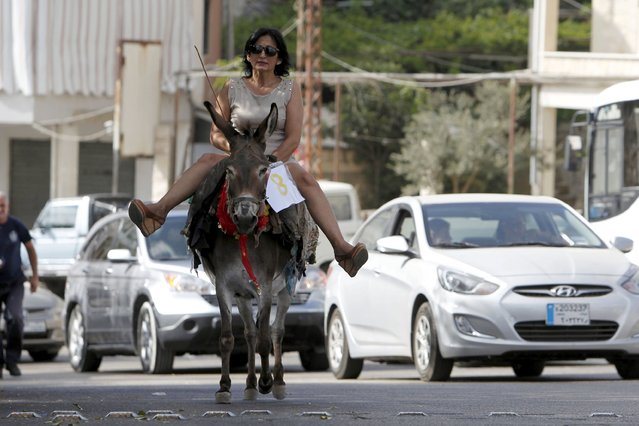
A woman rides a donkey during a donkey race in Roum village, Jizeen countryside, southern Lebanon, August 9, 2015. (Photo by Ali Hashisho/Reuters)

A woman rides a donkey during a donkey race in Roum village, Jizeen countryside, southern Lebanon, August 9, 2015. (Photo by Ali Hashisho/Reuters)
Details
10 Aug 2015 09:11:00
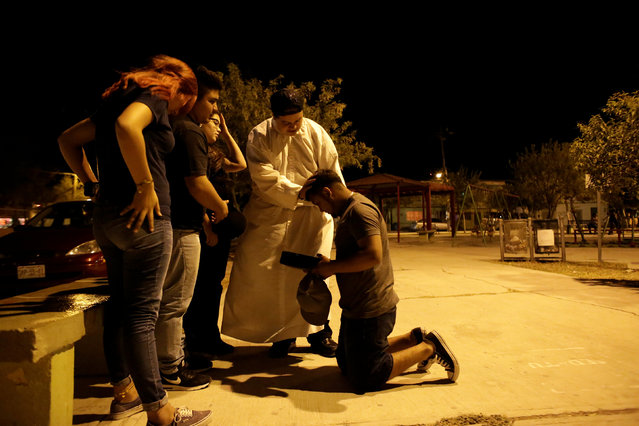
An aspiring Catholic priest Jose Luis Guerra, a member of Raza Nueva in Christ, a project of the archdiocese of Monterrey, and other missionaries hand out a Bible to Angel Castillo, who wants to become a missionary with Raza Nueva, in the municipality of Garcia, outskirts of Monterrey, Mexico, July 12, 2016. (Photo by Daniel Becerril/Reuters)

An aspiring Catholic priest Jose Luis Guerra, a member of Raza Nueva in Christ, a project of the archdiocese of Monterrey, and other missionaries hand out a Bible to Angel Castillo, who wants to become a missionary with Raza Nueva, in the municipality of Garcia, outskirts of Monterrey, Mexico, July 12, 2016. In the troubled fringes of the northern Mexican city of Monterrey, an aspiring priest is using his faith to reach out to young gang members and at-risk youth, and bring them into his “Gang of Christ”. (Photo by Daniel Becerril/Reuters)
Details
28 Jul 2016 13:22:00
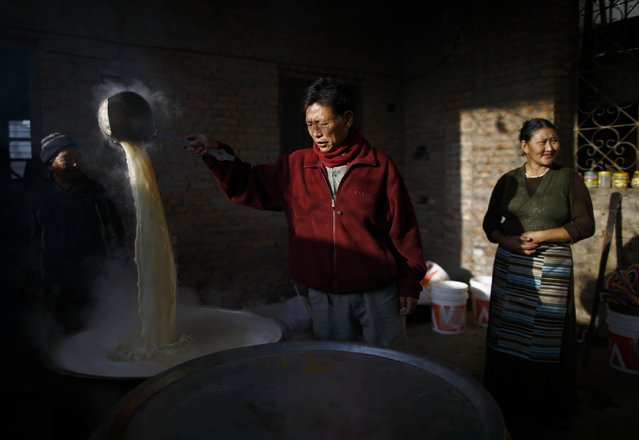
A Tibetan man stirs butter tea made for the arriving guest during the function organised to mark Losar or the Tibetan New Year at a Tibetan Refugee Camp in Lalitpur February 19, 2015. (Photo by Navesh Chitrakar/Reuters)

A Tibetan man stirs butter tea made for the arriving guest during the function organised to mark Losar or the Tibetan New Year at a Tibetan Refugee Camp in Lalitpur February 19, 2015. Tibetans across the world marked the arrival of the New Year with prayers and festivities. (Photo by Niranjan Shrestha/AP Photo)
Details
20 Feb 2015 13:06:00
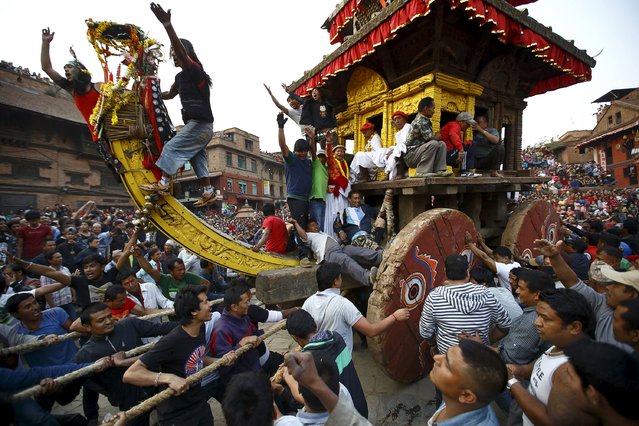
The chariot of God Bhairab is pulled through the city centre of Bhaktapur near Kathmandu during the Bisket festival April 10, 2015. The festival, which runs for more than a week and coincides with the Nepalese New Year, involves devotees offering prayers and the pulling of two chariots, one carrying the idol of God Bhairab and the other with the idol of Goddess Bhadrakali, around the ancient city of Bhaktapur. (Photo by Navesh Chitrakar/Reuters)

The chariot of God Bhairab is pulled through the city centre of Bhaktapur near Kathmandu during the Bisket festival April 10, 2015. The festival, which runs for more than a week and coincides with the Nepalese New Year, involves devotees offering prayers and the pulling of two chariots, one carrying the idol of God Bhairab and the other with the idol of Goddess Bhadrakali, around the ancient city of Bhaktapur. Devotees participate in the festival with the belief that they will be blessed with good health, fortune and harvest for the coming year. (Photo by Navesh Chitrakar/Reuters)
Details
12 Apr 2015 07:52:00
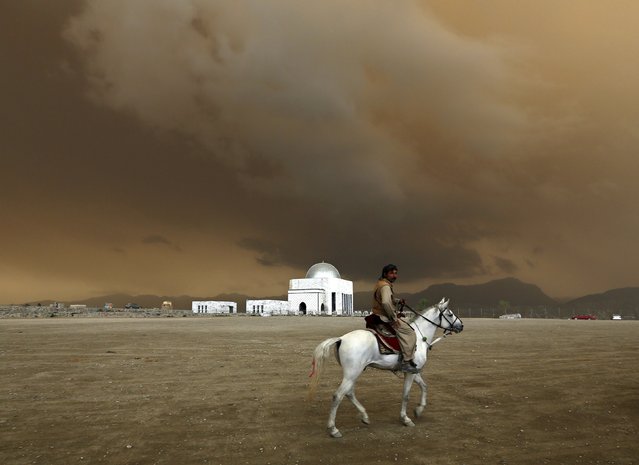
A man rides a horse at a playground on a hill in Kabul April 19, 2015. (Photo by Mohammad Ismail/Reuters)

A man rides a horse at a playground on a hill in Kabul April 19, 2015. (Photo by Mohammad Ismail/Reuters)
Details
21 Apr 2015 10:46:00
A Kashmiri woman walks on a footbridge as it rains in Srinagar, June 24, 2015. This year's monsoon rains in India are officially forecast to be only 88 percent of the long-term average. (Photo by Danish Ismail/Reuters)

A Kashmiri woman walks on a footbridge as it rains in Srinagar, June 24, 2015. This year's monsoon rains in India are officially forecast to be only 88 percent of the long-term average. (Photo by Danish Ismail/Reuters)
Details
29 Jun 2015 12:11:00