Loading...
Done


An young exhibitor chases his wayward pig during the Great Yorkshire Show on July 12, 2011 in Harrogate, England. The annual Great Yorkshire Show has attracted a record number of 12,700 livestock entries over the three day event. The show now in its 153rd year is Britain's leading agricultural gathering, where over 125,000 visitors come to celebrate the farming community and their way of life. (Photo by Christopher Furlong/Getty Images)
Details
13 Jul 2011 09:52:00
Twin Baby Red Pandas

Zookeeper Michael Horn holds up Kit and Kitty, the twin red pandas born in June on the first day of their introduction into their new enclosure at Tierpark Zoo on September 13, 2011 in Berlin, Germany. The red panda (Ailerus fulgens) is a rare mammal native to the eastern Himalayas and southwestern China. (Photo by Sean Gallup/Getty Images)
Details
14 Sep 2011 12:24:00
Painting Elelphant

Karishma, a 13 year old female Asian elephant, paints at an easel in her enclosure at ZSL Whipsnade Zoo on September 20, 2011 in Dunstable, England. A selection of Karishma's artwork will go on display at the Zoo this weekend to celebrate Elephant Appreciation Day. (Photo by Oli Scarff/Getty Images)
Details
21 Sep 2011 10:53:00
Winter Brings Heavy Snowfalls To Tyrol And Bavaria

A sign reading “STOP Danger of Avalanches” blocks a local road on January 11, 2012 near Ischgl, Austria. Over the last few days heavy snowfalls have caused chaos in parts of Austria and Switzerland by blocking rail and road connections, stranding vacationers at mountain ski resorts and creating the risk of avalanches throughout the region. (Photo by Johannes Simon/Getty Images)
Details
12 Jan 2012 12:42:00
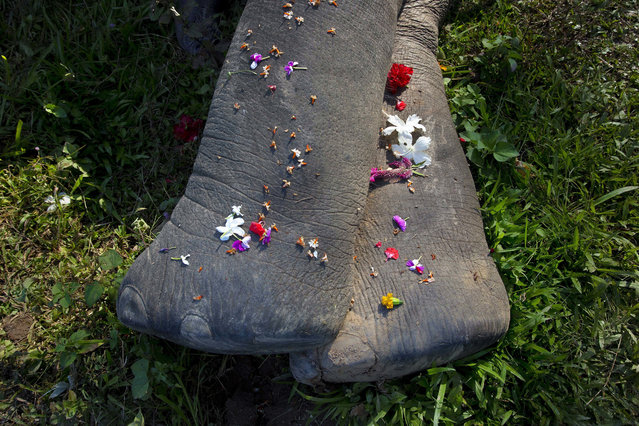
Villagers offer flowers to a wild tusker, laying dead in a field in Panbari villagein Panbari village on the outskirts of Gauhati, India, Thursday, November 2, 2017. According to a veterinarian the tusker died of food poisoning. Scarcity of food and illegal encroachment of forest areas have forced these wild elephant to move to populated areas for food. (Photo by Anupam Nath/AP Photo)

Villagers offer flowers to a wild tusker, laying dead in a field in Panbari villagein Panbari village on the outskirts of Gauhati, India, Thursday, November 2, 2017. According to a veterinarian the tusker died of food poisoning. Scarcity of food and illegal encroachment of forest areas have forced these wild elephant to move to populated areas for food. (Photo by Anupam Nath/AP Photo)
Details
10 Nov 2017 08:43:00
A mannequin with boots is stuffed upside down in the snow in front of a  home in Nisswa, Minnesota, on March 18, 2013. (Photo by Steve Kohls/The Brainerd Daily Dispatch)

A mannequin with boots is stuffed upside down in the snow in front of a home in Nisswa, Minnesota, on March 18, 2013. (Photo by Steve Kohls/The Brainerd Daily Dispatch)

P.S. All pictures are presented in high resolution. To see Hi-Res images – just TWICE click on any picture. In other words, click small picture – opens the BIG picture. Click BIG picture – opens VERY BIG picture (if available; this principle works anywhere on the site AvaxNews).

Details
23 Mar 2013 14:08:00
A woman is carried to a safer place from her partially submerged house after incessant rains in Srinagar March 30, 2015. (Photo by Danish Ismail/Reuters)

A woman is carried to a safer place from her partially submerged house after incessant rains in Srinagar March 30, 2015. (Photo by Danish Ismail/Reuters)
Details
31 Mar 2015 12:34:00
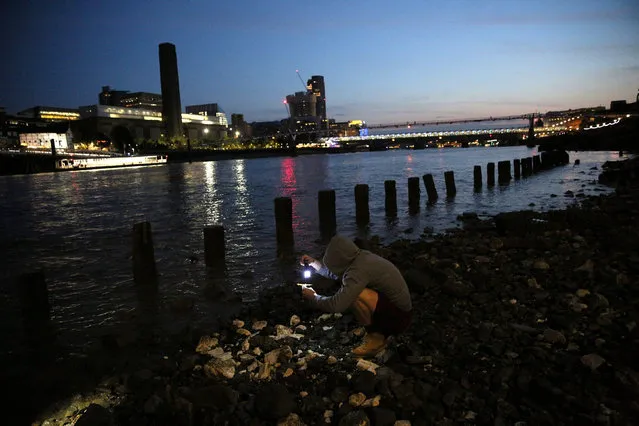
A mudlark uses a torch to look for items on the bank of the River Thames in London, Britain June 06, 2016. Mudlarking is believed to trace its origins to the 18th and 19th century, when scavengers searched the Thames' shores for items to sell. These days, history and archaeology fans are the ones hoping to find old relics such as coins, ceramics, artifacts or everyday items from across centuries. They wait for the low tide and then scour specific areas of exposed shores. "If you're in a field you could be out all day long, with the river you're restricted to about two or three hours," mudlark Nick Stevens said. While many just use the naked eye for their searches, others rely on metal detectors for which a permit from the Port of London Authority is needed. Digging also requires consent. (Photo by Neil Hall/Reuters)

A mudlark uses a torch to look for items on the bank of the River Thames in London, Britain June 06, 2016. Mudlarking is believed to trace its origins to the 18th and 19th century, when scavengers searched the Thames' shores for items to sell. These days, history and archaeology fans are the ones hoping to find old relics such as coins, ceramics, artifacts or everyday items from across centuries. their finds with the Portable Antiquities Scheme. Any item over 300 years old must be recorded. (Photo by Neil Hall/Reuters)
Details
27 Aug 2016 10:43:00