Loading...
Done
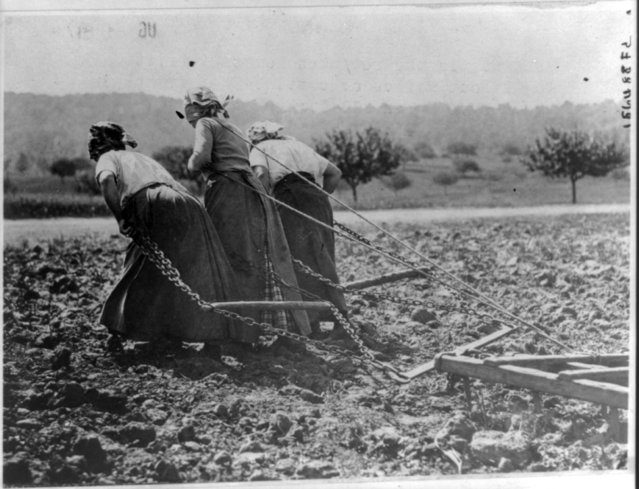
Peasants in the re-taken Somme District work in the fields, circa 1916- 1917, in this Library of Congress handout photo. (Photo by Reuters/Bain Collection/Library of Congress)

Peasants in the re-taken Somme District work in the fields, circa 1916- 1917, in this Library of Congress handout photo. For women 100 years ago, opportunities to work beyond the home and take part in political life were very limited. As the 20th century progressed, hard-won progress included gradually improved voting rights, while the upheaval of war pushed doors ajar as women worked as part of the war effort. U.S. Library of Congress archive photos show women's workplaces ranging from a flour mill in England to a coal mine in Belgium or Lincoln Motor Co.'s welding department in Detroit. International Women's Day is celebrated on March 8. (Photo by Reuters/Bain Collection/Library of Congress)
Details
03 Mar 2016 11:39:00
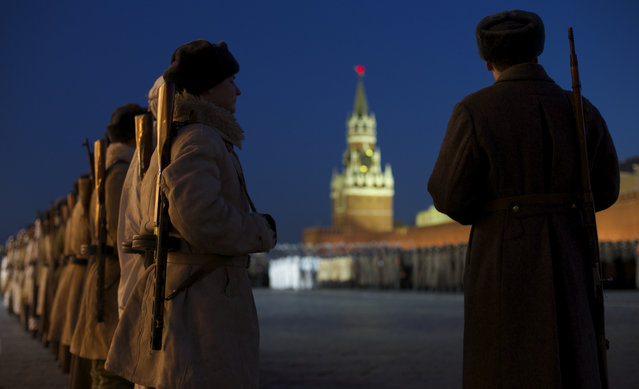
Russian soldiers dressed in Red Army World War II uniforms attend a rehearsal for the Nov. 7 parade in the Red Square with Spassky Tower in the background, in Moscow, Russia, Friday, November 6, 2015. The parade marks the 74th anniversary of a November 7 parade on Red Square when soldiers went directly to the front during World War II. For decades Nov. 7 was a holiday celebrating the 1917 Bolshevik Revolution. (Photo by Ivan Sekretarev/AP Photo)

Russian soldiers dressed in Red Army World War II uniforms attend a rehearsal for the Nov. 7 parade in the Red Square with Spassky Tower in the background, in Moscow, Russia, Friday, November 6, 2015. The parade marks the 74th anniversary of a November 7 parade on Red Square when soldiers went directly to the front during World War II. For decades Nov. 7 was a holiday celebrating the 1917 Bolshevik Revolution. (Photo by Ivan Sekretarev/AP Photo)
Details
09 Nov 2015 08:03:00
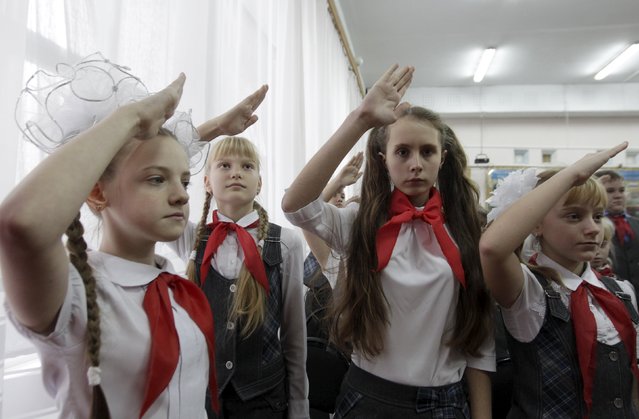
Children, wearing red neckerchiefs, a symbol of the Pioneer Organization, salute during a ceremony for the inauguration of 18 new members at a local school in the southern settlement of Kazminskoye in Stavropol region, Russia, November 19, 2015. Early pro-communist youth movements, which appeared in Russia after the 1917 Bolshevik revolution, were reformed into the Pioneer Organization of the Soviet Union. (Photo by Eduard Korniyenko/Reuters)

Children, wearing red neckerchiefs, a symbol of the Pioneer Organization, salute during a ceremony for the inauguration of 18 new members at a local school in the southern settlement of Kazminskoye in Stavropol region, Russia, November 19, 2015. Early pro-communist youth movements, which appeared in Russia after the 1917 Bolshevik revolution, were reformed into the Pioneer Organization of the Soviet Union. While the organization lost its dominance among students in post-Soviet Russia, some educational institutions and families still carry on this tradition. (Photo by Eduard Korniyenko/Reuters)
Details
22 Nov 2015 08:01:00
A worshipper wearing a kerchief with the image of the Our Lady of Fatima attends a mass at the Our Lady of Fatima shrine, in Fatima, central Portugal, Wednesday, May 13, 2015. (Photo by Francisco Seco/AP Photo)

A worshipper wearing a kerchief with the image of the Our Lady of Fatima attends a mass at the Our Lady of Fatima shrine, in Fatima, central Portugal, Wednesday, May 13, 2015. Every year on May 12 and 13 tens of thousands of Catholic believers go on pilgrimage to the Fatima sanctuary to pray and attend masses where the apparitions of the Virgin Mary were witnessed by three shepherd children Lucia, Jacinta and Francisco in 1917. (Photo by Francisco Seco/AP Photo)
Details
14 May 2015 11:44:00
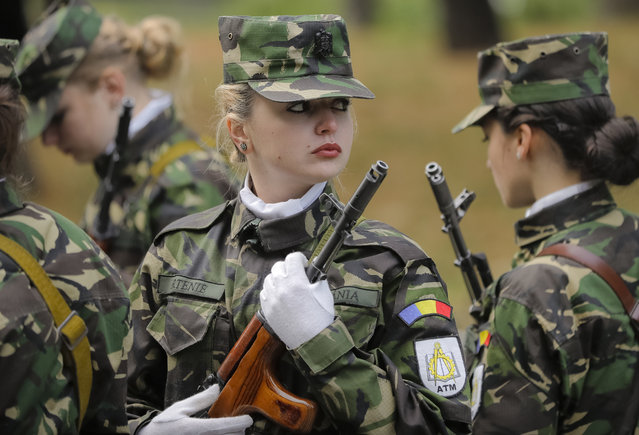
Students hold their weapons before the swearing in ceremony for the military students, in Bucharest, Romania, Wednesday, October 25, 2017. (Photo by Vadim Ghirda/AP Photo)

Students hold their weapons before the swearing in ceremony for the military students, in Bucharest, Romania, Wednesday, October 25, 2017. The Romanian Army is proudly celebrating their Army Day and marking 100-years since the landmark battle of Marasesti, a key World War I battle in 1917 when Romanian and Russian soldiers defeated German troops, halting a German offensive. (Photo by Vadim Ghirda/AP Photo)
Details
29 Oct 2017 08:52:00
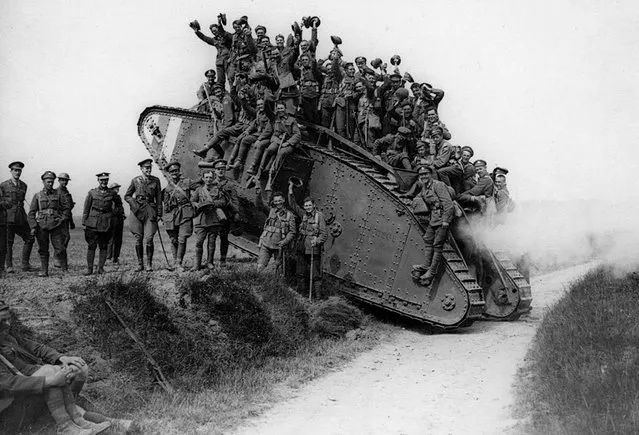
These black-and-white photos are taken from the new book “Armoured Warfare in the First World War 1916 – 1918” by Anthony Tucker-Jones and published by Pen & Sword Military. “Interestingly the British, French and Germans took completely different approaches with varying results”. The British military produced “Little Willie” in Autumn 1915 weighing 18 tonnes, which had a crew of two plus four gunners. “Inspired by a tracked artillery tractor “Little Willie” was referred to as a water tank – hence the name tank – to ensure secrecy”, said Anthony. “This led to the strange looking Mark I with its peculiar rhomboid shape, designed to cross trenches with guns in sponsons on either side. The Germans saw the tank as unchivalrous and were slow to grasp its utility. They favoured the Stormtrooper (specialist soldiers used to infiltrate enemy trenches) and artillery, not the tank”, said Anthony. “However, they didn’t hesitate to make use of captured British tanks. Although the tank helped secure victory and German soldiers dubbed it “Germany’s Downfall” the country was ultimately brought to its knees by the Allies blockade”. Here: British troops hitch a ride on a Mark IV after the massed tank fleet spearheading attack at Cambrai on November 20, 1917. (Photo by Anthony Tucker-Jones/Mediadrumworld.com)

These black-and-white photos are taken from the new book “Armoured Warfare in the First World War 1916 – 1918” by Anthony Tucker-Jones and published by Pen & Sword Military. Here: British troops hitch a ride on a Mark IV after the massed tank fleet spearheading attack at Cambrai on November 20, 1917. (Photo by Anthony Tucker-Jones/Mediadrumworld.com)
Details
23 Feb 2017 00:02:00
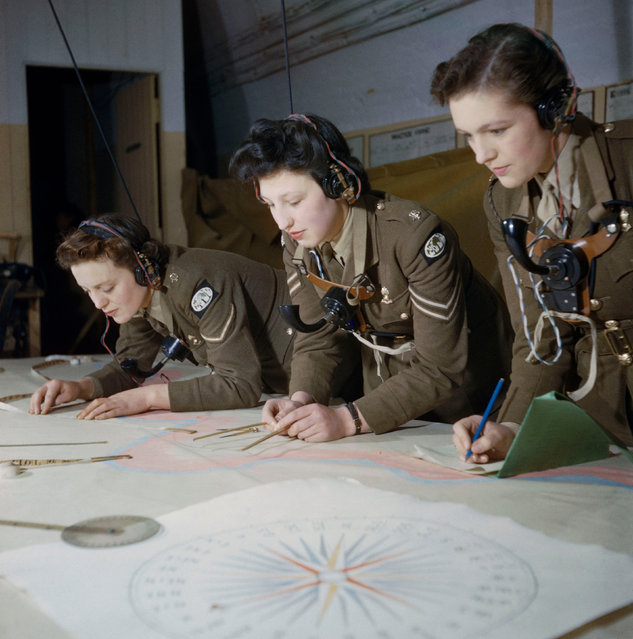
Auxiliary Territorial Service (ATS) plotters at work at Coastal Artillery Headquarters in Dover, December 1942. (Photo by Ted Dearberg/IWM/PA Wire)

Auxiliary Territorial Service (ATS) plotters at work at Coastal Artillery Headquarters in Dover, December 1942. The Auxiliary Territorial Service was the women's branch of the British Army during the Second World War. It was formed on 9 September 1938, initially as a women's voluntary service, and existed until 1 February 1949, when it was merged into the Women's Royal Army Corps. The ATS had its roots in the Women's Auxiliary Army Corps (WAAC), which was formed in 1917 as a voluntary service. During the First World War its members served in a number of jobs including clerks, cooks, telephonists and waitresses. The WAAC was disbanded after four years in 1921. (Photo by Ted Dearberg/IWM/PA Wire)
Details
13 Jul 2017 07:52:00
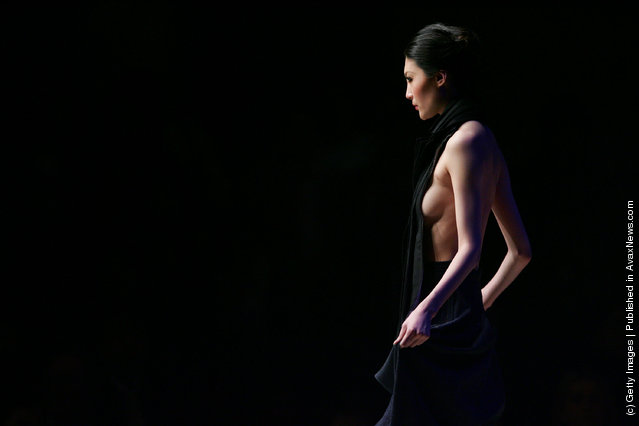
A model walks down the runway at the 13th China International Young Fashion Designers Contest during China Fashion Week

A model walks down the runway at the 13th China International Young Fashion Designers Contest during China Fashion Week on March 25, 2005 in Beijing, China. (Photo by China Photos/Getty Images)
Details
27 Feb 2012 12:13:00