Loading...
Done
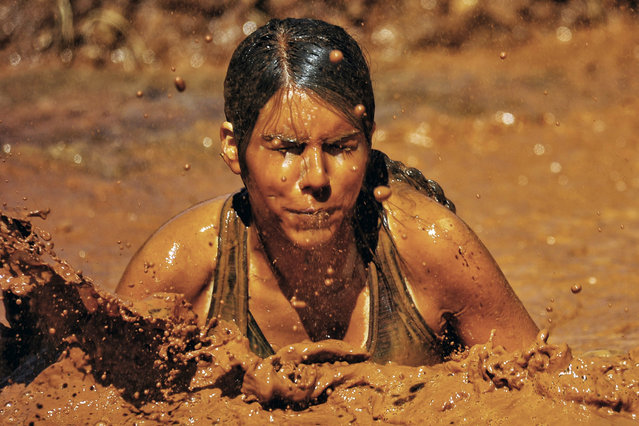
A picture made available on 09 October 2016 shows competitors during a Legion Run event, in Sofiko near the city of Corinth, Greece, 08 October 2016. Legion Run is run covering five kilometres with obstacles of mud, fire, ice and barbed wire, which takes place in different countries around the globe. (Photo by Vassilis Psomas/EPA)

A picture made available on 09 October 2016 shows competitors during a Legion Run event, in Sofiko near the city of Corinth, Greece, 08 October 2016. Legion Run is run covering five kilometres with obstacles of mud, fire, ice and barbed wire, which takes place in different countries around the globe. (Photo by Vassilis Psomas/EPA)
Details
10 Oct 2016 10:24:00
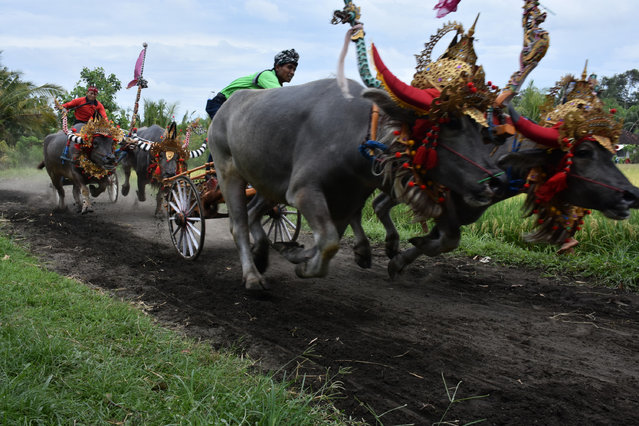
Jockeys spur buffalos during the Makepung buffalo races at Jembrana in Bali, Indonesia on October 23, 2016. Makepung is a tradition for farmers to celebrate a bumper harvest in Bali. (Photo by Kadek Raharja/Xinhua/Barcroft Images)

Jockeys spur buffalos during the Makepung buffalo races at Jembrana in Bali, Indonesia on October 23, 2016. Makepung is a tradition for farmers to celebrate a bumper harvest in Bali. (Photo by Kadek Raharja/Xinhua/Barcroft Images)
Details
25 Oct 2016 10:50:00
Chloe Goodman attending the Fantastic Beasts and Where to Find Them European Premiere at Leicester Square, London. (Photo by Ian West/PA Images via Getty Images)

Chloe Goodman attending the Fantastic Beasts and Where to Find Them European Premiere at Leicester Square, London. (Photo by Ian West/PA Images via Getty Images)
Details
20 Nov 2016 11:03:00
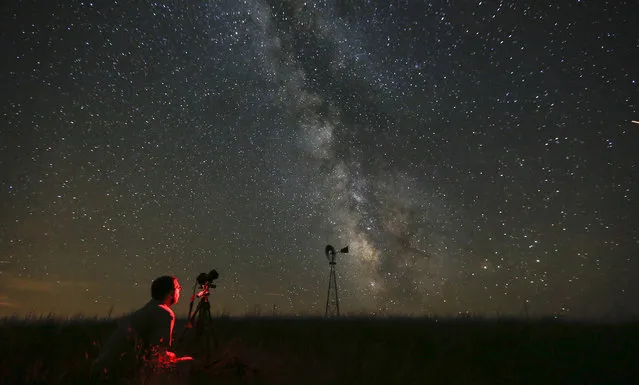
In this Wednesday, July 23, 2014 file photo, Omaha photographer Lane Hickenbottom photographs the night sky in a pasture near Callaway, Neb. With no moon in the sky, the Milky Way was visible to the naked eye. More than one-third of the world’s population can no longer see the Milky Way because of man-made lights, according to a scientific paper by Light Pollution Science and Technology Institute's Fabio Falchi and his team members, published on Friday, June 10, 2016. (Photo by Travis Heying/The Wichita Eagle via AP Photo)

In this Wednesday, July 23, 2014 file photo, Omaha photographer Lane Hickenbottom photographs the night sky in a pasture near Callaway, Neb. With no moon in the sky, the Milky Way was visible to the naked eye. More than one-third of the world’s population can no longer see the Milky Way because of man-made lights, according to a scientific paper by Light Pollution Science and Technology Institute's Fabio Falchi and his team members, published on Friday, June 10, 2016. (Photo by Travis Heying/The Wichita Eagle via AP Photo)
Details
11 Jun 2016 12:37:00
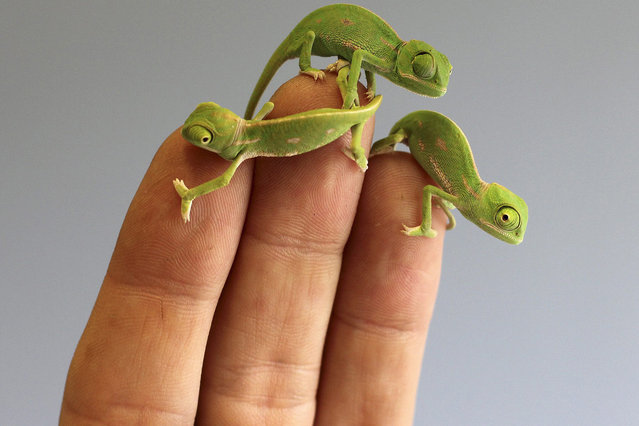
A handout image released by the Taronga Zoo shows Veiled Chameleon hatchlings at Taronga Zoo in Sydney, Australia, 11 March 2015. Taronga has welcomed more than 20 baby chameleons, with the last of three clutches of eggs hatching this week. Veiled Chameleons, or Chamaeleo calyptratus, are native to Saudi Arabia and Yemen and can live up to five years. (Photo by EPA/Taronga Zoo)

A handout image released by the Taronga Zoo shows Veiled Chameleon hatchlings at Taronga Zoo in Sydney, Australia, 11 March 2015. Taronga has welcomed more than 20 baby chameleons, with the last of three clutches of eggs hatching this week. Veiled Chameleons, or Chamaeleo calyptratus, are native to Saudi Arabia and Yemen and can live up to five years. (Photo by EPA/Taronga Zoo)
Details
21 Mar 2015 13:13:00
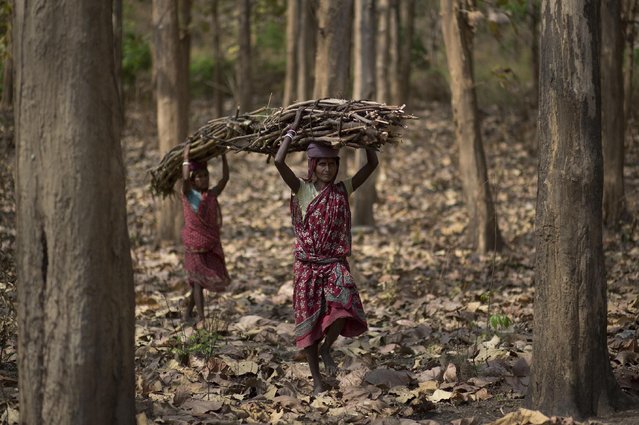
In this Tuesday, March 31, 2015 photo, Indian women walk carrying firewood they collected from a forest at Gobhali village on the outskirts of Gauhati, India. Every evening, hundreds of millions of Indian women hover over crude stoves making dinner for their families. They feed the flames with polluting fuels like kerosene or cow dung, and breathe the acrid smoke wafting from the fires. (Photo by Anupam Nath/AP Photo)

In this Tuesday, March 31, 2015 photo, Indian women walk carrying firewood they collected from a forest at Gobhali village on the outskirts of Gauhati, India. Every evening, hundreds of millions of Indian women hover over crude stoves making dinner for their families. They feed the flames with polluting fuels like kerosene or cow dung, and breathe the acrid smoke wafting from the fires. (Photo by Anupam Nath/AP Photo)
Details
16 Apr 2015 12:29:00
A receptionist dinosaur robot performs at the new robot hotel, aptly called Henn na Hotel or Weird Hotel, in Sasebo, southwestern Japan, Wednesday, July 15, 2015. From the receptionist that does the check-in and check-out to the porter that’s a stand-on-wheels taking luggage up to the room, the hotel, that is run as part of Huis Ten Bosch amusement park, is “manned” almost totally by robots to save labor costs. (Photo by Shizuo Kambayashi/AP Photo)

A receptionist dinosaur robot performs at the new robot hotel, aptly called Henn na Hotel or Weird Hotel, in Sasebo, southwestern Japan, Wednesday, July 15, 2015. From the receptionist that does the check-in and check-out to the porter that’s a stand-on-wheels taking luggage up to the room, the hotel, that is run as part of Huis Ten Bosch amusement park, is “manned” almost totally by robots to save labor costs. (Photo by Shizuo Kambayashi/AP Photo)
Details
16 Jul 2015 11:18:00
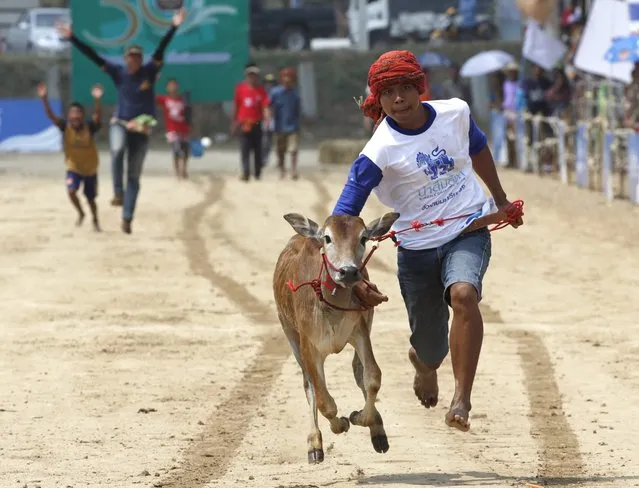
A Thai villager runs with a bullock during a catching a bullock competition as part of the annual bullock cart racing festival in Phetchaburi province, Thailand, 21 February 2016. The annual bullock cart race festival held to celebrate the end of the harvest season. (Photo by Rungroj Yongrit/EPA)

A Thai villager runs with a bullock during a catching a bullock competition as part of the annual bullock cart racing festival in Phetchaburi province, Thailand, 21 February 2016. The annual bullock cart race festival held to celebrate the end of the harvest season. (Photo by Rungroj Yongrit/EPA)
Details
22 Feb 2016 10:33:00