Loading...
Done


“The Daleks are a fictional extraterrestrial race of genetically manipulated mutants from the British science fiction television series Doctor Who. Various storylines portray them as having had every emotion removed except hate, leaving them with a desire to purge the Universe of all non-Dalek life. Collectively they are the greatest enemies of the series' protagonist, the Time Lord known as the Doctor. Their famous catchphrase is “Exterminate!”, with each syllable individually synthesised in a frantic electronic voice” – Wikipedia

Photo: Max Hardy, aged 6, stands by a street sign from the Doctor Who Experience as Dalek, from the cult television show Doctor Who watches him on April 16, 2011 in London, England. The Doctor Who Experience Exhibition is currently running at Kensington Olympia Two, celebrating the science fiction programme that was originally screened in 1963. (Photo by Matthew Lloyd/Getty Images for BBC Worldwide)
Details
04 May 2011 10:47:00


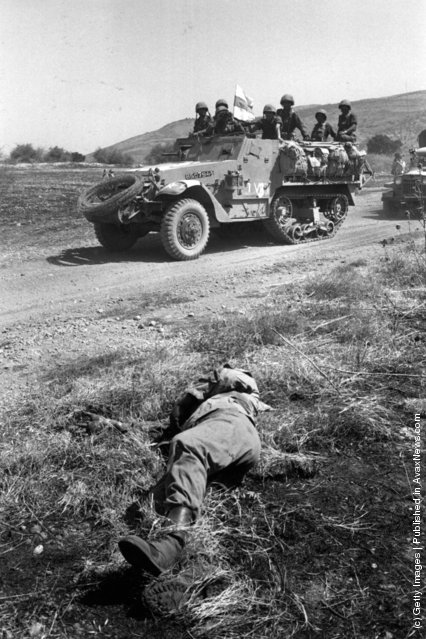
“The Six-Day War or June War, also known as the 1967 Arab-Israeli War or the Third Arab-Israeli War, was fought between June 5 and June 10, 1967, by Israel and the neighboring states of Egypt (known then as the United Arab Republic [UAR]), Jordan, and Syria. The war began with a large-scale surprise air strike by Israel on Egypt. The outcome was a swift and decisive Israeli victory. Israel took effective control of the Gaza Strip and the Sinai Peninsula from Egypt, the West Bank and East Jerusalem from Jordan, and the Golan Heights from Syria. Opinions are divided on whether Israel's attack was an act of aggression or a preemptive strike of a defensive nature”. – Wikipedia

Photo: The corpse of a soldier lying on the line of the Israeli advance into Syria during the Six-Day War. (Photo by Terry Fincher/Getty Images). 1967
Details
21 May 2011 08:29:00


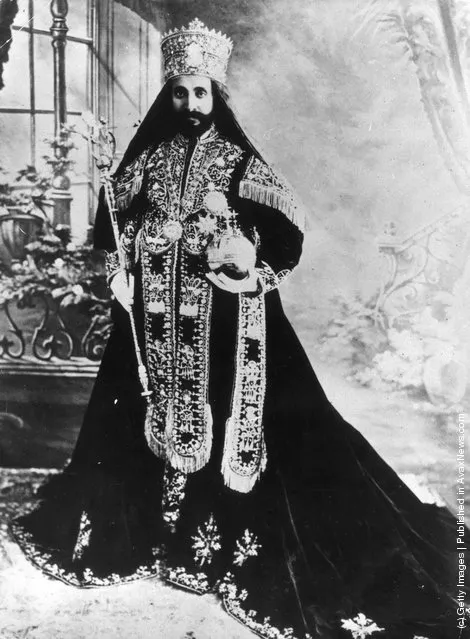
“Haile Selassie I (23 July 1892 – 27 August 1975), born Tafari Makonnen, was Ethiopia's regent from 1916 to 1930 and Emperor of Ethiopia from 1930 to 1974. The heir to a dynasty that traced its origins to the 13th century, and from there by tradition back to King Solomon and Queen Makeda, Empress of Axum, known in the Abrahamic tradition as the Queen of Sheba. Haile Selassie is a defining figure in both Ethiopian and African history.

Haile Selassie is revered as the returned Messiah of the Bible, God incarnate, among the Rastafari movement, the number of followers of which is estimated between 200,000 and 800,000. Begun in Jamaica in the 1930s, the Rastafari movement perceives Haile Selassie as a messianic figure who will lead a future golden age of eternal peace, righteousness, and prosperity. He himself remained an Ethiopian Orthodox Christian throughout his life”. – Wikipedia

Photo: Negusa Negasti, Emperor of Ethiopia Haile Selassie I, known as “Lord of Lords”, “The Conquering Lion of the tribe of Judah”, “Light of the world”, “Elect of God”, in full ceremonial regalia following his coronation. (Photo by Hulton Archive/Getty Images)
Details
21 Jun 2011 11:04:00
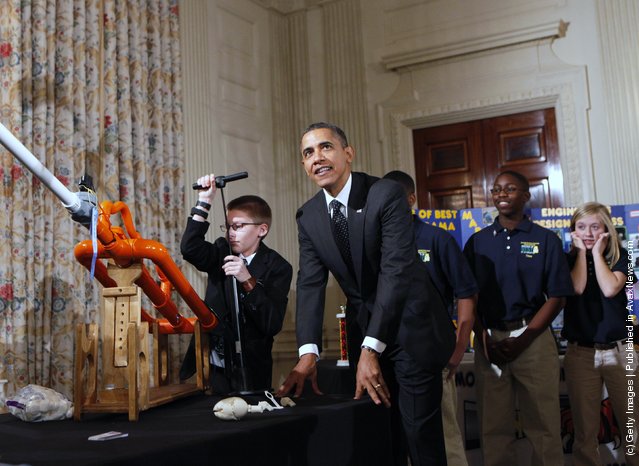
President Barack Obama watches as Joey Hudy (L), 14, from Phoenix, Arizona pumps the Extreme Marshmallow Cannon he invented, while touring student science fair projects on exhibit in the State Dining Room at the White House

President Barack Obama watches as Joey Hudy (L), 14, from Phoenix, Arizona pumps the Extreme Marshmallow Cannon he invented, while touring student science fair projects on exhibit in the State Dining Room at the White House February 7, 2012 in Washington, DC. Obama hosted the second White House Science Fair celebrating the student winners of science, technology, engineering and math (STEM) competitions from across the country. (Photo by Molly Riley-Pool/Getty Images)
Details
08 Feb 2012 10:33:00
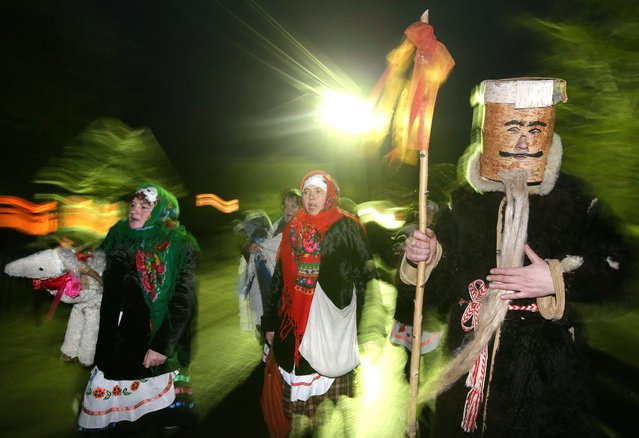
Belarussians in costumes sing songs during the traditional rite of Shchadrets (Schedry vecher or Generous Eve) in the village of Osovo, some 190 km from Minsk, Belarus, 13 January 2015. Shchadrets is a Belarusian folk holiday celebrated on the New Year's Eve in accordance with the Julian calendar (Old New Year). (Photo by Tatyana Zenkovich/EPA)

Belarussians in costumes sing songs during the traditional rite of Shchadrets (Schedry vecher or Generous Eve) in the village of Osovo, some 190 km from Minsk, Belarus, 13 January 2015. Shchadrets is a Belarusian folk holiday celebrated on the New Year's Eve in accordance with the Julian calendar (Old New Year). The holiday is similar to Koliady, when youth in costumes walk from house to house singing holiday songs, performing, and asking for a reward afterwards. (Photo by Tatyana Zenkovich/EPA)
Details
17 Jan 2015 12:21:00
Weighing in at just under 6 pounds and at 22.6 inches long, the female pup arrived at Shedd in late October from Monterey Bay Aquarium in California, where she spent the first four weeks of her life being stabilized. (Photo by Brenna Hernandez/AP Photo)

Weighing in at just under 6 pounds and at 22.6 inches long, the female pup arrived at Shedd in late October from Monterey Bay Aquarium in California, where she spent the first four weeks of her life being stabilized. The pup has been doing well since her arrival, receiving continual care behind the scenes of Shedd’s Abbott Oceanarium. Currently referred to as “Pup 681”, Shedd’s animal care and veterinarian teams are providing the continual, round-the-clock care she needs to thrive. Photos used with permisson from Shedd Aquarium. (Photo by Brenna Hernandez/AP Photo)
Details
09 Nov 2014 09:35:00
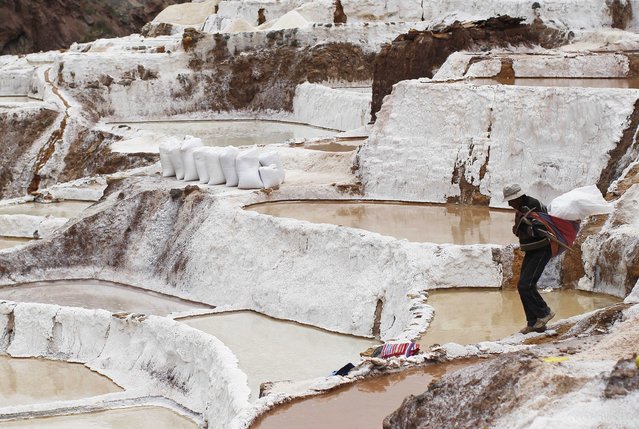
A worker carries a bag of salt after collecting it from a pond at the Maras mines in Cuzco December 3, 2014. Salt has been obtained in Maras since pre-Incan times by evaporating highly salty local subterranean stream water. The water is intricately channelled through constructions, flowing gradually down onto several hundred ancient terraced ponds. (Photo by Enrique Castro-Mendivil/Reuters)

A worker carries a bag of salt after collecting it from a pond at the Maras mines in Cuzco December 3, 2014. Salt has been obtained in Maras since pre-Incan times by evaporating highly salty local subterranean stream water. The water is intricately channelled through constructions, flowing gradually down onto several hundred ancient terraced ponds. From each pond, a local member of the mine cooperative can produce 150 to 200 kilos per month which can be sold in the markets at $0.34 per kilogram, according to miners. (Photo by Enrique Castro-Mendivil/Reuters)
Details
05 Dec 2014 13:36:00
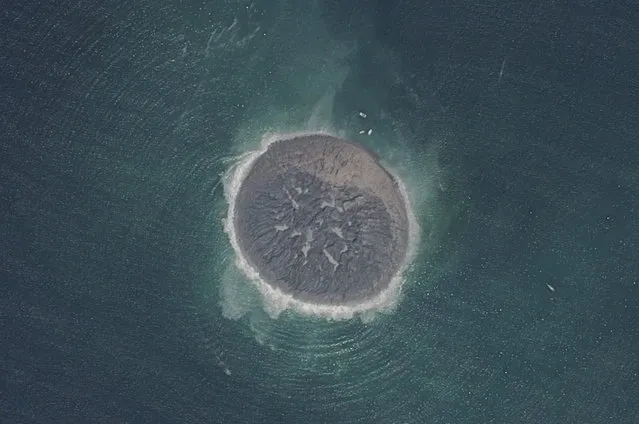
This handout picture taken by Pleiades satellite and released on September 27, 2013 shows a small island of mud and rock created by the huge earthquake that hit southwest Pakistan has fascinated locals but experts – who found methane gas rising from it – say it is unlikely to last long

This handout picture taken by Pleiades satellite and released on September 27, 2013 shows a small island of mud and rock created by the huge earthquake that hit southwest Pakistan has fascinated locals but experts – who found methane gas rising from it – say it is unlikely to last long. The 7.7-magnitude quake struck on September 25 in Baluchistan's remote Awaran district, killing at least 271 people and affecting hundreds of thousands. The island is about 60 to 70 feet (18 to 21 metres) high, up to 300 feet wide and up to 120 feet long and sits about 650 feet from the coast. (Photo by AFP Photo/CNES/Distribution Astrium Services)
Details
01 Oct 2013 08:23:00