Loading...
Done
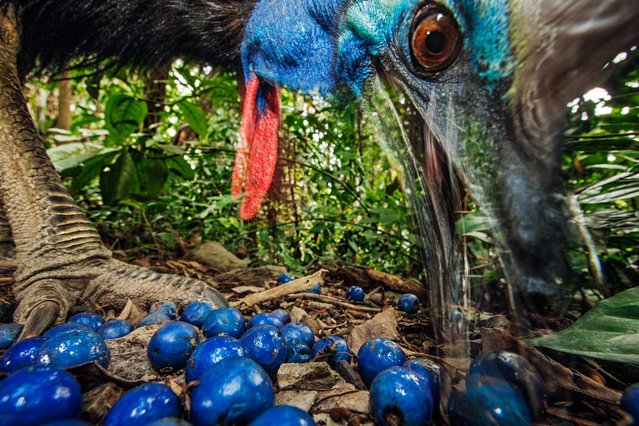
“Cassowaries are large, flightless birds related to emus and (more distantly) to ostriches, rheas, and kiwis”, writes Olivia Judson in the September issue of National Geographic magazine. (Photo by Christian Ziegler/National Geographic)

“Cassowaries are large, flightless birds related to emus and (more distantly) to ostriches, rheas, and kiwis”, writes Olivia Judson in the September issue of National Geographic magazine. How large? People-size: Adult males stand well over five foot five and top 110 pounds. Females are even taller, and can weigh more than 160 pounds. Dangerous when roused, they’re shy and peaceable when left alone. But even birds this big and tough are prey to habitat loss. The dense New Guinea and Australia rain forests where they live have dwindled. Today cassowaries might number 1,500 to 2,000. And because they help shape those same forests – by moving seeds from one place to another – “if they vanish”, Judson writes, “the structure of the forest would gradually change” too. (Photo by Christian Ziegler/National Geographic)
Details
06 Jan 2014 12:21:00
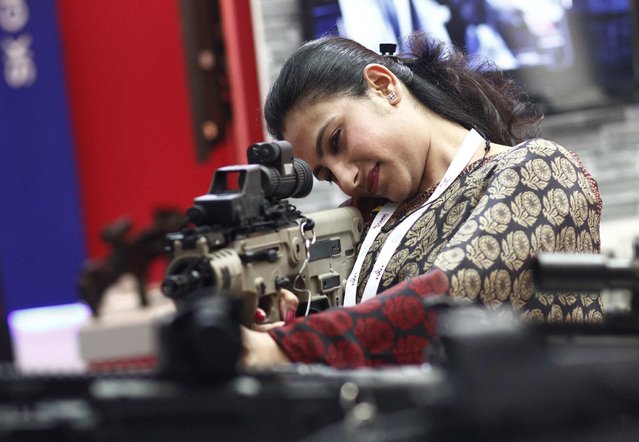
A visitor holds an Israeli-made rifle during the 8th International Land and Naval Defense system exhibition, in New Delhi, India, on February 6, 2014. (Photo by Anindito Mukherjee/Reuters)

A visitor holds an Israeli-made rifle during the 8th International Land and Naval Defense system exhibition, in New Delhi, India, on February 6, 2014. (Photo by Anindito Mukherjee/Reuters)
Details
08 Feb 2014 15:38:00
Demonstrators dance around a burning an effigy of the Russian President Vladimir Putin during an anti-war action in Tbilisi, Georgia, Sunday, March 27, 2022. (Photo by AP Photo/Stringer)

Demonstrators dance around a burning an effigy of the Russian President Vladimir Putin during an anti-war action in Tbilisi, Georgia, Sunday, March 27, 2022. (Photo by AP Photo/Stringer)
Details
28 Mar 2022 05:39:00
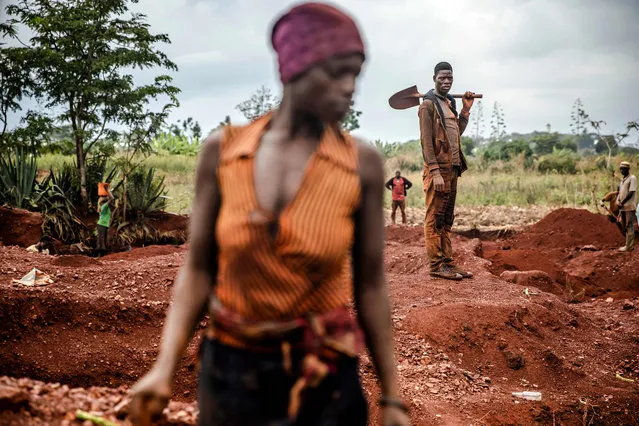
A gold miner observes from the distance how some women miners work at an open-pit gold mine in Nyarugusu, Geita Region, Tanzania on May 27, 2022. Tanzania is a land rich in minerals and one of the main gold producers in Africa, with gold representing more than 90% of the country's mineral exports. Artisanal and small-scale gold mining have culturally and historically relegated women's participation. The extractive sector in Tanzania has historically been a male-dominated industry with high levels of harassment, sеxual abuse, discrimination and misconceptions over women's involvement, and contributions following traditional beliefs. (Photo by Luis Tato/AFP Photo)

A gold miner observes from the distance how some women miners work at an open-pit gold mine in Nyarugusu, Geita Region, Tanzania on May 27, 2022. Tanzania is a land rich in minerals and one of the main gold producers in Africa, with gold representing more than 90% of the country's mineral exports. Artisanal and small-scale gold mining have culturally and historically relegated women's participation. The extractive sector in Tanzania has historically been a male-dominated industry with high levels of harassment, sеxual abuse, discrimination and misconceptions over women's involvement, and contributions following traditional beliefs. (Photo by Luis Tato/AFP Photo)
Details
13 Jun 2022 04:31:00
Nature – first prize, stories. Pandemic Pigeons – A Love Story. The photographer’s daughter, Merel, cowers after Dollie flies past and perches on the balcony before entering the house in Vlaardingen in the Netherlands on 6 April 2020. “She’s still frightened when Dollie suddenly lands on the balcony railing. I hide my smile behind the camera, as I try to comfort her by saying they won’t hurt you. “I thought he was going to attack me”, she replies. As the nesting pigeons keep coming back to our place, slowly my girls have started to appreciate them – perhaps not as much as I do, but it’s a start”. (Photo by Jasper Doest/World Press Photo 2021)

Nature – first prize, stories. Pandemic Pigeons – A Love Story. The photographer’s daughter, Merel, cowers after Dollie flies past and perches on the balcony before entering the house in Vlaardingen in the Netherlands on 6 April 2020. “She’s still frightened when Dollie suddenly lands on the balcony railing. I hide my smile behind the camera, as I try to comfort her by saying they won’t hurt you. “I thought he was going to attack me”, she replies. As the nesting pigeons keep coming back to our place, slowly my girls have started to appreciate them – perhaps not as much as I do, but it’s a start”. (Photo by Jasper Doest/World Press Photo 2021)
Details
17 Apr 2021 09:30:00
File photo dated 21/04/66 of Pattie Boyd in London's West End wearing a mini skirt, as the British designer Mary Quant, widely credited with popularising the mini skirt has recalled its “feeling of freedom and liberation” 50 years after she took the fashion world by storm. (Photo by PA Wire)

File photo dated 21/04/66 of Pattie Boyd in London's West End wearing a mini skirt, as the British designer Mary Quant, widely credited with popularising the mini skirt has recalled its “feeling of freedom and liberation” 50 years after she took the fashion world by storm. Quant, who named the skirt after her favourite make of car, said she “couldn't have imagined” in 1964 that it would become a staple of women's clothing, but added: “It seemed then to be obvious, and so right”. (Photo by PA Wire)
Details
29 Jan 2015 11:33:00
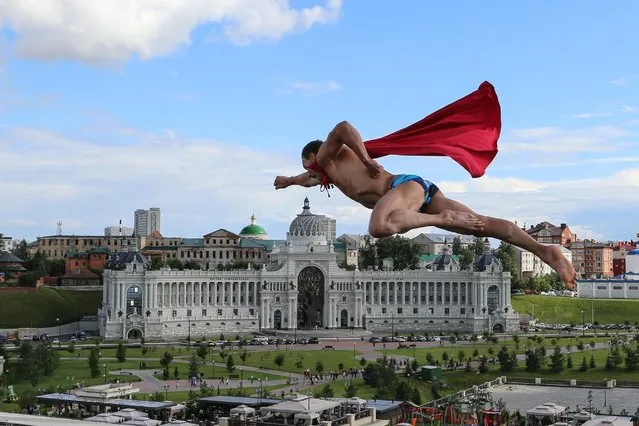
Michal Navratil of the Czech Republic performs after the men's 27 meter high dive final at the Swimming World Championships in Kazan, Russia, Wednesday, August 5, 2015. (Photo by Denis Tyrin/AP Photo)

Michal Navratil of the Czech Republic performs after the men's 27 meter high dive final at the Swimming World Championships in Kazan, Russia, Wednesday, August 5, 2015. (Photo by Denis Tyrin/AP Photo)
Details
06 Aug 2015 12:13:00
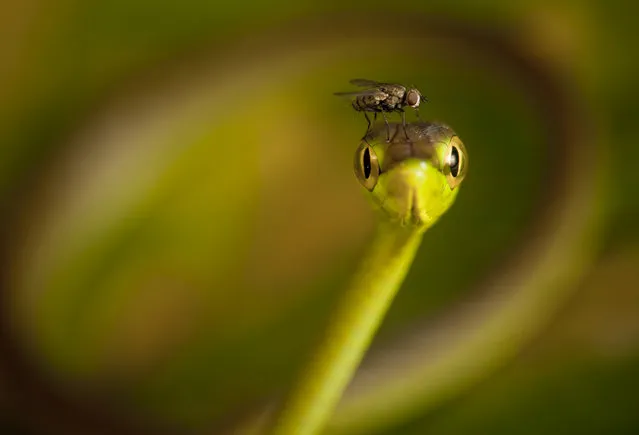
“Fly cap for a vine snake”. A fly lands on the head of a vine snake in the Choco of Colombia. (Photo and caption by Robin Moore/National Geographic Traveler Photo Contest)

“Fly cap for a vine snake”. A fly lands on the head of a vine snake in the Choco of Colombia. (Photo and caption by Robin Moore/National Geographic Traveler Photo Contest)

ATTENTION! All pictures are presented in high resolution. To see Hi-Res images – just TWICE click on any picture. In other words, click small picture – opens the BIG picture. Click BIG picture – opens VERY BIG picture.
Details
24 Jun 2013 11:36:00