Loading...
Done
In this photograph taken on December 14, 2016, an Indian craftsman works on unfinished cricket bats in a factory in Meerut, some 70 kms north- east of New Delhi. As Indian factory worker Jitender Singh carves out another big- hitting slab of thick willow he insists MCC proposals to limit the size of cricket bats won' t tame Twenty20 marauders. “I don' t think the thickness matters. It' s more about the balance of the bat and the talent of the batsman”, says Singh, who has made bats for many stars, including South Africa's AB de Villiers. The World Cricket committee of the MCC, the guardians of the game, recommended in December 2016 that limitations be placed on the width and depth of bats because it had become too easy to smash fours and sixes. (Photo by Dominique Faget/AFP Photo)

In this photograph taken on December 14, 2016, an Indian craftsman works on unfinished cricket bats in a factory in Meerut, some 70 kms north- east of New Delhi. (Photo by Dominique Faget/AFP Photo)
Details
11 Jan 2017 14:32:00
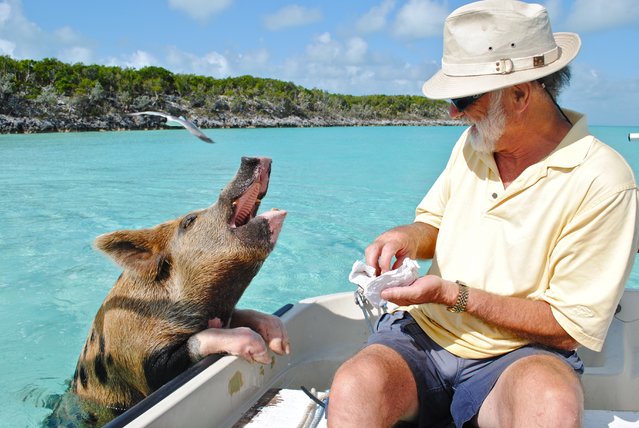
“So you're on a boat in Bahamas and then this pig swims by begging for food”. (Photo and caption by Lisa Larsen/Public Domain)


The Bahamas, the Commonwealth nation of hundreds of islands roughly the size of Connecticut and with population of just a bit over Anaheim, is known for its crystal waters and pristine beaches. This is possibly one of the world’s most beautiful havens of nature, yet people are coming here to see pigs. It is unclear when the pigs first appeared on Exuma Island or where they come from. There’s talk about a daring escape from a shipwreck, or sailors releasing the swine on purpose. In all probability, there were no pigs on this tropical paradise before European settlers came, so their mere presence is the work of human. The intriguing feat of nature, however, is that this population of pigs developed a fine aptitude for swimming. Here: “So you're on a boat in Bahamas and then this pig swims by begging for food”. (Photo and caption by Lisa Larsen/Public Domain)
Details
03 Sep 2015 11:53:00
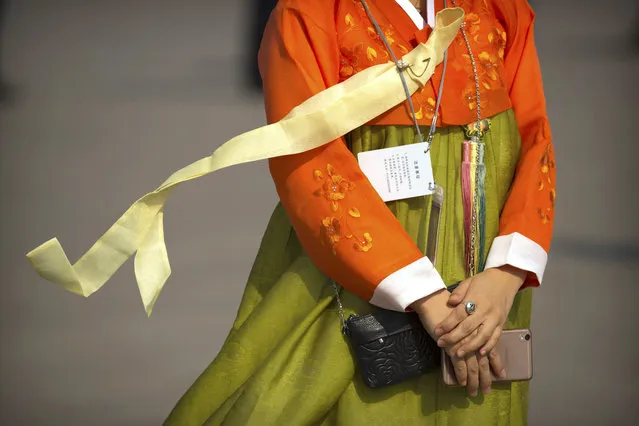
In this Friday, March 3, 2017 photo, a ribbon on a staff member's outfit blows in the breeze as she arrives for the opening session of the Chinese People's Political Consultative Congress (CPPCC) at the Great Hall of the People in Beijing. (Photo by Mark Schiefelbein/AP Photo)

In this Friday, March 3, 2017 photo, a ribbon on a staff member's outfit blows in the breeze as she arrives for the opening session of the Chinese People's Political Consultative Congress (CPPCC) at the Great Hall of the People in Beijing. The annual session of China's ceremonial legislature is designed to awe onlookers with its size and sweep, yet the experience is also made up of tiny moments, details that point to the personalities of the participants and the event's unique, sometimes quirky, traits that a casual observer might easily miss. (Photo by Mark Schiefelbein/AP Photo)
Details
15 Mar 2017 00:05:00
A scene showing one of the first trench battles is prepared for the opening of the 3D Panorama exhibition “Memory talks. The road through war” in the former Sevcabel port in St. Petersburg, Russia, 16 September 2019. (Photo by Anatoly Maltsev/EPA/EFE)

A scene showing one of the first trench battles is prepared for the opening of the 3D Panorama exhibition “Memory talks. The road through war” in the former Sevcabel port in St. Petersburg, Russia, 16 September 2019. Various 3D dioramas – containing genuine wartime items such as aircraft, tanks and artillery in original size – allow visitors to walk through scenes from the beginning to the end of WWII without any museum barriers. The exhibition opens from 19 September 2019 to May 2020. (Photo by Anatoly Maltsev/EPA/EFE)
Details
19 Sep 2019 00:01:00
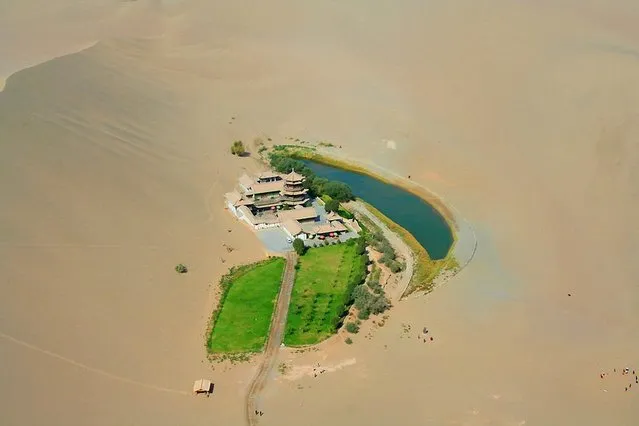
Crescent Lake In China

Yueyaquan is a crescent-shaped lake in an oasis, 6 km south of the city of Dunhuang in Gansu Province, China. It was named Yueyaquan in the Qing Dynasty. According to measurements made in 1960, the average depth of the lake was 4 to 5 meters, with a maximum depth of 7.5 metres In the following 40 years, the depth of the lake continually declined. In the early 1990s, its area had shrunk to only 5,500 m2 with an average depth of 0.9 meter (maximum 1.3 meter). In 2006, the local government with help of the central government started to fill the lake and restore its depth; its depth and size have been growing yearly since then. The lake and the surrounding deserts are very popular with tourists, who are offered camel and 4x4 rides.
Details
25 Jun 2013 10:29:00
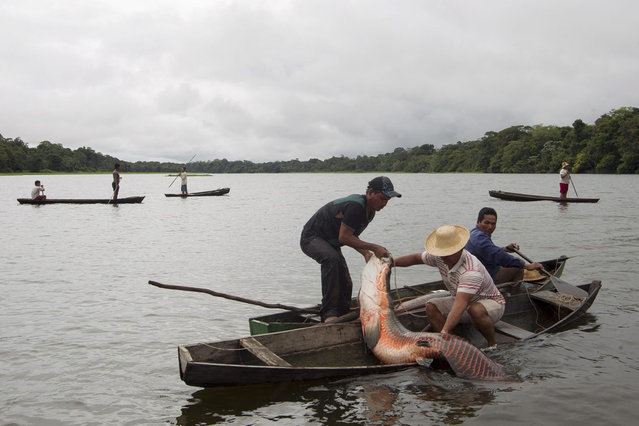
Villagers from the Porto Novo community load into their canoes arapaima or pirarucu, the largest freshwater fish species in South America and one of the largest in the world, while fishing in Poco Fundo lake along a branch of the Solimoes river, one of the main tributaries of the Amazon, in the Mamiraua nature reserve near Fonte Boa about 600 km (373 miles) west of Manaus, November 26, 2013. (Photo by Bruno Kelly/Reuters)

Villagers from the Porto Novo community load into their canoes arapaima or pirarucu, the largest freshwater fish species in South America and one of the largest in the world, while fishing in Poco Fundo lake along a branch of the Solimoes river, one of the main tributaries of the Amazon, in the Mamiraua nature reserve near Fonte Boa about 600 km (373 miles) west of Manaus, November 26, 2013. Catching the arapaima, a fish that is sought after for its meat and is considered by biologists to be a living fossil, is only allowed once a year by Brazil's environmental protection agency. The minimum size allowed for a fisherman to keep an arapaima is 1.5 meters (4.9 feet). (Photo by Bruno Kelly/Reuters)
Details
17 Dec 2013 08:03:00
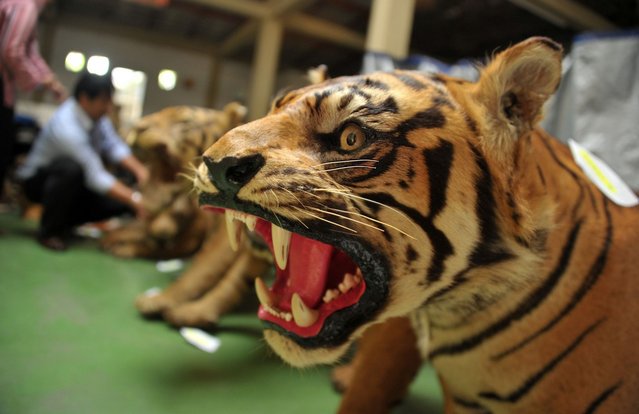
This photo taken on July 25, 2012 one of 14 preserved bodies of critically-endangered Sumatran tigers seized as members of the Indonesian national police and the special crime unit inspect the scene at a warehouse in Cibubur, south of Jakarta. Indonesian police seized 14 preserved bodies of critically-endangered Sumatran tigers in a raid on a house near Jakarta, a spokesman said on July 19. (Photo by Bay Ismoyo/AFP Photo)

“The Sumatran tiger (Panthera tigris sumatrae) is a rare tiger subspecies that inhabits the Indonesian island of Sumatra. It was classified as critically endangered by IUCN in 2008 as the population is projected to be 441 to 679 individuals, with no subpopulation having an effective population size larger than 50 individuals, with a declining trend”. – Wikipedia

This photo taken on July 25, 2012 one of 14 preserved bodies of critically-endangered Sumatran tigers seized as members of the Indonesian national police and the special crime unit inspect the scene at a warehouse in Cibubur, south of Jakarta. Indonesian police seized 14 preserved bodies of critically-endangered Sumatran tigers in a raid on a house near Jakarta, a spokesman said on July 19. (Photo by Bay Ismoyo/AFP Photo)
Details
04 Mar 2015 08:13:00
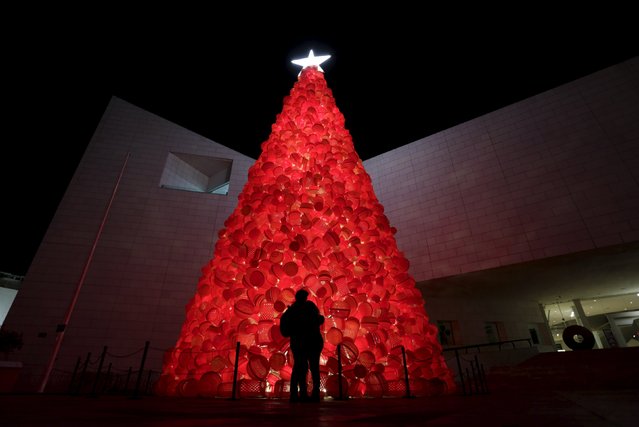
A couple hugs while standing near a Christmas tree made out of plastic bins and plastic hampers outside the Museum of History in Monterrey, Mexico, December 4, 2015. (Photo by Daniel Becerril/Reuters)

A couple hugs while standing near a Christmas tree made out of plastic bins and plastic hampers outside the Museum of History in Monterrey, Mexico, December 4, 2015. The humble Christmas tree has a rich history, from evergreen trees used to symbolise eternal life in Ancient Egypt to tree worship among pagan Europeans. The modern version has its origins in Germany, where the song “O Tannenbaum” is still a festive favourite. Today the traditional tree with lights and decorations appears in cities including Washington, Moscow and Beirut. Alternative constructions range from recycled rubbish in Mexico City to old window frames in Rakvere, Estonia. Whatever the shape or size, the message is the same: Merry Christmas. (Photo by Neil Hall/Reuters)
Details
23 Dec 2015 08:01:00