Janja Garnbret of Slovenia competes during the women's boulder qualification of the IFSC World Cup Innsbruck 2024 on June 26, 2024 in Innsbruck, Austria. (Photo by Marco Kost/Getty Images)
Torchbearers Charles Antoine Kouakou, Fabien Lamirault, Elodie Lorandi, Nantenin Keita and Alexis Hanquinquant gesture after lighting the Cauldron to conclude the opening ceremony of the Paris 2024 Summer Paralympic Games at Place de la Concorde on August 28, 2024 in Paris, France. (Photo by David Ramos/Getty Images)
A woman helps another to wade through a waterlogged road during heavy rain following tropical storm Dana, in Kolkata, India, Friday, October 25, 2024. (Photo by Bikas Das/AP Photo)
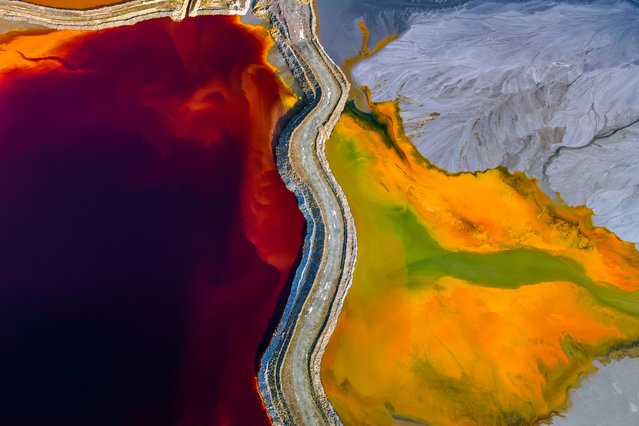
The Rio Tinto river in Spain crosses an ancient mining site which makes the water turn a variety of bright colours. Copper, silver and gold are mined here, as well as iron, which turns the water red. An ochre mix is responsible for the yellow tint of the rest of the river. (Photo by Olivier Jarry-Lancombe/Solent News)
An Afghan Army soldier secures the hill overlooking the Kart-e Sakhi mosque in Kabul, Afghanistan, Wednesday, March 20, 2013. Thousands of Afghans will celebrate Nowruz on Thursday, March 21, 2013 to mark the first day of spring and the beginning of the year on the Iranian calendar. (Photo by Ahmad Jamshid/AP Photo)
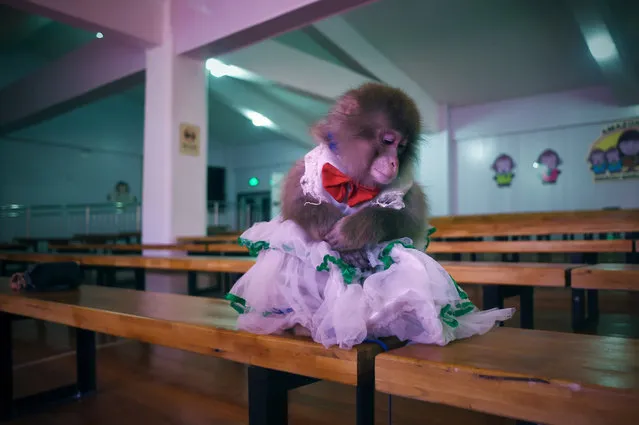
This picture taken on January 26, 2016 shows a monkey sitting on a bench during rehearsal at a monkey training school in a zoo in Dongying, eastern China's Shandong province. Shows featuring performing simians, popular in China and throughout Asia, are expecting a boost in the Lunar New Year of the monkey, which begins on February 8. But they are facing a growing backlash from Chinese people concerned about animal welfare. (Photo by Wang Zhao/AFP Photo)
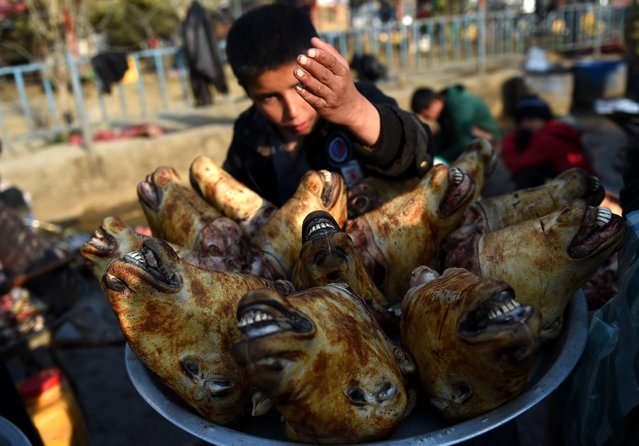
A young Afghan vendor waits for customers to buy sheep's heads at a roadside stall at the busy market in Kabul on November 29, 2015. (Photo by Wakil Kohsar/AFP Photo)
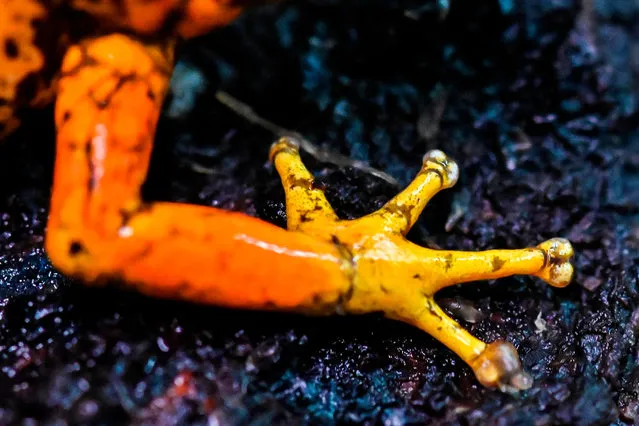
A leg of a “diablito” frog (Oophaga sylvatica) is photographed in a laboratory at a laboratory in the zoo of Cali, Colombia, on July 19, 2019. Colombia is the second country with the largest number of amphibians in the world after Brazil. More than 40% of amphibian species worldwide are in danger of extinction. (Photo by Luis Robayo/AFP Photo)