Loading...
Done
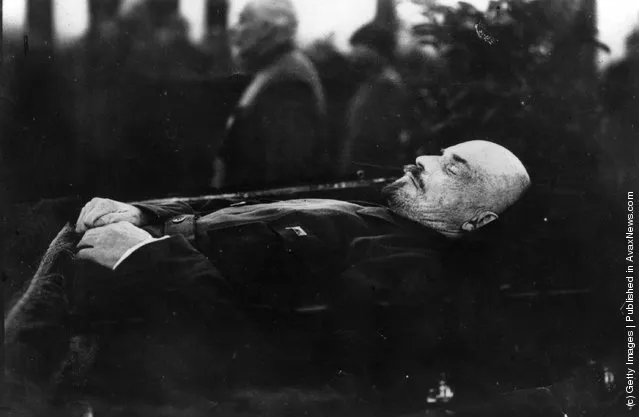
1924:  Vladimir Ilyich Lenin lying in state in the Kremlin

Photo: Vladimir Ilyich Lenin (1870 – 1924) lying in state in the Kremlin. (Photo by Hulton Archive/Getty Images). 1924

Important! For the same article in Russian language click here.

Something quite intriguing is happening within Russian-speaking internet during the last few – should you type a fully academic inquiry (at least, according to Russian academic requirements) in national search engines for "Lenin's mausoleum" – the first thing you get (even in top 10 searches) is website pages talking about black magic and occult. Website authors view this construction differently, but unconditionally agree on one thing: the mausoleum of the "leader of the world proletariat” – the essence of a magical artifact, a sort of “energy vampire”. It was built with a certain purpose: to drain the energy out of miserable Soviet citizens on one hand; and to poison the anthroposphere of one-sixth part of the earth with its vibes (the exact territory that was occupied by the former Soviet Union), depriving the Russian people of will to resist on the other hand. Complete nonsense? No doubt. Nevertheless, an intriguing one. Well, probably because some oddities do exist in mausoleum's history. These oddities are the thing we are going to discuss this time. First, let me refresh you memory on the subject.
Details
16 Oct 2011 11:27:00
Miniature spring-wound 35-mm film camera in a modified cigarette pack. The Tessina’s small size and quiet operation provided more options for concealment than most commercially available models. (Photo by Central Intelligence Agency)

Miniature spring-wound 35-mm film camera in a modified cigarette pack. The Tessina’s small size and quiet operation provided more options for concealment than most commercially available models. (Photo by Central Intelligence Agency)
Details
18 Jul 2014 13:27:00
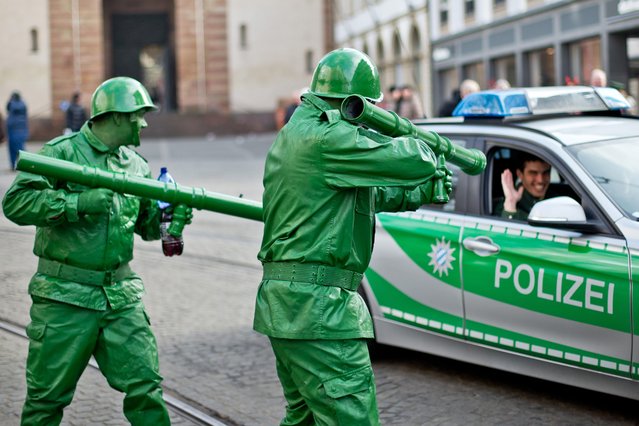
Two revelers dressed as toy soldiers gesture toward a police officer in a patrol car during the traditional carnival parade in Wuerzburg, Germany, 15 February 2015. Under the motto “Carnival Parade is cool” about 160 groups with over 3,000 members took part in one of the biggest carnival parades in southern Germany. (Photo by Daniel Karmann/EPA)

Two revelers dressed as toy soldiers gesture toward a police officer in a patrol car during the traditional carnival parade in Wuerzburg, Germany, 15 February 2015. Under the motto “Carnival Parade is cool” about 160 groups with over 3,000 members took part in one of the biggest carnival parades in southern Germany. (Photo by Daniel Karmann/EPA)
Details
21 Feb 2015 11:31:00
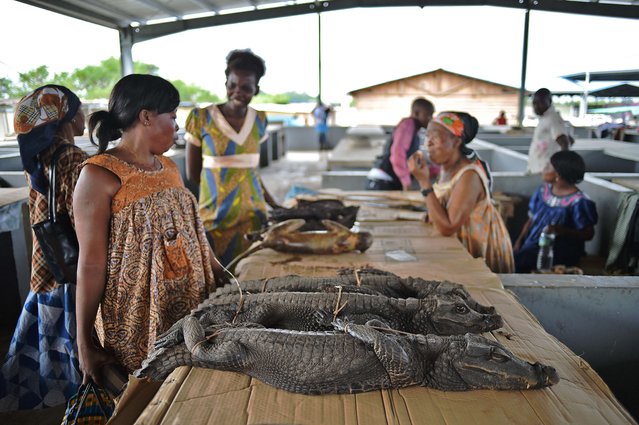
Shoppers walk past crocodiles for sale at a market in Bata on February 3, 2015. Markets in Equatorial Guinea sell a variety of animals including pangolins, monkeys and crocodiles as food. (Photo by Carl De Souza/AFP Photo)

Shoppers walk past crocodiles for sale at a market in Bata on February 3, 2015. Markets in Equatorial Guinea sell a variety of animals including pangolins, monkeys and crocodiles as food. (Photo by Carl De Souza/AFP Photo)
Details
07 Feb 2015 14:33:00
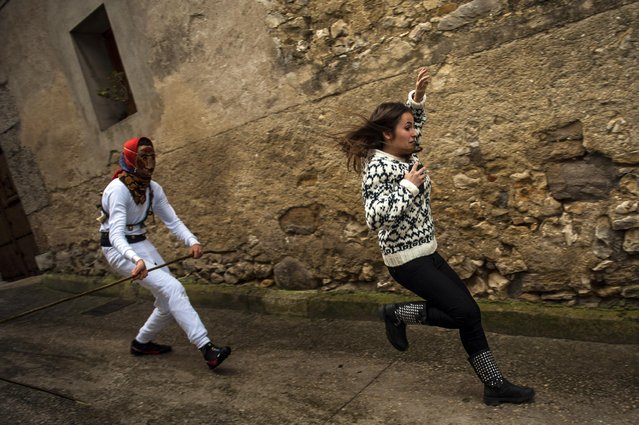
In this photo taken on Sunday, February 15, 2015 a girl runs away from a “Mamuxarro” during the carnival, in the small town of Unanu, northern Spain. While Rio de Janeiro may boast the world’s most famous carnival, the festive period of masquerades and wild and colorful costumes that precedes the Christian religious season of Lent is also a permanent and popular fixture for celebration in Spain and Portugal, with each country having its own strange and unique way of doing it. (Photo by Alvaro Barrientos/AP Photo)

In this photo taken on Sunday, February 15, 2015 a girl runs away from a “Mamuxarro” during the carnival, in the small town of Unanu, northern Spain. In the northern Spanish ancient village of Unamu, people dress up as “Mamuxarro”, folkloric figures in white with a red sash and a metal mask to cover their faces as they pursue townsfolk with sticks. According to custom, their “victims” (usually young women) must kneel and kiss the mamuxarro’s knee after he makes the sign of the cross on their forehead. (Photo by Alvaro Barrientos/AP Photo)
Details
22 Feb 2015 10:51:00
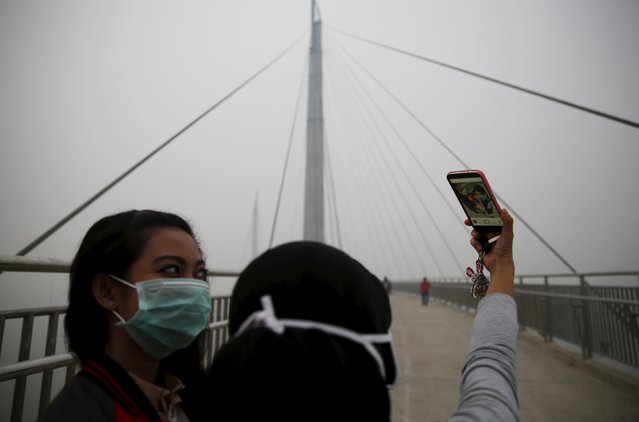
Girls take a selfie at the haze shrouded Batanghari River bridge in Jambi, Indonesia Sumatra island, September 14, 2015. Indonesian islands are blanketed in the so-called “haze”, caused by slash-and-burn clearances on the islands of Sumatra and Borneo, which makes thousands sick, delays flights and pushes air quality to unhealthy levels in neighboring Singapore and Malaysia. (Photo by Reuters/Beawiharta)

Girls take a selfie at the haze shrouded Batanghari River bridge in Jambi, Indonesia Sumatra island, September 14, 2015. Indonesian islands are blanketed in the so-called “haze”, caused by slash-and-burn clearances on the islands of Sumatra and Borneo, which makes thousands sick, delays flights and pushes air quality to unhealthy levels in neighboring Singapore and Malaysia. (Photo by Reuters/Beawiharta)
Details
15 Sep 2015 14:32:00
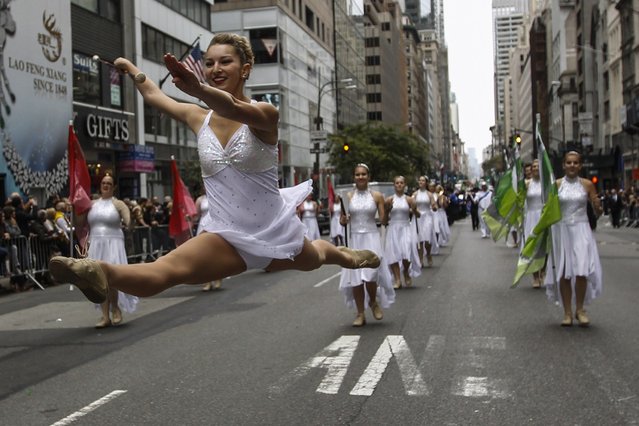
Revellers take part in the the 70th Annual Columbus Day Parade in New York, October 13, 2014. (Photo by Eduardo Munoz/Reuters)

Revellers take part in the the 70th Annual Columbus Day Parade in New York, October 13, 2014. (Photo by Eduardo Munoz/Reuters)
Details
18 Oct 2014 10:29:00
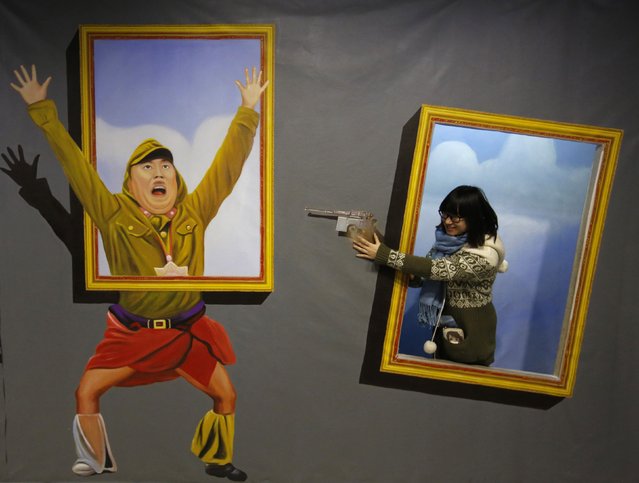
A visitor poses for a photograph in front of a 3D painting depicting a Japanese Imperial army soldier at a 3D art gallery in Beijing January 16, 2015. (Photo by Kim Kyung-Hoon/Reuters)

A visitor poses for a photograph in front of a 3D painting depicting a Japanese Imperial army soldier at a 3D art gallery in Beijing January 16, 2015. (Photo by Kim Kyung-Hoon/Reuters)
Details
17 Jan 2015 12:27:00