Loading...
Done
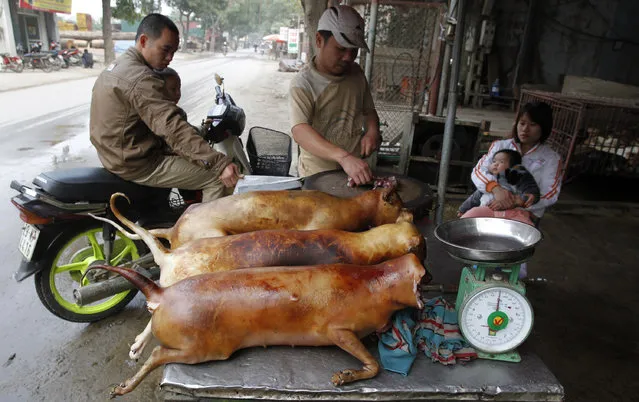
A vendor (C) cuts slaughtered dogs for sale at his roadside stall in Duong Noi village, outside Hanoi December 16, 2011. While animal rights activists have condemned eating dog meat as cruel treatment of the animals, it is still an accepted popular delicacy for some Vietnamese, as well in some other Asian countries. (Photo by Reuters/Kham)

A vendor (C) cuts slaughtered dogs for sale at his roadside stall in Duong Noi village, outside Hanoi December 16, 2011. While animal rights activists have condemned eating dog meat as cruel treatment of the animals, it is still an accepted popular delicacy for some Vietnamese, as well in some other Asian countries. Duong Noi is well-known as a dog-meat village, where hundreds of dogs are killed each day for sale as popular traditional food. Dog-eating as a custom is rooted in Vietnam and was developed as a result of poverty. One kilogram of dog meat costs about 130,000 dongs ($6.2). (Photo by Reuters/Kham)
Details
16 Jul 2013 11:40:00
Haitian soldiers shoot in the air to try to control the crowd as they wait for food to be handed out after Hurricane Matthew hit Jeremie, Haiti, October 18, 2016. (Photo by Carlos Garcia Rawlins/Reuters)

Haitian soldiers shoot in the air to try to control the crowd as they wait for food to be handed out after Hurricane Matthew hit Jeremie, Haiti, October 18, 2016. (Photo by Carlos Garcia Rawlins/Reuters)
Details
20 Oct 2016 11:02:00
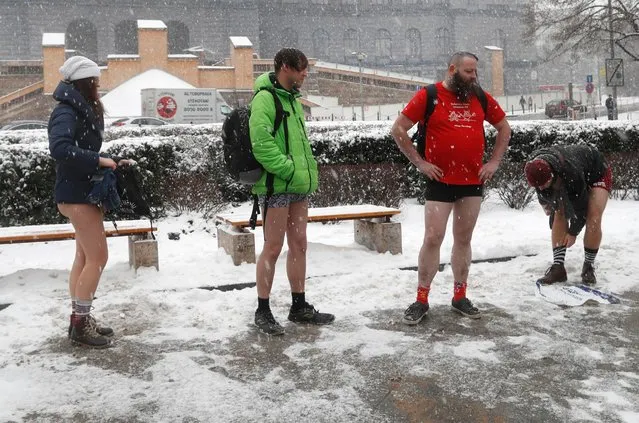
Passengers prepare to take part in the No Pants Subway Ride in Prague, Czech Republic, Sunday, January 8, 2017. The No Pants Subway Ride began in 2002 in New York as a stunt and has taken place in cities around the world since then. (Photo by Petr David Josek/AP Photo)

Passengers prepare to take part in the No Pants Subway Ride in Prague, Czech Republic, Sunday, January 8, 2017. The No Pants Subway Ride began in 2002 in New York as a stunt and has taken place in cities around the world since then. (Photo by Petr David Josek/AP Photo)
Details
09 Jan 2017 13:05:00
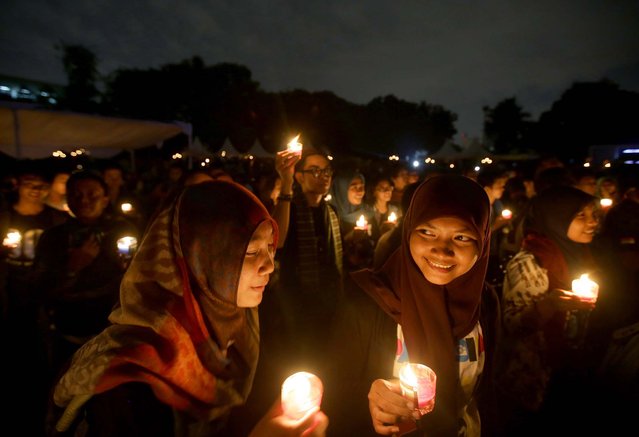
Muslim women light candles during the “EarthHour” in Jakarta, Indonesia, on March 23, 2013. Hundreds of people observed the global event that encourages people to turn off their lights for 60 minutes. (Photo by Dita Alangkara/Associated Press)

Muslim women light candles during the “EarthHour” in Jakarta, Indonesia, on March 23, 2013. Hundreds of people observed the global event that encourages people to turn off their lights for 60 minutes. (Photo by Dita Alangkara/Associated Press)
Details
24 Mar 2013 09:20:00
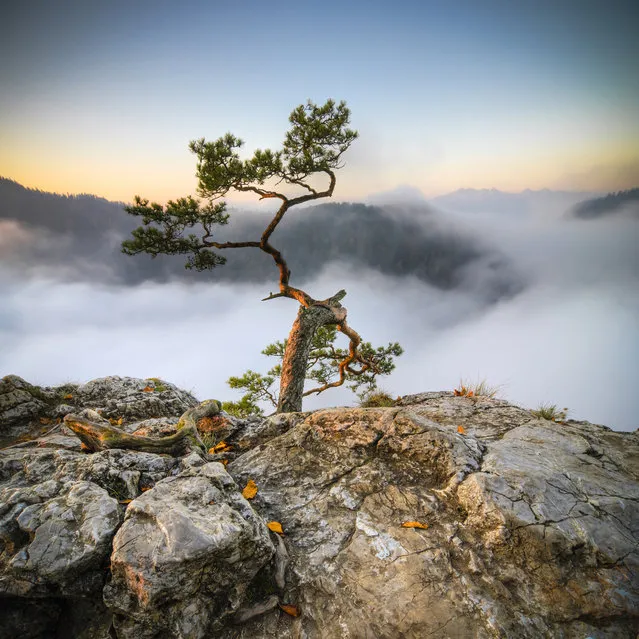
“Sokolica”. Sokolica, Poland. (Photo and caption by Marcin Kęsek/National Geographic Traveler Photo Contest)

“Sokolica”. Sokolica, Poland. (Photo and caption by Marcin Kęsek/National Geographic Traveler Photo Contest)

ATTENTION! All pictures are presented in high resolution. To see Hi-Res images – just TWICE click on any picture. In other words, click small picture – opens the BIG picture. Click BIG picture – opens VERY BIG picture.
Details
25 Jun 2013 09:13:00
Ocean voyage

Do you think that history is a science? Well, not exactly. First, and foremost, history is the state's “legend of wars”, it’s official regalia. Of course, public historians are not interested in scientific truth – quite the opposite. In this respect, any attempt to present a state’s history as altruistic and benevolent as possible is welcomed and encouraged – as opposed to any revisionism attempts that may be more accurate. In this matter, Chinese have surpassed us all – they revised in highly creative manner (but rather shamelessly) the technology already invented by Europeans, a process that resulted in oldest state on the planet. Here is an interesting paradox: ask any sinologist about the Middle Kingdom during second century B.C., and he will describe it to you in such a vivid manner as if he has been living there all his life – but as soon as you will ask him to describe Chinese history in the 19-20th centuries… let's say, his eagerness will be greatly diminished. However, we will discuss China in a different article, and in the meantime we will try to understand how exactly historic “legend of wars” is formed and functions – based on a specific and well-known example. A great example is Ferdinand Magellan's first voyage around the world.
Details
14 Nov 2011 09:11:00
Young migrants gesture during a day of solidarity organised by local organizations and resdients for asylum seekers at a makeshift camp outside the foreign office in Brussels, Belgium September 6, 2015. (Photo by Yves Herman/Reuters)

Young migrants gesture during a day of solidarity organised by local organizations and resdients for asylum seekers at a makeshift camp outside the foreign office in Brussels, Belgium September 6, 2015. Over 150,000 people seeking to enter Europe have reached Hungary this year, most coming through the southern border with Serbia, and many apply for asylum but quickly try to leave for wealthier EU countries. (Photo by Yves Herman/Reuters)
Details
07 Sep 2015 13:34:00
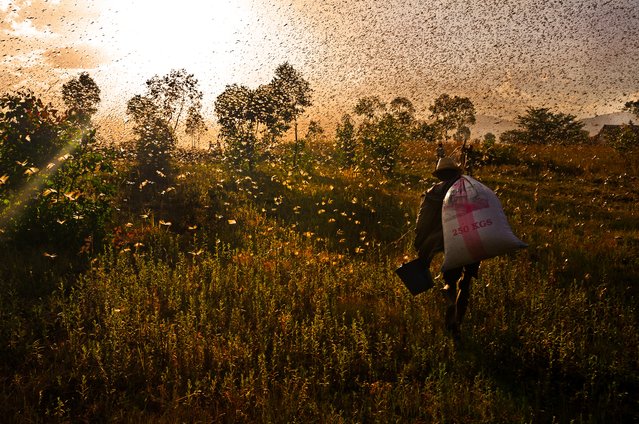
“Locusts & Men”. Oppression, interaction, collaboration. In the life cycle of nature nothing is lost, but the coexistence of different species is sometimes difficult. In Madagascar periodically returns the archaic antagonism between man and the migratory locust, in a circle of life where the two species are looking for space and food for their survival. Photo location: Madagascar, 2013. (Photo and caption by Michele Martinelli/National Geographic Photo Contest)

“Locusts & Men”. Oppression, interaction, collaboration. In the life cycle of nature nothing is lost, but the coexistence of different species is sometimes difficult. In Madagascar periodically returns the archaic antagonism between man and the migratory locust, in a circle of life where the two species are looking for space and food for their survival. At the end of the day a man walks home carrying on his shoulders the heavy bag which contains the locusts captured during the day. The insects provide nutritious meals for the man and his family. Photo location: Madagascar, 2013. (Photo and caption by Michele Martinelli/National Geographic Photo Contest)

ATTENTION! All pictures are presented in high resolution. To see Hi-Res images – just TWICE click on any picture. In other words, click small picture – opens the BIG picture. Click BIG picture – opens VERY BIG picture.
Details
03 Dec 2013 10:59:00