Loading...
Done
Labourers walk near trucks loaded with logs, which are trapped on a muddy road, near an unreserved forest in the village of Igbatoro, southwest Nigeria, August 28, 2014. (Photo by Akintunde Akinleye/Reuters)

Labourers walk near trucks loaded with logs, which are trapped on a muddy road, near an unreserved forest in the village of Igbatoro, southwest Nigeria, August 28, 2014. Wood, a form of biomass, is the sole source of energy for hundreds of millions of Africans who lack access to modern sources of power, and logging, both legal and illegal, remains a lucrative business that has contributed to the rapid shrinking of Africa's rainforests and woodlands. (Photo by Akintunde Akinleye/Reuters)
Details
21 Nov 2014 12:50:00
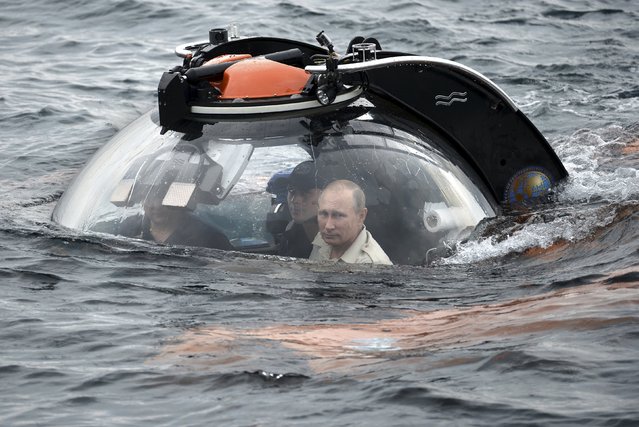
Russian President Vladimir Putin (R) looks through a window of a research bathyscaphe while submerging into the waters of the Black Sea as he takes part in an expedition near Sevastopol, Crimea, August 18, 2015. (Photo by Alexei Nikolsky/Reuters/RIA Novosti/Kremlin)

Russian President Vladimir Putin (R) looks through a window of a research bathyscaphe while submerging into the waters of the Black Sea as he takes part in an expedition near Sevastopol, Crimea, August 18, 2015. (Photo by Alexei Nikolsky/Reuters/RIA Novosti/Kremlin)
Details
19 Aug 2015 12:32:00
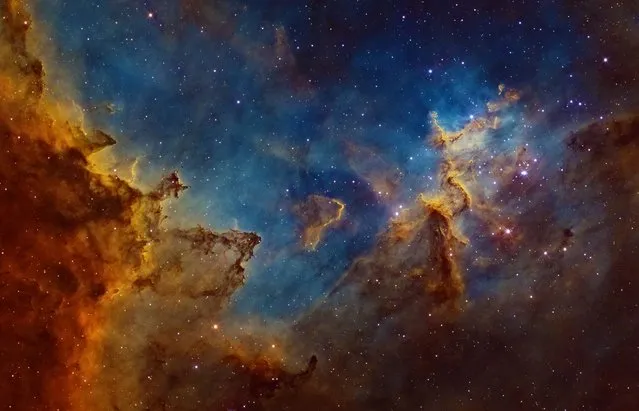
Centre of the Heart Nebula by Ivan Eder (Hungary). Situated 7500 light years away in the ‘W’-shaped constellation of Cassiopeia, the Heart Nebula is a vast region of glowing gas, energized by a cluster of young stars at its centre. The image depicts the central region, where dust clouds are being eroded and moulded into rugged shapes by the searing cosmic radiation. (Photo by Ivan Eder)

The competition, which is run by the Royal Observatory Greenwich in association with BBC Sky at Night Magazine, is now in its sixth year and has received over 2,500 entries. Photo: Centre of the Heart Nebula by Ivan Eder (Hungary). Situated 7500 light years away in the “W”-shaped constellation of Cassiopeia, the Heart Nebula is a vast region of glowing gas, energized by a cluster of young stars at its centre. The image depicts the central region, where dust clouds are being eroded and moulded into rugged shapes by the searing cosmic radiation. (Photo by Ivan Eder)
Details
03 Jul 2014 11:59:00
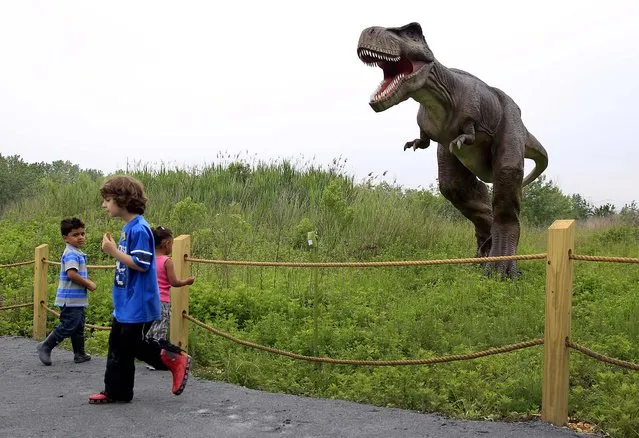
Children watch and react as a T-Rex moves and growls in an inter-active display at Field Station Dinosaurs in Secaucus, N.J on May 25, 2012

Children watch and react as a T-Rex moves and growls in an inter-active display at Field Station Dinosaurs in Secaucus, N.J on May 25, 2012. There will be 31 types of life-sized dinosaurs displayed at the Jurassic expedition that opens Saturday, May 26. (Photo by Mel Evans/Associated Press)
Details
27 May 2012 10:58:00
Number 10. BELL H-13 SIOUX was a two-bladed, single engine, light helicopter built by Bell Helicopter. Westland Aircraft manufactured the Sioux under license for the British military as the Sioux AH.1 and HT. (Photo by AP Photo)

Number 10. BELL H-13 SIOUX was a two-bladed, single engine, light helicopter built by Bell Helicopter. Westland Aircraft manufactured the Sioux under license for the British military as the Sioux AH.1 and HT. In 1947, the United States Air Force ordered the improved Bell Model 47A. Most were designated YR-13 and three winterized versions were designated YR-13A. The United States Army first ordered Bell 47s in 1948 under the designation H-13. These would later receive the name Sioux. The Bell-built H-13 B is seen airborne in this April 29, 1951 photo. The helicopter is equipped with a 173 horsepower engine, cruises at 85 miles per hour, climbs 900 feet in a minute and has a service ceiling of 11,500 feet. (Photo by AP Photo)
Details
08 Aug 2014 11:59:00
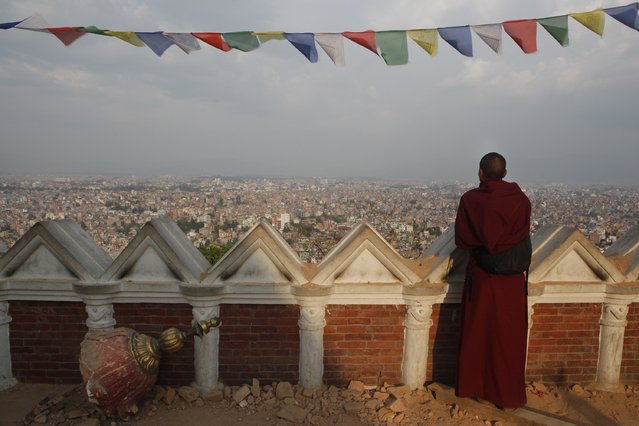
A Buddhist monk catches an aerial view of Kathmandu from the damaged Swayambhunath Stupa premises in Kathmandu, Nepal, Wednesday, May 6, 2015. The April 25 earthquake killed thousands and injured many more as it flattened mountain villages and destroyed buildings and archaeological sites in Kathmandu. (Photo by Niranjan Shrestha/AP Photo)

A Buddhist monk catches an aerial view of Kathmandu from the damaged Swayambhunath Stupa premises in Kathmandu, Nepal, Wednesday, May 6, 2015. The April 25 earthquake killed thousands and injured many more as it flattened mountain villages and destroyed buildings and archaeological sites in Kathmandu. (Photo by Niranjan Shrestha/AP Photo)
Details
08 May 2015 13:20:00
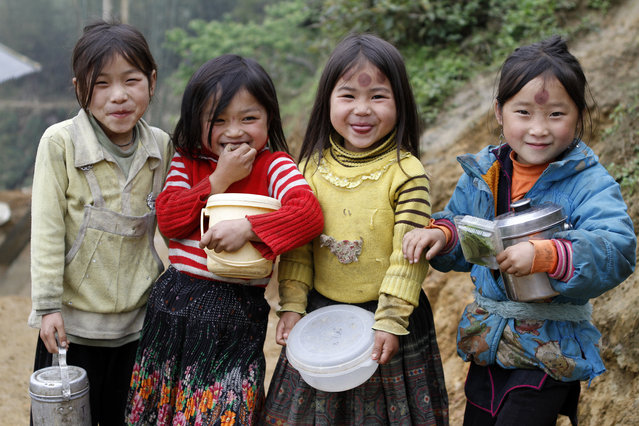
“Kids of Sapa”. Four little beautiful Hmong girls from Lao Chai Village, near Sapa, Vietnam. (Photo and caption by Felipe Hanower/National Geographic Traveler Photo Contest)

“Kids of Sapa”. Four little beautiful Hmong girls from Lao Chai Village, near Sapa, Vietnam. (Photo and caption by Felipe Hanower/National Geographic Traveler Photo Contest)
Details
15 Jul 2013 09:14:00
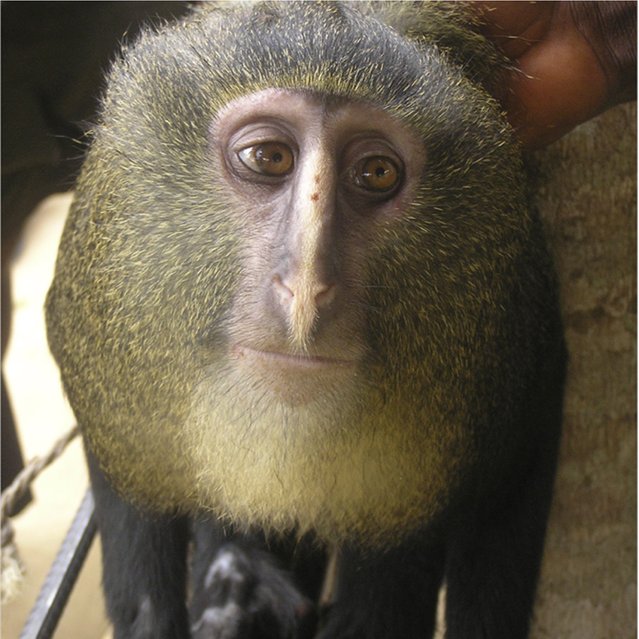
A new species of monkey found in the Democratic Republic of the Congo and identified as Lesula (Cercopithecus lomamiensis) is seen in this undated photograph from an article published September 12, 2012 in the science journal PLOS One. (Photo by Hart J. A., Detwiler K. M., Gilbert C. C./Reuters)

A new species of monkey found in the Democratic Republic of the Congo and identified as Lesula (Cercopithecus lomamiensis) is seen in this undated photograph from an article published September 12, 2012 in the science journal PLOS One. The monkey was first seen in 2007 by researchers John and Terese Hart of the Peabody Museum of Natural History at Yale Research Project. The finding of C. lomamiensis represents only the second new species of African monkey to be discovered in the past 28 years, according to the research article. (Photo by Hart J. A., Detwiler K. M., Gilbert C. C./Reuters)
Details
27 Sep 2012 08:17:00