Loading...
Done
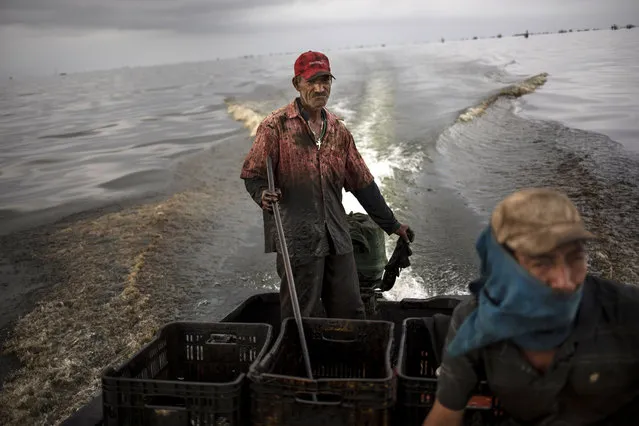
Fisherman Jose Miguel Perez, whose nickname is “Taliban”, navigates the oil infested waters of Lake Maracaibo, near Cabimas, Venezuela, May 21, 2019. Nobody lives as closely with the environmental fallout of Venezuela's collapsing oil industry as the fishermen who scratch out an existence on the blackened, sticky shores of Lake Maracaibo. (Photo by Rodrigo Abd/AP Photo)

Fisherman Jose Miguel Perez, whose nickname is “Taliban”, navigates the oil infested waters of Lake Maracaibo, near Cabimas, Venezuela, May 21, 2019. Nobody lives as closely with the environmental fallout of Venezuela's collapsing oil industry as the fishermen who scratch out an existence on the blackened, sticky shores of Lake Maracaibo. (Photo by Rodrigo Abd/AP Photo)
Details
26 Nov 2019 00:03:00
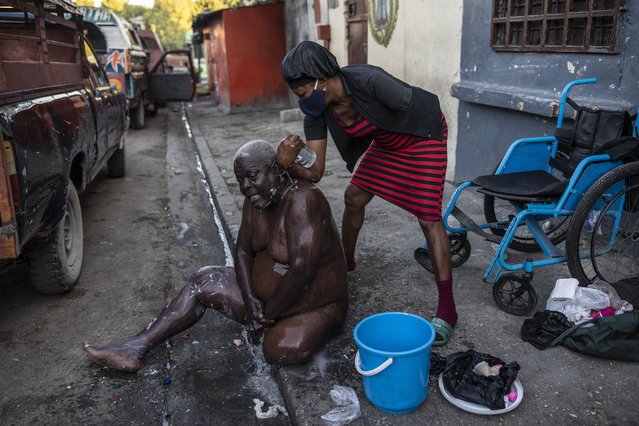
Marie Joseph bathes her friend Jean Robert outside a shelter for the internally displaced where they live due to police violence in Port-au-Prince, Haiti, Thursday, September 16, 2021. Most of the population of Port-au-Prince has no access to basic public services, no drinking water, electricity or garbage collection. (Photo by Rodrigo Abd/AP Photo)

Marie Joseph bathes her friend Jean Robert outside a shelter for the internally displaced where they live due to police violence in Port-au-Prince, Haiti, Thursday, September 16, 2021. Most of the population of Port-au-Prince has no access to basic public services, no drinking water, electricity or garbage collection. (Photo by Rodrigo Abd/AP Photo)
Details
26 Oct 2021 08:34:00
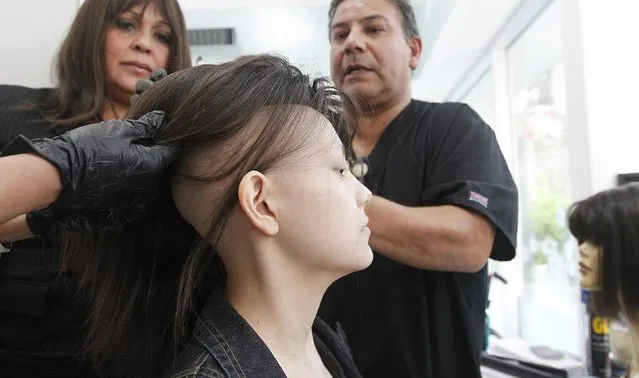
Hair stylist Marcelo Avatte (R) prepares to fit Isidora Serrano, a 14-year-old who lost her hair due to chemotherapy to treat her bone cancer, with a natural hair wig in the cancer ward of the Luis Calvo Mackenna Hospital in Santiago, October 23, 2014. (Photo by Rodrigo Garrido/Reuters)

Hair stylist Marcelo Avatte (R) prepares to fit Isidora Serrano, a 14-year-old who lost her hair due to chemotherapy to treat her bone cancer, with a natural hair wig in the cancer ward of the Luis Calvo Mackenna Hospital in Santiago, October 23, 2014. The wigs, handmade by Italian-Chilean hair stylist Marcelo Avatte and his team, have helped the children regain their self-esteem and confidence during cancer treatment. Renowned for making customised wigs, Avatte has donated more than 300 wigs since 2009 and says he was motivated to begin the project by the pain he felt when his own son lost his hair during chemotherapy. (Photo by Rodrigo Garrido/Reuters)
Details
18 Nov 2014 11:33:00
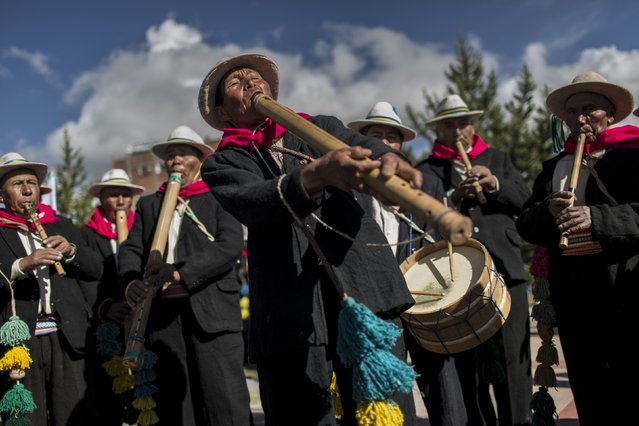
In this January 29, 2017 photo, musicians perform for dancers on the shores of Lake Titicaca, as they practice before their presentation for the Virgin of Candelaria celebrations in Puno, Peru. Dancers in colorful masks and elaborate costume celebrate the Virgin of Candelaria, patron saint of communities along the shore of Lake Titicaca, in what's considered the largest Catholic festival in the Andes. (Photo by Rodrigo Abd/AP Photo)

In this January 29, 2017 photo, musicians perform for dancers on the shores of Lake Titicaca, as they practice before their presentation for the Virgin of Candelaria celebrations in Puno, Peru. Dancers in colorful masks and elaborate costume celebrate the Virgin of Candelaria, patron saint of communities along the shore of Lake Titicaca, in what's considered the largest Catholic festival in the Andes. (Photo by Rodrigo Abd/AP Photo)
Details
03 Feb 2017 06:50:00
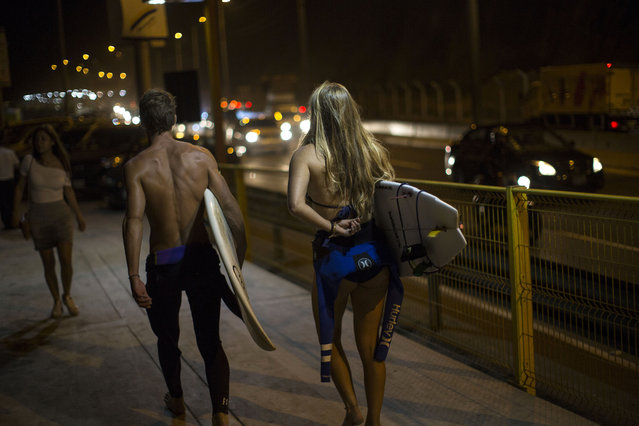
In this Feb. 17, 2017 photo, surfers walk to La Pampilla beach in Lima, Peru. Night surfing apparently came about in Lima because of a dispute with the capital municipality that in 2015 increased the width of a road that runs along the coast. The surfers protested the construction for months by camping on the asphalted beach area, but in the end the municipality prevailed, with support from the police. At the end of 2016, perhaps to win over the surfers, Lima's mayor set up beach lights that allows for night surfing. (Photo by Rodrigo Abd/AP Photo)

In this Feb. 17, 2017 photo, surfers walk to La Pampilla beach in Lima, Peru. Night surfing apparently came about in Lima because of a dispute with the capital municipality that in 2015 increased the width of a road that runs along the coast. The surfers protested the construction for months by camping on the asphalted beach area, but in the end the municipality prevailed, with support from the police. At the end of 2016, perhaps to win over the surfers, Lima's mayor set up beach lights that allows for night surfing. (Photo by Rodrigo Abd/AP Photo)
Details
04 May 2017 09:23:00
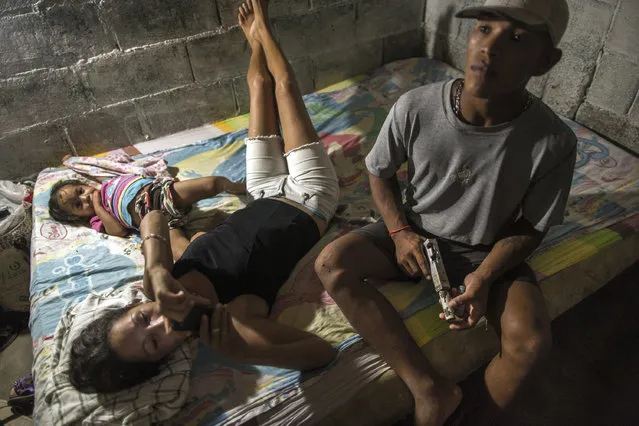
In this November 7, 2016 photo, “El Menor”, a member of “Los Cainos” self-defense group formed by the Marval fishing family, holds a homemade gun before starting a night patrol to help protect fishermen from pirate attacks in Punta de Araya, Sucre state, Venezuela. Pirates are terrorizing the coastal state of Sucre, once home to the world's fourth-largest tuna fleet and a thriving fishing industry. (Photo by Rodrigo Abd/AP Photo)

In this November 7, 2016 photo, “El Menor”, a member of “Los Cainos” self-defense group formed by the Marval fishing family, holds a homemade gun before starting a night patrol to help protect fishermen from pirate attacks in Punta de Araya, Sucre state, Venezuela. Pirates are terrorizing the coastal state of Sucre, once home to the world's fourth-largest tuna fleet and a thriving fishing industry. (Photo by Rodrigo Abd/AP Photo)
Details
09 Dec 2016 11:46:00
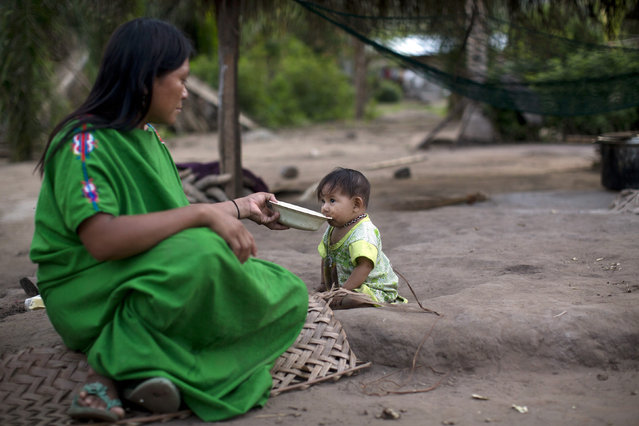
In this November 19, 2015 photo, Ester Melendez feeds banana porridge to her nine-month-old daughter Dina, in Pichiquia, an Ashaninka indigenous community in Peru's Junin region. Incursions and assaults by loggers, miners, colonists and leftist guerrillas have reduced the lands of the Ashaninka people in the Peruvian Amazon, leaving many of the 97,000 members of the group malnourished, despite efforts by the government and independent organizations to help. (Photo by Rodrigo Abd/AP Photo)

In this November 19, 2015 photo, Ester Melendez feeds banana porridge to her nine-month-old daughter Dina, in Pichiquia, an Ashaninka indigenous community in Peru's Junin region. Incursions and assaults by loggers, miners, colonists and leftist guerrillas have reduced the lands of the Ashaninka people in the Peruvian Amazon, leaving many of the 97,000 members of the group malnourished, despite efforts by the government and independent organizations to help. (Photo by Rodrigo Abd/AP Photo)
Details
10 Dec 2015 08:00:00
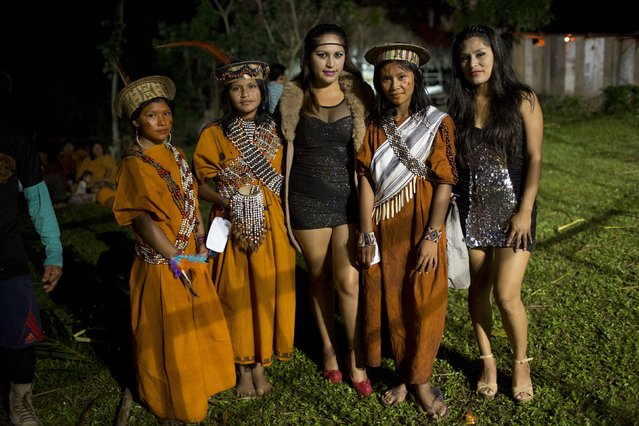
In this June 23, 2015 photo, Ashaninka Indian beauty contestants pose for a photo with members of a visiting music group, hired to perform during the annual founding anniversary festivities, in Otari Nativo, Pichari, Peru. The contestants wear the simple brown dresses of the Ashaninka woman, their faces dotted in a traditional design with a red dye extracted from a spice called achiote. (Photo by Rodrigo Abd/AP Photo)

In this June 23, 2015 photo, Ashaninka Indian beauty contestants pose for a photo with members of a visiting music group, hired to perform during the annual founding anniversary festivities, in Otari Nativo, Pichari, Peru. The contestants wear the simple brown dresses of the Ashaninka woman, their faces dotted in a traditional design with a red dye extracted from a spice called achiote. (Photo by Rodrigo Abd/AP Photo)
Details
16 Jul 2015 11:12:00