Loading...
Done
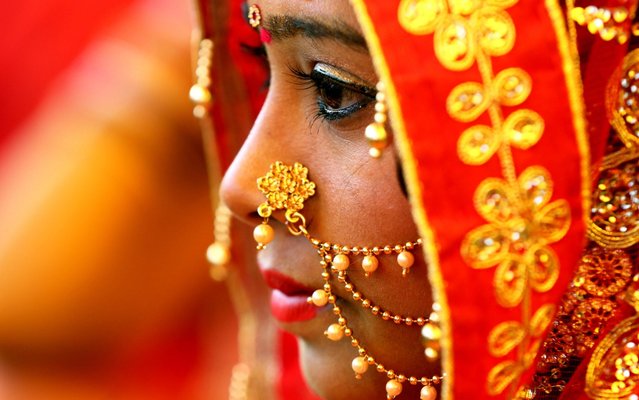
Indian bride takes part in a mass marriage ceremony under chief minister's welfare scheme (Mukhyamantri Kanyadan Yojna) on the occasion of the Basant Panchami festival, in Bhopal, India, 30 January 2020. Reports state, some 600 couples tied up the nuptial knot in various mass marriage ceremonies in Bhopal on Basant Panchami day, which is considered auspicious for marriages. Some communities undertake the responsibility of arranging mass marriages for couples belonging to the financially weaker caste of the society. (Photo by Sanjeev Gupta/EPA/EFE/Rex Features/Shutterstock)

Indian bride takes part in a mass marriage ceremony under chief minister's welfare scheme (Mukhyamantri Kanyadan Yojna) on the occasion of the Basant Panchami festival, in Bhopal, India, 30 January 2020. (Photo by Sanjeev Gupta/EPA/EFE/Rex Features/Shutterstock)
Details
10 Feb 2020 10:17:00


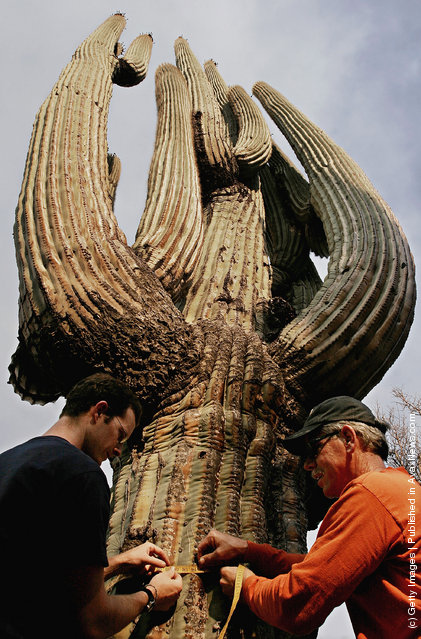
“The saguaro (scientific name Carnegiea gigantea) is a large, tree-sized cactus species in the monotypic genus Carnegiea. It is native to the Sonoran Desert in the U.S. state of Arizona, the Mexican state of Sonora, a small part of Baja California in the San Felipe Desert and an extremely small area of California, U.S. The saguaro blossom is the State Wildflower of Arizona”. – Wikipedia

Photo: Daniel Appel (L), a firefighter with Engine 84 from the Lassen National Forest in California and Mike Hallen, (R), Arizona representative of the National Register of Big Trees, measure the circumference of this Saguaro cactus called the "Grand One," in the Tonto National Forest on July 1, 2005 35 miles north of Phoenix, near Carefree, Arizona. The cactus, estimated to be more than 200 years old, measures a circumference of 7 feet, 10 inches (2.4 meters) and stands 46 feet high (14 meters). The cactus was burned in the Cave Creek Complex fire and may not survive. It was once the largest Saguaro in the world, two others have been found recently that have tied it's measurements. The fire has burned more than 214,000 acres of the Sonoran desert. (Photo by Jeff Topping/Getty Images)

Details
26 Jul 2011 12:27:00
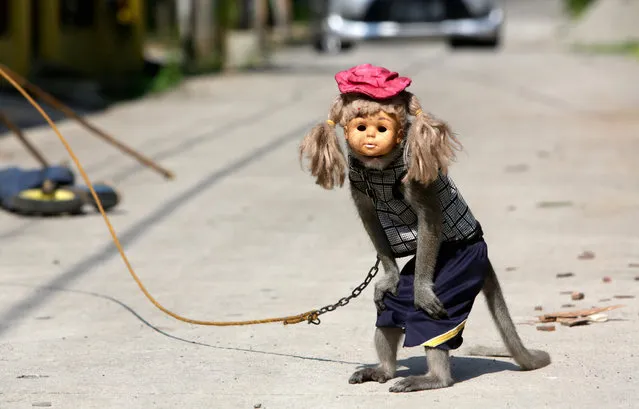
A chained male monkey in a costume and wearing a toy mask performs at a street in Depok, West Java, Indonesia, 30 September 2021. A performing monkey in a street, known as “Topeng Monyet” (lit. Monkey Mask), is a popular form of cheap entertainment in Indonesia, especially on the island of Java. During a street monkey show, a trainer issues orders by pulling the chain tied around the primate's neck, forcing it to perform tricks such as wearing a mask or riding a toy motorcycle. The Indonesian government in 2013 banned the Topeng Monyet in the capital Jakarta to improve public order and ending animal abuse. However, monkey performances are still popular in several other parts of the country, such as West Java, especially after the government lowered the level of Enforcement of Restrictions on Community Activities (PPKM) in a number of areas during the COVID-19 pandemic. (Photo by Adi Weda/EPA/EFE)

A chained male monkey in a costume and wearing a toy mask performs at a street in Depok, West Java, Indonesia, 30 September 2021. A performing monkey in a street, known as “Topeng Monyet” (lit. Monkey Mask), is a popular form of cheap entertainment in Indonesia, especially on the island of Java. (Photo by Adi Weda/EPA/EFE)
Details
16 Oct 2021 09:08:00
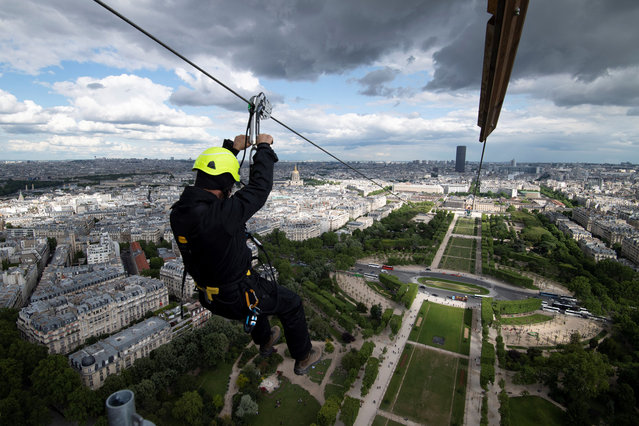
A person rides on a zip-line descending from the second floor of the Eiffel Tower on May 28, 2019 in Paris. The 800 meter crossing takes one minute at a speed of 90km/h. The zip-line will be opened from May 29 to June 2, 2019. (Photo by Francois Guillot/AFP Photo)

A person rides on a zip-line descending from the second floor of the Eiffel Tower on May 28, 2019 in Paris. The 800 meter crossing takes one minute at a speed of 90km/h. The zip-line will be opened from May 29 to June 2, 2019. (Photo by Francois Guillot/AFP Photo)
Details
30 May 2019 00:05:00
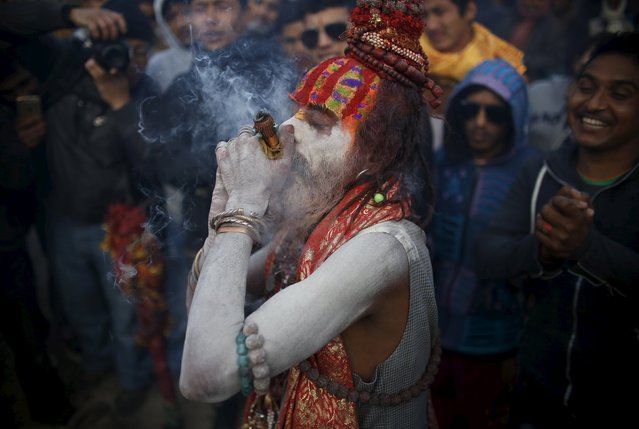
A Hindu holy man, or sadhu, smeared with ashes smokes marijuana in a chillum during the Shivaratri festival on the premises of Pashupatinath Temple in Kathmandu, Nepal, March 7, 2016. Hindu holy men from Nepal and India come to this temple to take part in the Maha Shivaratri festival. Celebrated by Hindu devotees all over the world, Shivaratri is dedicated to Lord Shiva, and holy men mark the occasion by praying, smoking marijuana or smearing their bodies with ashes. (Photo by Navesh Chitrakar/Reuters)

A Hindu holy man, or sadhu, smeared with ashes smokes marijuana in a chillum during the Shivaratri festival on the premises of Pashupatinath Temple in Kathmandu, Nepal, March 7, 2016. Hindu holy men from Nepal and India come to this temple to take part in the Maha Shivaratri festival. Celebrated by Hindu devotees all over the world, Shivaratri is dedicated to Lord Shiva, and holy men mark the occasion by praying, smoking marijuana or smearing their bodies with ashes. (Photo by Navesh Chitrakar/Reuters)
Details
08 Mar 2016 13:46:00
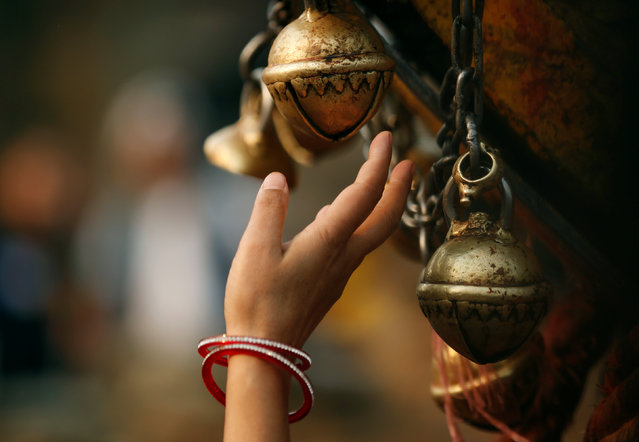
A hand of a devotee is pictured as she rings a bell while offering prayers to the chariot of God Bhairab during the Bisket festival in Bhaktapur, Nepal, April 13, 2016. (Photo by Navesh Chitrakar/Reuters)

A hand of a devotee is pictured as she rings a bell while offering prayers to the chariot of God Bhairab during the Bisket festival in Bhaktapur, Nepal, April 13, 2016. During the festival, also regarded as Nepalese New Year, images of the Hindu god Bhairava and his female counterpart Bhadrakali are enshrined in two large chariots and pulled to an open square after which rituals and festivities are performed. (Photo by Navesh Chitrakar/Reuters)
Details
15 Apr 2016 11:20:00
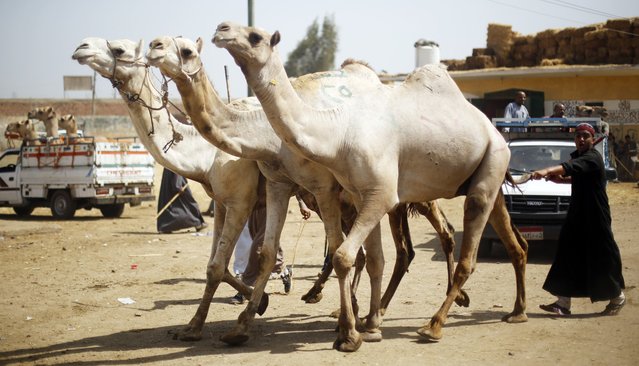
A man walks behind camels at the Birqash Camel Market, ahead of Eid al-Adha or Festival of Sacrifice, on the outskirts of Cairo September 29, 2014. (Photo by Amr Abdallah Dalsh/Reuters)

A man walks behind camels at the Birqash Camel Market, ahead of Eid al-Adha or Festival of Sacrifice, on the outskirts of Cairo September 29, 2014. Birqash Camel Market, one of the biggest markets for camel meat in Africa, draws sellers from Libya, Sudan, Somalia and other regions in Egypt. The camels sold at the market are also used in tourism. Traders say that the selling rate for a camel in 2014 is anywhere between 5,000 and 20,000 Egyptian pounds (700 – 2800 USD). (Photo by Amr Abdallah Dalsh/Reuters)
Details
02 Oct 2014 10:20:00
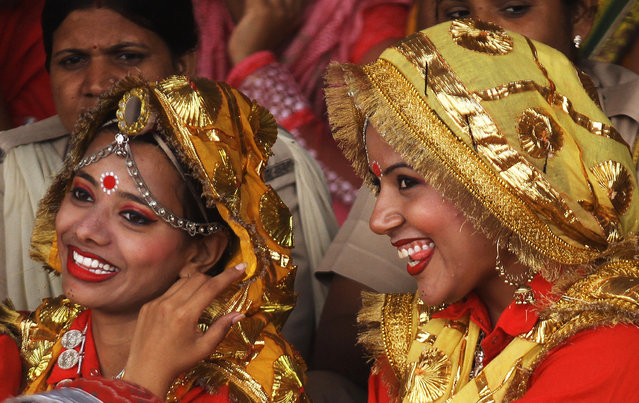
Participants share a moment after performing at a cultural program during India's Independence Day celebrations in Ajmer, in the desert state of Rajasthan, India, August 15, 2016. (Photo by Himanshu Sharma/Reuters)

Participants share a moment after performing at a cultural program during India's Independence Day celebrations in Ajmer, in the desert state of Rajasthan, India, August 15, 2016. (Photo by Himanshu Sharma/Reuters)
Details
23 Aug 2016 09:48:00