Loading...
Done
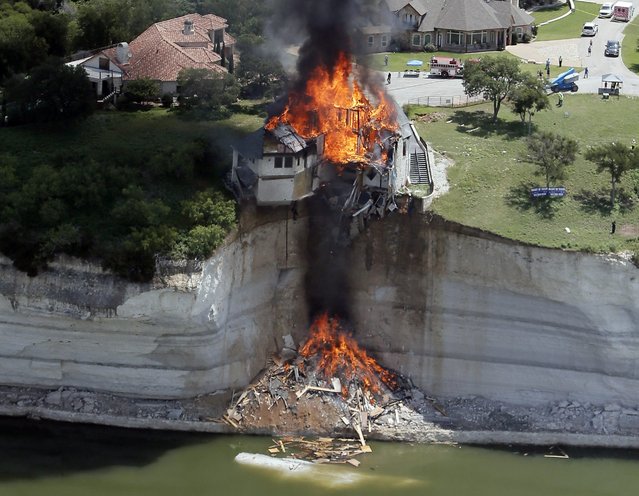
Smoke rises from a house days after part of the ground it was resting on collapsed into Lake Whitney, Texas in this June 13, 2014 file photo. I was covering the controlled burn of a house slowly falling into Lake Whitney due to the decaying cliff underneath.  Asked to take photos from an aerial perspective, an instructor and I took off from Grand Prairie Municipal Airport around 9am. (Photo and caption by Brandon Wade/Reuters)

Smoke rises from a house days after part of the ground it was resting on collapsed into Lake Whitney, Texas in this June 13, 2014 file photo. I was covering the controlled burn of a house slowly falling into Lake Whitney due to the decaying cliff underneath. Asked to take photos from an aerial perspective, an instructor and I took off from Grand Prairie Municipal Airport around 9am. The burn, scheduled to start an hour later, was delayed. I love flying, but patience proved challenging as circling for nearly three hours gets boring fast. Once the fire started we only had 15 minutes to take photos because the plane was booked at 1pm. The owners invested their retirement savings in the house and were even advised by geologists that the ground was stable. To watch your investment literally go up in flames must take its toll emotionally. The owners said they don't expect their insurance to cover the loss. (Photo and caption by Brandon Wade/Reuters)
Details
27 Nov 2014 15:01:00
A visitor walks on a giant chalk artwork called “Wasting Time” at the Chalk Urban Arts Festival in Sydney on October 25, 2014. The picture is the biggest 3-D artwork created in Australia by two artists, Leon Keer from Holland and Jenny McCracken from Australia. (Photo by Peter Parks/AFP Photo)

A visitor walks on a giant chalk artwork called “Wasting Time” at the Chalk Urban Arts Festival in Sydney on October 25, 2014. The picture is the biggest 3-D artwork created in Australia by two artists, Leon Keer from Holland and Jenny McCracken from Australia. (Photo by Peter Parks/AFP Photo)
Details
25 Oct 2014 13:58:00
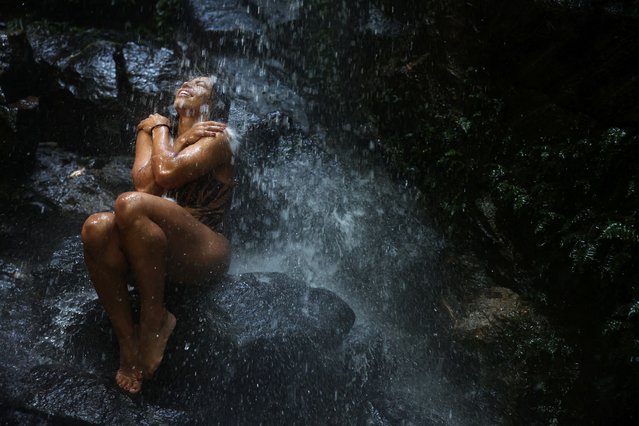
Anda Oliveira, 34, enjoys a waterfall in the Tijuca National Park, one of the world's biggest urban forests, marking the World Water Day in Rio de Janeiro, Brazil on March 15, 2024. (Photo by Pilar Olivares/Reuters)

Anda Oliveira, 34, enjoys a waterfall in the Tijuca National Park, one of the world's biggest urban forests, marking the World Water Day in Rio de Janeiro, Brazil on March 15, 2024. (Photo by Pilar Olivares/Reuters)
Details
01 Jul 2025 02:56:00
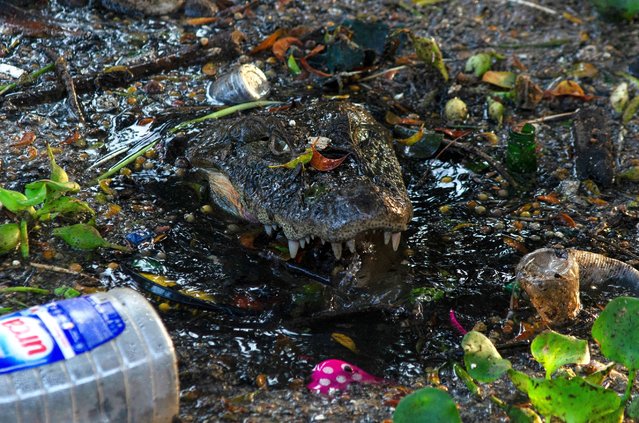
A caiman swims amidst trash in Canal das Taxas at the Recreio dos Bandeirantes neighborhood in west Rio de Janeiro, Brazil, on November 22, 2023. The urban expansion of the area and the resulting pollution have put the yacare caiman (Caiman latirostris) “in danger of extinction”. (Photo by Tercio Teixeira/AFP Photo)

A caiman swims amidst trash in Canal das Taxas at the Recreio dos Bandeirantes neighborhood in west Rio de Janeiro, Brazil, on November 22, 2023. The urban expansion of the area and the resulting pollution have put the yacare caiman (Caiman latirostris) “in danger of extinction”. (Photo by Tercio Teixeira/AFP Photo)
Details
12 Jun 2024 03:33:00
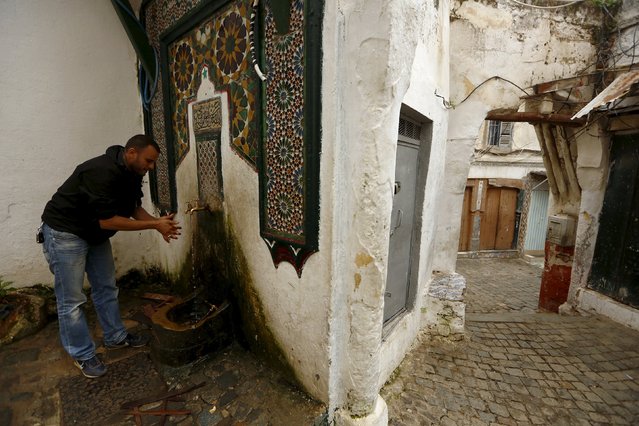
A man performs ablution using water at an old fountain before performing prayers in the old city of Algiers Al Casbah, Algeria December 3, 2015. (Photo by Zohra Bensemra/Reuters)

A man performs ablution using water at an old fountain before performing prayers in the old city of Algiers Al Casbah, Algeria December 3, 2015. The Algiers Casbah is a UNESCO World heritage site that includes the Sidi Ramdane mosque and former fortress, 10 centuries old. Decay from the passing years, as well as earthquake damage in 2003, leads some to consider a move to modern apartments with financial backing from the government. Others refuse to leave a neighbourhood they have called home for decades. (Photo by Zohra Bensemra/Reuters)
Details
22 Jan 2016 11:00:00
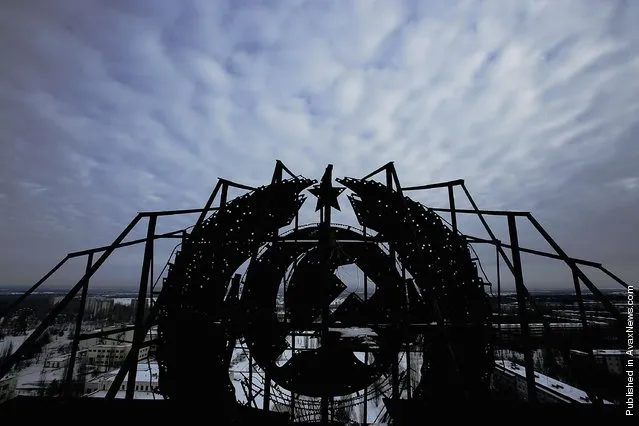
Chernobyl

Scaffolding holding a remnant of the Soviet Union, the hammer and sickle, is seen on a rooftop of an abandoned building in the town of Pripyat on January 25, 2006 near Chernobyl, Ukraine. The town of Pripyat, deserted since the 1986 catastrophe, once housed 30,000 people, the majority of being workers from the Chernobyl Nuclear Power Plant. Days after the catastrophe the inhabitants were relocated to other locations in the Soviet Union. The town of Pripyat has remained uninhabited since. Prypyat and the surrounding area will not be safe for human habitation for several centuries. Scientists estimate that the most dangerous radioactive elements will take up to 900 years to decay sufficiently to render the area safe.
Details
14 Mar 2011 10:20:00
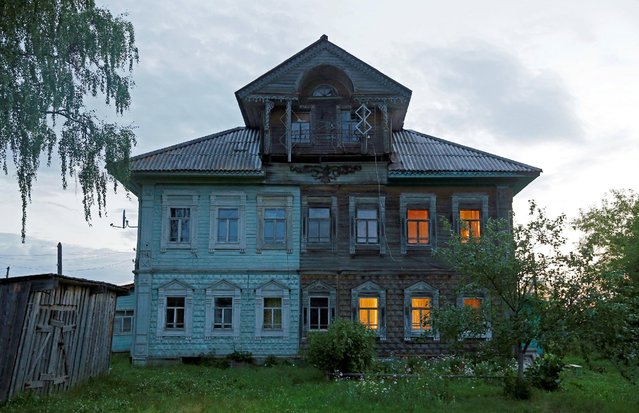
A view of the facade of a house in the village of Cherevkovo, Arkhangelsk region, Russia, July 12, 2016. (Photo by Maxim Shemetov/Reuters)

A view of the facade of a house in the village of Cherevkovo, Arkhangelsk region, Russia, July 12, 2016. Traditional wooden houses, many featuring exquisite carvings and craftsmanship, are falling into decay across Russia because of neglect, lack of funds and an exodus from the countryside to the cities. Urbanisation and a low birth rate are emptying out the countryside, and residents and authorities are often largely indifferent towards the historical value of their properties. (Photo by Maxim Shemetov/Reuters)
Details
10 Nov 2016 12:11:00
Simon – a friendly fox, who often approaches tourists in the exclusion zone, asking for food. (Photo by Vladimir Mitgutin/Caters News Agency)

This fascinating photo series looks at the bleak isolation of Chernobyl as never before. Employing infrared filters, photographer Vladimir Mitgutin is able to bring out details of decay – an abandoned bus, a radar system, an amusement park, a doll, a sports hall, a piano – frozen in time. Here: Simon – a friendly fox, who often approaches tourists in the exclusion zone, asking for food. (Photo by Vladimir Mitgutin/Caters News Agency)
Details
12 Feb 2018 00:02:00