Loading...
Done
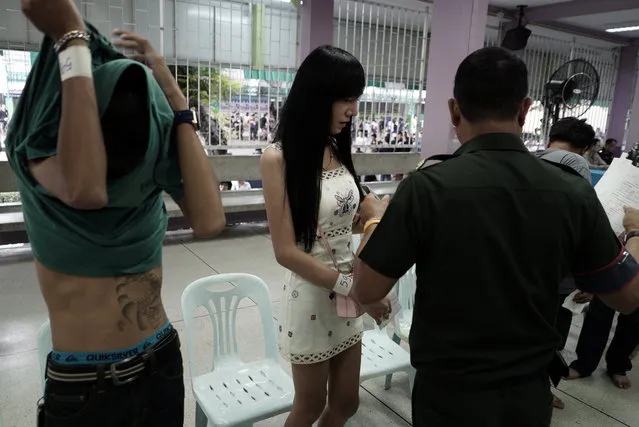
Kanphitcha Sungsuk, 21, (C), lines up with young men to speak to officers during an army draft held at a school in Klong Toey, the dockside slum area in Bangkok, Thailand, April 6, 2017. (Photo by Athit Perawongmetha/Reuters)

Kanphitcha Sungsuk, 21, (C), lines up with young men to speak to officers during an army draft held at a school in Klong Toey, the dockside slum area in Bangkok, Thailand, April 6, 2017. Thailand is widely seen as a paradise for gay and transgender people, but many complain of being treated as second-class citizens and the obligation to respond to the draft can be a nightmare when they turn 21. (Photo by Athit Perawongmetha/Reuters)
Details
11 Apr 2017 09:33:00
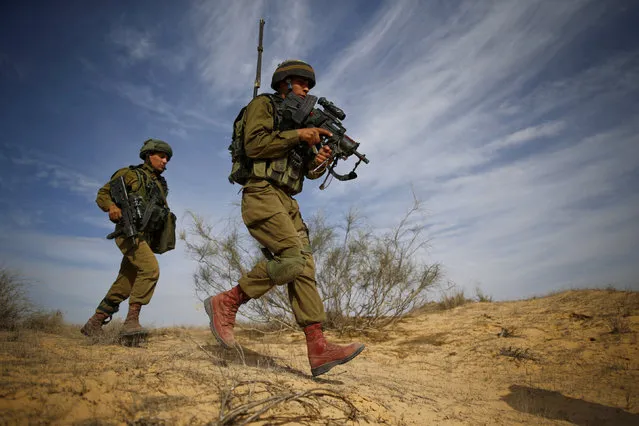
Yussef Saluta (R), 20, an Israeli Arab soldier from the Desert Reconnaissance battalion takes part in a drill near Kissufim in southern Israel November 29, 2016. (Photo by Amir Cohen/Reuters)

Yussef Saluta (R), 20, an Israeli Arab soldier from the Desert Reconnaissance battalion takes part in a drill near Kissufim in southern Israel November 29, 2016. A battalion of soldiers crawls across the desert sand with assault rifles cocked. It's a routine exercise, but these are no ordinary troops – they are Arabs who have chosen to fight for the Jewish state. (Photo by Amir Cohen/Reuters) (Photo by Amir Cohen/Reuters)
Details
07 Dec 2016 11:48:00
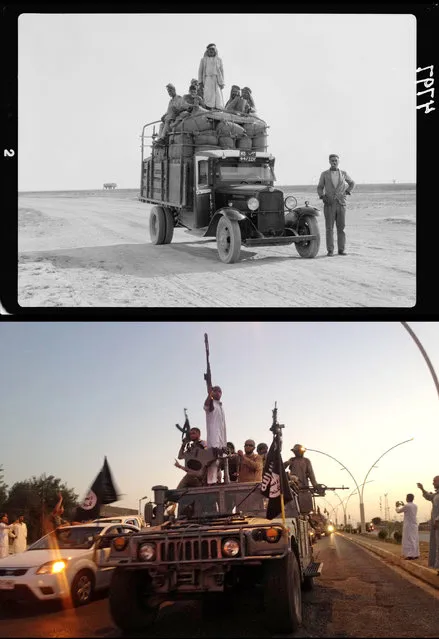
This combination of two photographs shows a 1932 image of men on a lorry on the road to Mosul, northern Iraq, from the Library of Congress, top, and fighters from the Islamic State group parading in a commandeered Iraqi security forces armored vehicle down a main road in Mosul on Monday, June 23, 2014. (Photo by AP Photo)


Iraq's second largest city, Mosul, is locked under the rule of extremists from the Islamic State group trying to purge it of everything they see as contradicting their stark vision of Islam. A trove of photographs now housed at the Library of Congress offers a glimpse of a different Mosul – before wars, insurgency, sectarian strife and now radicals' rule. The scenes were taken in the autumn of 1932 by staff from the American Colony Photo Department during a visit to Iraq at the end of the British mandate. (Photo by AP Photo)
Details
21 Sep 2014 11:13:00
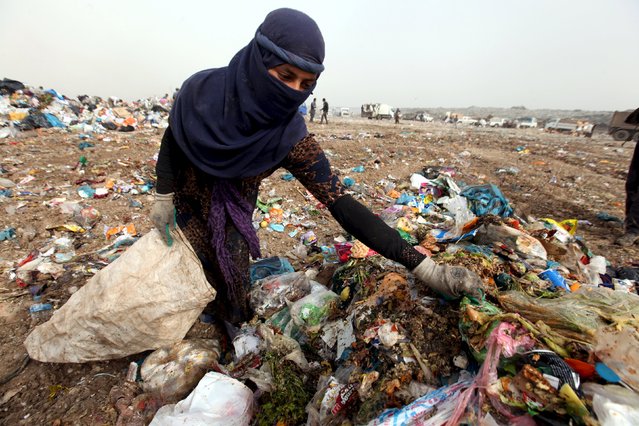
A garbage collector looks for recyclable waste at a dump in Erbil, in Iraq's northern autonomous Kurdistan region, February 21, 2016. (Photo by Azad Lashkari/Reuters)

A garbage collector looks for recyclable waste at a dump in Erbil, in Iraq's northern autonomous Kurdistan region, February 21, 2016. (Photo by Azad Lashkari/Reuters)
Details
22 Feb 2016 10:18:00
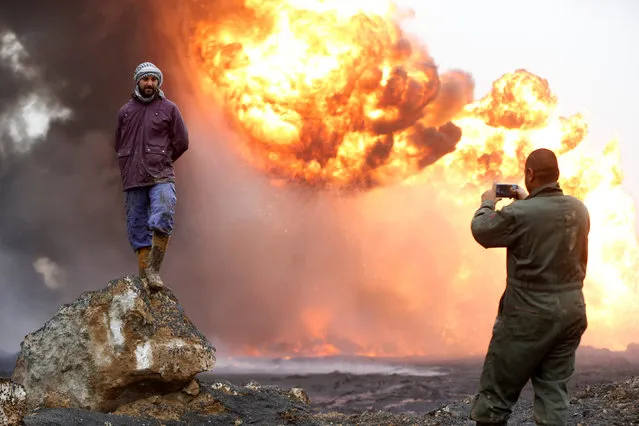
A man takes a photograph of his friend as thick smoke rises from a fire, which broke out at oil wells set ablaze by Islamic State militants before they fled the oil-producing region of Qayyara, Iraq, January 28, 2017. (Photo by Muhammad Hamed/Reuters)

A man takes a photograph of his friend as thick smoke rises from a fire, which broke out at oil wells set ablaze by Islamic State militants before they fled the oil-producing region of Qayyara, Iraq, January 28, 2017. (Photo by Muhammad Hamed/Reuters)
Details
30 Jan 2017 09:55:00
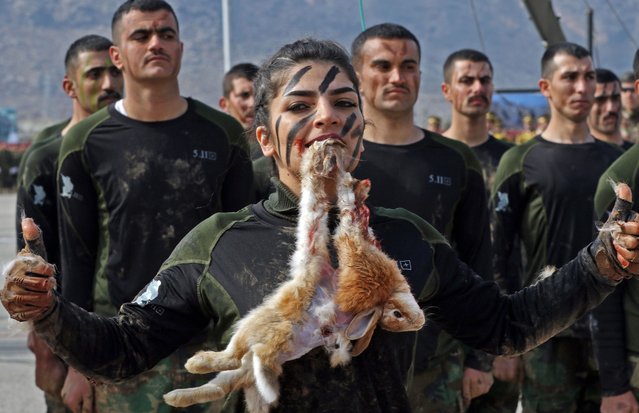
An Iraqi Kurdish Peshmerga female officer bites a Rabbit while demonstrating skills during a graduation ceremony in the Kurdish town of Soran, about 100 kilometres northeast of the capital of Iraq's autonomous Kurdish region Arbil, on February 12, 2020. (Photo by Safin Hamed/AFP Photo)

An Iraqi Kurdish Peshmerga female officer bites a Rabbit while demonstrating skills during a graduation ceremony in the Kurdish town of Soran, about 100 kilometres northeast of the capital of Iraq's autonomous Kurdish region Arbil, on February 12, 2020. (Photo by Safin Hamed/AFP Photo)
Details
09 Mar 2020 00:01:00
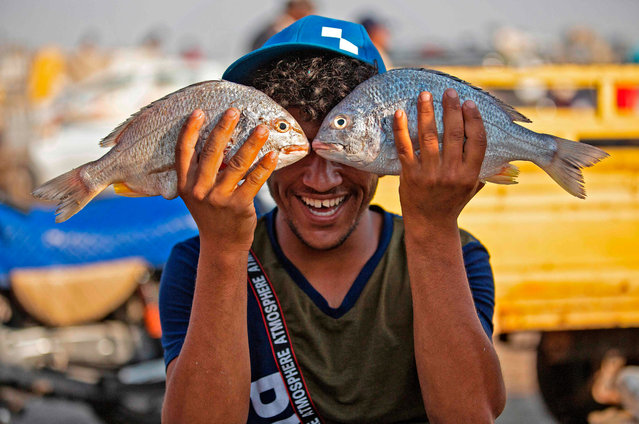
A youth poses while holding two fishes before his face in Iraq's southern port city of al-Faw, 90 kilometres south of Basra near the Shatt al-Arab and the Gulf, on May 18, 2020. In Iraq, a national lockdown to halt the COVID-19 coronavirus pandemic has found some unexpected fans: local businesses who no longer have to compete with Turkish, Iranian or Chinese imports. Those countries, as well as Saudi Arabia, Jordan and Kuwait, typically flood Iraqi markets with inexpensive products at prices local producers can't compete with. (Photo by Hussein Faleh/AFP Photo)

A youth poses while holding two fishes before his face in Iraq's southern port city of al-Faw, 90 kilometres south of Basra near the Shatt al-Arab and the Gulf, on May 18, 2020. In Iraq, a national lockdown to halt the COVID-19 coronavirus pandemic has found some unexpected fans: local businesses who no longer have to compete with Turkish, Iranian or Chinese imports. Those countries, as well as Saudi Arabia, Jordan and Kuwait, typically flood Iraqi markets with inexpensive products at prices local producers can't compete with. (Photo by Hussein Faleh/AFP Photo)
Details
02 Jul 2020 00:01:00
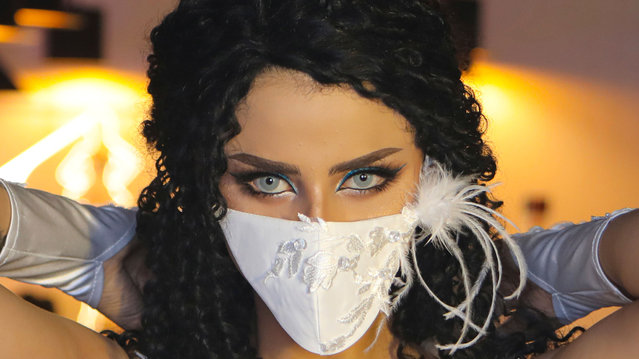
A model wears a face mask to help prevent the spread of the coronavirus, designed by Iraqi designer Ziad Tariq at his workshop in Basra, Iraq, Monday, July 20, 2020. (Photo by Nabil al-Jurani/AP Photo)

A model wears a face mask to help prevent the spread of the coronavirus, designed by Iraqi designer Ziad Tariq at his workshop in Basra, Iraq, Monday, July 20, 2020. (Photo by Nabil al-Jurani/AP Photo)
Details
19 Sep 2020 00:05:00