Loading...
Done
Art Styles By Brano Hlavac

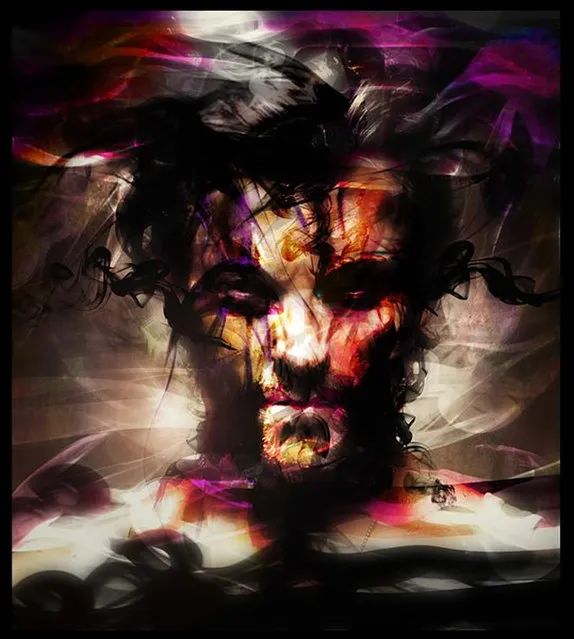
Brano Hlavac aka Gartier Atelier is another one of those artists whose work can be difficult to pinpoint. His artwork jumps from style to style, but it's not such a bad thing considering how well it shows off his talents.
Details
20 Apr 2013 09:33:00
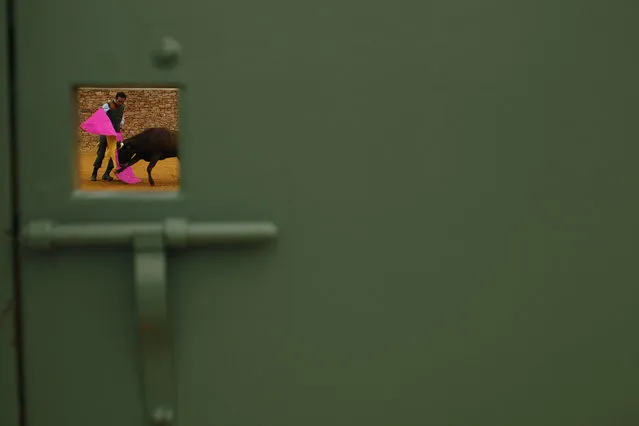
Spanish bullfighter Manuel Jesus “El Cid” is seen through a small window of a door as he performs a pass to a heifer during a “tentadero” (a small bullfight to check the bravery of calves and heifers which are not killed) during the first International Biennial of bullfighting at Reservatauro Ronda cattle ranch in Ronda, near Malaga February 17, 2013. Spain's parliament voted last Tuesday to consider protecting bullfighting as a national pastime, angering animal rights campaigners and politicians in two regions where the sport is banned. (Photo by Jon Nazca/Reuters)

Spanish bullfighter Manuel Jesus “El Cid” is seen through a small window of a door as he performs a pass to a heifer during a “tentadero” (a small bullfight to check the bravery of calves and heifers which are not killed) during the first International Biennial of bullfighting at Reservatauro Ronda cattle ranch in Ronda, near Malaga February 17, 2013. Spain's parliament voted last Tuesday to consider protecting bullfighting as a national pastime, angering animal rights campaigners and politicians in two regions where the sport is banned. (Photo by Jon Nazca/Reuters)
Details
22 Feb 2013 11:15:00
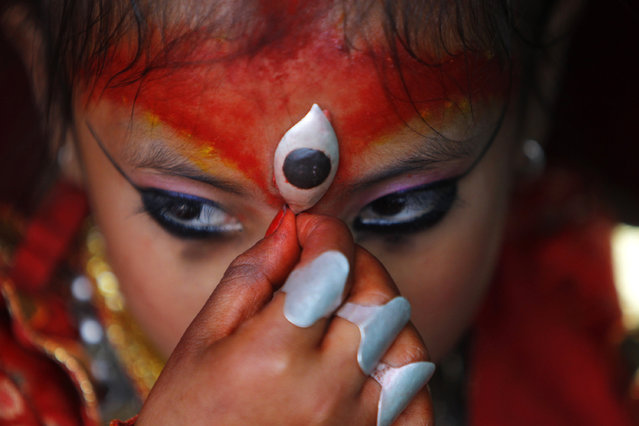
Nepal's Kumari, or living goddess, adjusts her ornament as she watches the Rato Machindranath chariot Festival in Lalitpur, Nepal, Friday, April 24, 2015. Nepal's living goddesses are young pre-pubescent girls considered by devotees to be incarnations of a Hindu goddess. Selected as toddlers, living goddesses usually keep their positions until they reach puberty. (Photo by Niranjan Shrestha/AP Photo)

Nepal's Kumari, or living goddess, adjusts her ornament as she watches the Rato Machindranath chariot Festival in Lalitpur, Nepal, Friday, April 24, 2015. Nepal's living goddesses are young pre-pubescent girls considered by devotees to be incarnations of a Hindu goddess. Selected as toddlers, living goddesses usually keep their positions until they reach puberty. (Photo by Niranjan Shrestha/AP Photo)
Details
25 Apr 2015 10:05:00
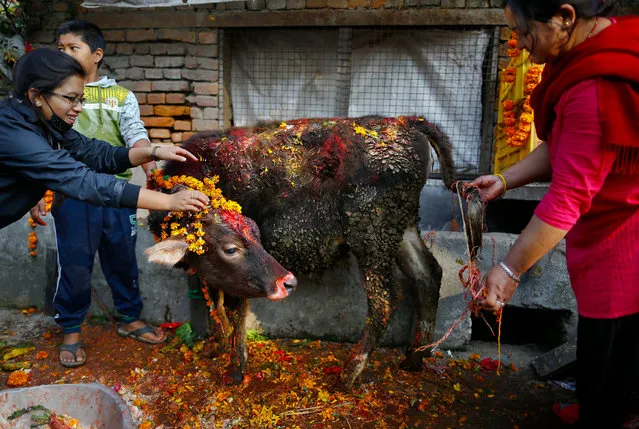
A Nepalese devotee bows in front of a cow during the 'Gai Puja', also known as the Cow Worship Day, as part of the Tihar festival in Kathmandu, Nepal, 11 November 2015. The Tihar festival is the second most important event for Nepalese Hindus. During the celebrations people worship cows, considered the incarnation of Lord Laxmi, the god of wealth. (Photo by Narendra Shrestha/EPA)

A Nepalese devotee bows in front of a cow during the 'Gai Puja', also known as the Cow Worship Day, as part of the Tihar festival in Kathmandu, Nepal, 11 November 2015. The Tihar festival is the second most important event for Nepalese Hindus. During the celebrations people worship cows, considered the incarnation of Lord Laxmi, the god of wealth. (Photo by Narendra Shrestha/EPA)
Details
14 Nov 2015 08:05:00
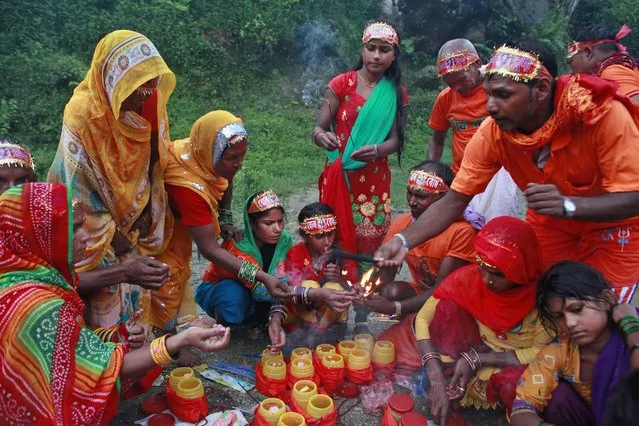
Hindu devotees perform rituals during the Bol Bom pilgrimage, on the outskirts of Kathmandu, Nepal, Monday, August 8, 2016. During this pilgrimage, devotees walk miles barefooted before offering water collected from Bagmati river, at the Pashupatinath temple in Katmandu. Shravan Somwar or Monday of Hindu calendar month of Shravan is considered auspicious for offering prayers to Lord Shiva, the god of destruction. (Photo by Niranjan Shrestha/AP Photo)

Hindu devotees perform rituals during the Bol Bom pilgrimage, on the outskirts of Kathmandu, Nepal, Monday, August 8, 2016. During this pilgrimage, devotees walk miles barefooted before offering water collected from Bagmati river, at the Pashupatinath temple in Katmandu. Shravan Somwar or Monday of Hindu calendar month of Shravan is considered auspicious for offering prayers to Lord Shiva, the god of destruction. (Photo by Niranjan Shrestha/AP Photo)
Details
09 Aug 2016 12:42:00
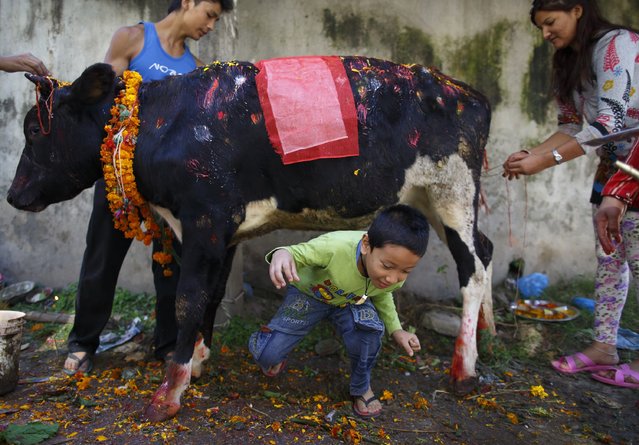
A boy crawls under a cow during a religious ceremony celebrating the Tihar festival, also called Diwali, in Kathmandu, October 23, 2014. Hindus all over Nepal are celebrating the festival during which they worship cows, which are considered a maternal figure, and other animals. Also known as the festival of lights, devotees worship the goddess of wealth Laxmi by illuminating and decorating their homes using garlands, oil lamps, candles and colourful light bulbs. (Photo by Navesh Chitrakar/Reuters)

A boy crawls under a cow during a religious ceremony celebrating the Tihar festival, also called Diwali, in Kathmandu, October 23, 2014. Hindus all over Nepal are celebrating the festival during which they worship cows, which are considered a maternal figure, and other animals. Also known as the festival of lights, devotees worship the goddess of wealth Laxmi by illuminating and decorating their homes using garlands, oil lamps, candles and colourful light bulbs. (Photo by Navesh Chitrakar/Reuters)
Details
25 Oct 2014 13:23:00
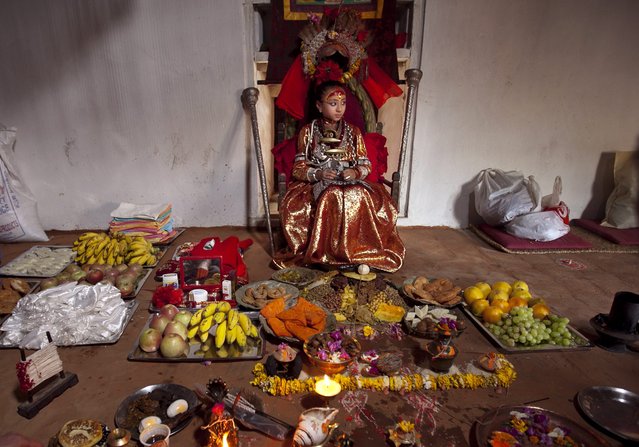
Kumari Samita Bajracharya sits in front of devotees offers during a special puja at Kumari Ghar in Patan, Nepal, 09 April 2011. It is believed that worshipping Kumari and receiving tika from her reduces illness and avoid problems. Kumari, or Kumari Devi, is a “living goddess”. The word literally means virgin in Nepali. The Living Goddesses are young pre-pubescent girls that are considered to be incarnations of the Hindu Goddess of Power, Kali. The Kumari retires when she reaches puberty. (Photo by Narendra Shrestha/EPA)

Kumari Samita Bajracharya sits in front of devotees offers during a special puja at Kumari Ghar in Patan, Nepal, 09 April 2011. It is believed that worshipping Kumari and receiving tika from her reduces illness and avoid problems. Kumari, or Kumari Devi, is a “living goddess”. The word literally means virgin in Nepali. The Living Goddesses are young pre-pubescent girls that are considered to be incarnations of the Hindu Goddess of Power, Kali. The Kumari retires when she reaches puberty. (Photo by Narendra Shrestha/EPA)
Details
18 Jun 2014 12:31:00
Ukraine's Leonid Stadnyk, who stands at a height of 2.53 metres (eight feet four inches) and may be considered the world's tallest living man, near his house in the village of Podolyantsi in Ukraine's Zhytomyr region, about 200 km (124 miles) from the capital Kiev, 2005. (Photo by Reuters/STR New)

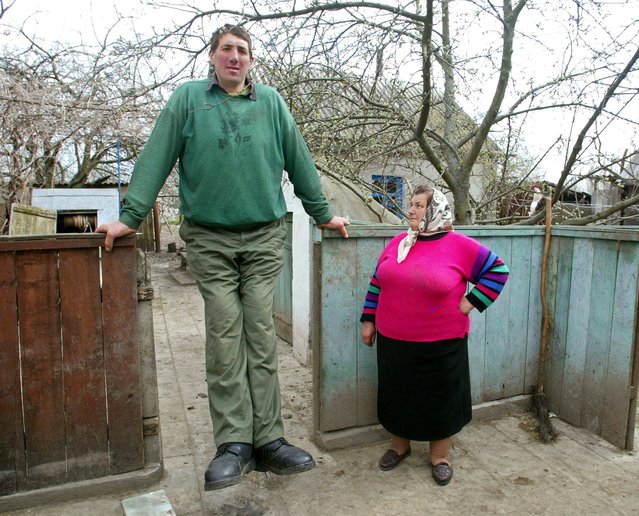
Ukraine's Leonid Stadnyk, who stands at a height of 2.53 metres (eight feet four inches) and may be considered the world's tallest living man, near his house in the village of Podolyantsi in Ukraine's Zhytomyr region, about 200 km (124 miles) from the capital Kiev, 2005. (Photo by Reuters/Stringer)
Details
29 Aug 2014 11:56:00