Loading...
Done
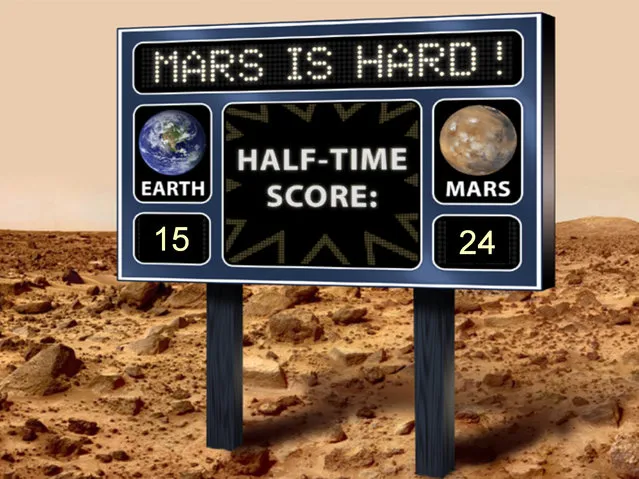
This artist's scoreboard displays a fictional game between Mars and Earth, with Mars in the lead. (Image by NASA/JPL-Caltech)

This artist's scoreboard displays a fictional game between Mars and Earth, with Mars in the lead. It refers to the success rate of sending missions to Mars, both as orbiters and landers. Of the previous 39 missions targeted for Mars from around the world, 15 have been successes and 24 failures. For baseball fans, that's a batting average of .385. The United States has had 13 successes out of 18 attempts, or a “batting average” of .722. NASA's Curiosity rover, set to land on the Red Planet the evening of Aug. 5, 2012 PDT (morning of Aug. 6 EDT), will mark the United States' 19th attempt to tackle the challenge of Mars, and the world's 40th attempt. (Image by NASA/JPL-Caltech)
Details
06 Aug 2012 09:47:00
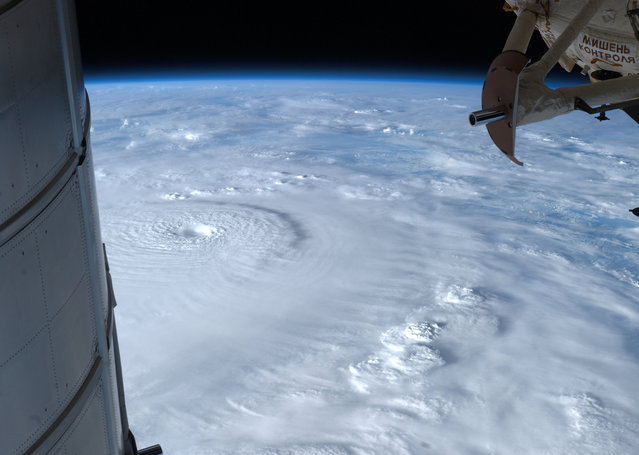
Typhoon Bopha moves toward the Philippines, observed from the ISS, on December 2, 2012. (Photo by AP Photo/NASA/The Atlantic)

Typhoon Bopha moves toward the Philippines, observed from the ISS, on December 2, 2012. (Photo by AP Photo/NASA via The Atlantic)
Details
02 Apr 2013 12:22:00
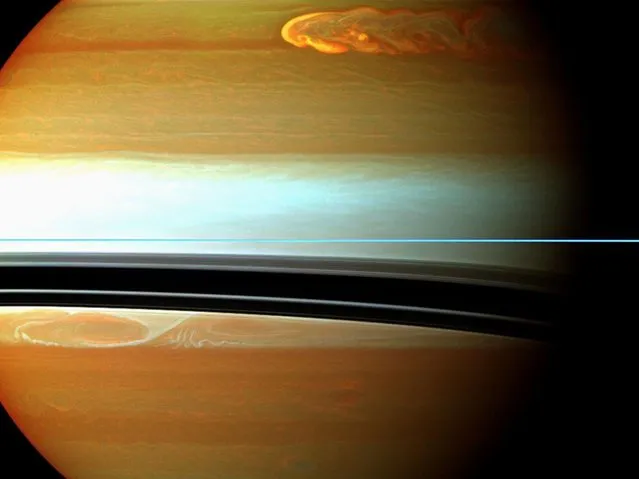
The huge storm which generated the lightning strike on Saturn can be seen in the top right of this image

An incredible view of daytime lightning on Saturn during one of the biggest storms the ringed planet has ever seen has been captured by a NASA spacecraft.

Photo: The huge storm which generated the lightning strike on Saturn can be seen in the top right of this image. (Photo by NASA)
Details
22 Jul 2012 08:43:00
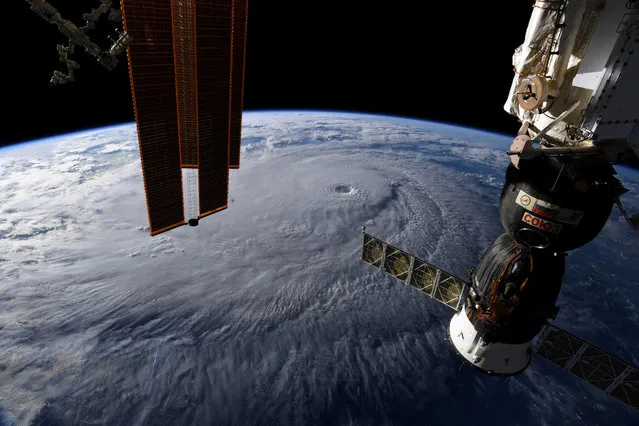
A photo taken from the International Space Station shows Hurricane Lane in the early morning hours near Hawaii, August 22, 2018. (Photo by Courtesy @astro_ricky/NASA/Handout via Reuters)

A photo taken from the International Space Station shows Hurricane Lane in the early morning hours near Hawaii, August 22, 2018. (Photo by Courtesy @astro_ricky/NASA/Handout via Reuters)
Details
01 Jan 2019 00:01:00
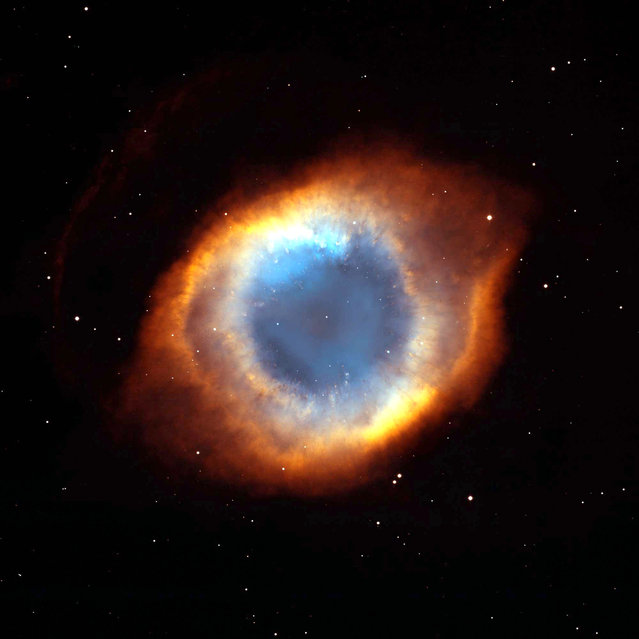
A coil-shaped Helix Nebula showing a fine web of filamentary “bicycle-spoke” features embedded in the colorful red and blue ring of gas. At 650 light-years away, the Helix is one of the nearest planetary nebulae to Earth. A planetary nebula is the glowing gas around a dying, Sun-like star. (Photo by Reuters/NASA)

A coil-shaped Helix Nebula showing a fine web of filamentary “bicycle-spoke” features embedded in the colorful red and blue ring of gas. At 650 light-years away, the Helix is one of the nearest planetary nebulae to Earth. A planetary nebula is the glowing gas around a dying, Sun-like star. (Photo by Reuters/NASA)
Details
22 Oct 2014 14:01:00
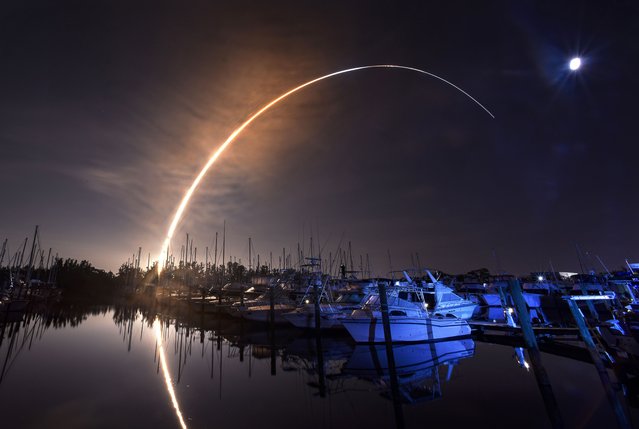
NASA's new moon rocket lifts off from the Kennedy Space Center in Cape Canaveral, Wednesday morning, November 16, 2022, as seen from Harbor town Marina on Merritt Island, Fla. The moon is visible in the sky. (Photo by Malcolm Denemark/Florida Today via AP Photo)

NASA's new moon rocket lifts off from the Kennedy Space Center in Cape Canaveral, Wednesday morning, November 16, 2022, as seen from Harbor town Marina on Merritt Island, Fla. The moon is visible in the sky. (Photo by Malcolm Denemark/Florida Today via AP Photo)
Details
23 Nov 2022 04:21:00


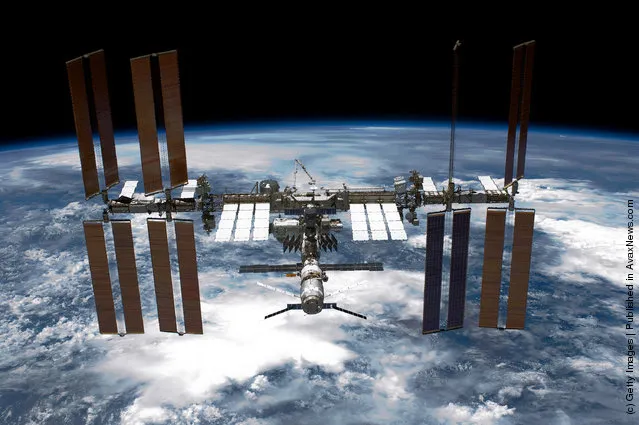
Back dropped by planet Earth the International Space Station (ISS) is seen from NASA space shuttle Endeavour after the station and shuttle began their post-undocking relative separation May 29, 2011 in space. After 20 years, 25 missions and more than 115 million miles in space, NASA space shuttle Endeavour is on the last leg of its final flight to the International Space Station before being retired and donated to the California Science Center in Los Angeles. Capt. Mark E. Kelly, U.S. Rep. Gabrielle Giffords' (D-AZ) husband, has lead mission STS-134 as it delivered the Express Logistics Carrier-3 (ELC-3) and the Alpha Magnetic Spectrometer (AMS-2) to the International Space Station. (Photo by NASA via Getty Images)
Details
01 Jun 2011 06:47:00


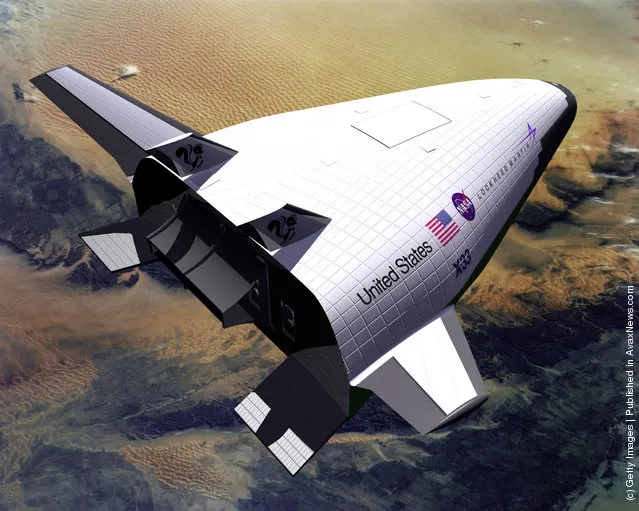
“The Lockheed Martin X-33 is an unmanned, sub-scale technology demonstrator suborbital spaceplane developed in the 1990s under the U.S. government-funded Space Launch Initiative program”. – Wikipedia

Photo: An Artist's Rendering Shows How Nasa's X-33 Technology Demonstrator, A Cost-Cutting Fully Reusable Single-Stage-To-Orbit Space Vehicle, Will Look Upon Completion. The 67 Foot-Long, 278,600 Pound, Twin Engine Space Vehicle, Capable Of Reaching Speeds In Excess Of Mach 15, Will Lead To The Construction Of A 127 Foot-Long, 2,186,000 Pound Version With Seven Engines And A 50,000 Pound Payload Capacity Called The “Venturestar”. (Photo By Nasa/Getty Images)
Details
22 Mar 2011 12:05:00