Loading...
Done
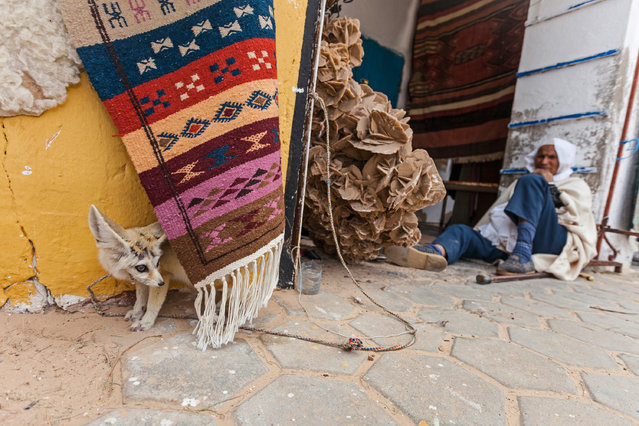
Sultan, a famous captive fennec that is displayed tied on a rope in front of a tourist shop, is the main attraction in the souk of Douz, a desert town in Tunisia. By the display of such a charismatic animal, tourists are often lured to buy things or pay for pictures. On inquiry, although Sultan has been caught as a pup in the wild, the owners of the shop reassure the foreigners stating that the animal is ‘domestic’. (Photo by Bruno D’Amicis/Fritz Pölking Prize/GDT EWPY 2015)

Sultan, a famous captive fennec that is displayed tied on a rope in front of a tourist shop, is the main attraction in the souk of Douz, a desert town in Tunisia. By the display of such a charismatic animal, tourists are often lured to buy things or pay for pictures. On inquiry, although Sultan has been caught as a pup in the wild, the owners of the shop reassure the foreigners stating that the animal is ‘domestic’. (Photo by Bruno D’Amicis/Fritz Pölking Prize/GDT EWPY 2015)
Details
23 Nov 2015 08:02:00
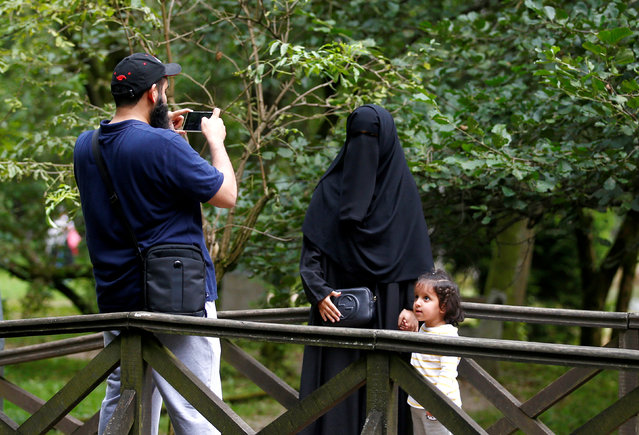
Tourists from the Middle East take pictures at Vrelo Bosne nature park in Ilidza near Sarajevo, Bosnia and Herzegovina, August 19, 2016. (Photo by Dado Ruvic/Reuters)

Tourists from the Middle East take pictures at Vrelo Bosne nature park in Ilidza near Sarajevo, Bosnia and Herzegovina, August 19, 2016. They discovered mountainous Bosnia, where half the population is Muslim, after the Arab Spring which destabilized many traditional holiday destinations such as Libya, Tunisia and Egypt. (Photo by Dado Ruvic/Reuters)
Details
25 Aug 2016 09:37:00
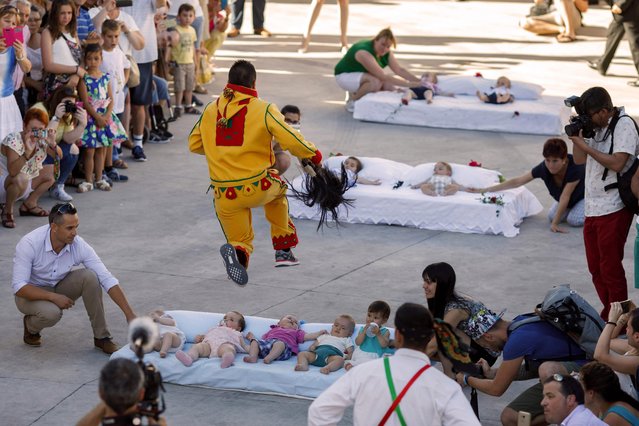
A man dressed up as the devil jumps over babies lying on a mattress in the street during “El Colacho”, the “baby jumping festival” in the village of Castrillo de Murcia, near Burgos on June 18, 2017. Baby jumping (El Colacho) is a traditional Spanish practice dating back to 1620 that takes place annually to celebrate the Catholic feast of Corpus Christi. During the act – known as El Salto del Colacho (the devil's jump) or simply El Colacho – men dressed as the Devil jump over babies born in the last twelve months of the year who lie on mattresses in the street. (Photo by Cesar Manso/AFP Photo)

A man dressed up as the devil jumps over babies lying on a mattress in the street during “El Colacho”, the “baby jumping festival” in the village of Castrillo de Murcia, near Burgos on June 18, 2017. Baby jumping (El Colacho) is a traditional Spanish practice dating back to 1620 that takes place annually to celebrate the Catholic feast of Corpus Christi. During the act – known as El Salto del Colacho (the devil's jump) or simply El Colacho – men dressed as the Devil jump over babies born in the last twelve months of the year who lie on mattresses in the street. (Photo by Cesar Manso/AFP Photo)
Details
20 Jun 2017 07:29:00
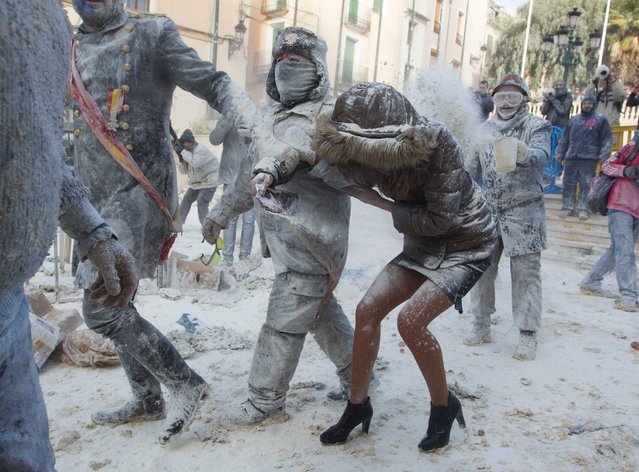
Revellers dressed in mock military garb take part in the “Els Enfarinats” battle in the southeastern Spanish town of Ibi on December 28, 2017. (Photo by Jaime Reina/AFP Photo)

Revellers dressed in mock military garb take part in the “Els Enfarinats” battle in the southeastern Spanish town of Ibi on December 28, 2017. During this 200-year-old traditional festival participants known as Els Enfarinats (those covered in flour) dress in military clothes and stage a mock coup d'etat as they battle using flour, eggs and firecrackers outside the town hall as part of the celebrations of the Day of the Innocents. (Photo by Jaime Reina/AFP Photo)
Details
30 Dec 2017 06:08:00
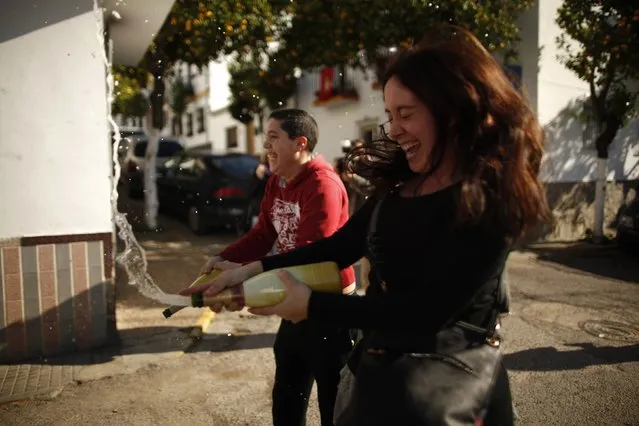
Winners of Spain's Christmas Lottery “El Gordo” celebrate in El Gastor, near Cadiz, December 22, 2014. The total prize money of 2.4 billion euros is split into thousands of cash prizes amongst hundreds of winning numbers. (Photo by Jon Nazca/Reuters)

Winners of Spain's Christmas Lottery “El Gordo” celebrate in El Gastor, near Cadiz, December 22, 2014. The total prize money of 2.4 billion euros is split into thousands of cash prizes amongst hundreds of winning numbers. (Photo by Jon Nazca/Reuters)
Details
23 Dec 2014 13:57:00
Arcelia Aguilar, a resident of “Hogar Jardin De Los Abuelitos”, receives a hug from her niece Maria Aguilar through “El muro de los Abrazos” (The Wall of Hugs) which is a wall made from plastic sheets to protect against the coronavirus, in San Salvador, El Salvador on September 1, 2020. (Photo by Jose Cabezas/Reuters)

Arcelia Aguilar, a resident of “Hogar Jardin De Los Abuelitos”, receives a hug from her niece Maria Aguilar through “El muro de los Abrazos” (The Wall of Hugs) which is a wall made from plastic sheets to protect against the coronavirus, in San Salvador, El Salvador on September 1, 2020. (Photo by Jose Cabezas/Reuters)
Details
03 Sep 2020 00:07:00
Mahmoud El Komy, a 26-year-old Egyptian mechatronics engineer, stands beside Cira 3, a remote-controlled robot that runs tests on suspected coronavirus disease (COVID-19) patients, to limit the human exposure to the virus, amid a second wave of infections in Tanta, Egypt, November 18, 2020. (Photo by Mohamed Abd El Ghany/Reuters)

Mahmoud El Komy, a 26-year-old Egyptian mechatronics engineer, stands beside Cira 3, a remote-controlled robot that runs tests on suspected coronavirus disease (COVID-19) patients, to limit the human exposure to the virus, amid a second wave of infections in Tanta, Egypt, November 18, 2020. (Photo by Mohamed Abd El Ghany/Reuters)
Details
20 Dec 2020 00:01:00
Aymara indigenous women “Martha La Altena” (El Alto's Martha) (R) and “Susana La Bonita” (Pretty Susana) take part in a freestyle wrestling flight in El Alto, on June 29, 2018. “Cholita Fighters” aim to include their show in a tourist route. (Photo by Aizar Raldes/AFP Photo)

Aymara indigenous women “Martha La Altena” (El Alto's Martha) (R) and “Susana La Bonita” (Pretty Susana) take part in a freestyle wrestling flight in El Alto, on June 29, 2018. “Cholita Fighters” aim to include their show in a tourist route. (Photo by Aizar Raldes/AFP Photo)
Details
06 Nov 2022 04:22:00